
When a Doctor’s Mistake Changes Everything: Finding a Medical Error Lawyer in Bergen County
If you need a medical error lawyer in Bergen County, here is a quick overview of what you should know:
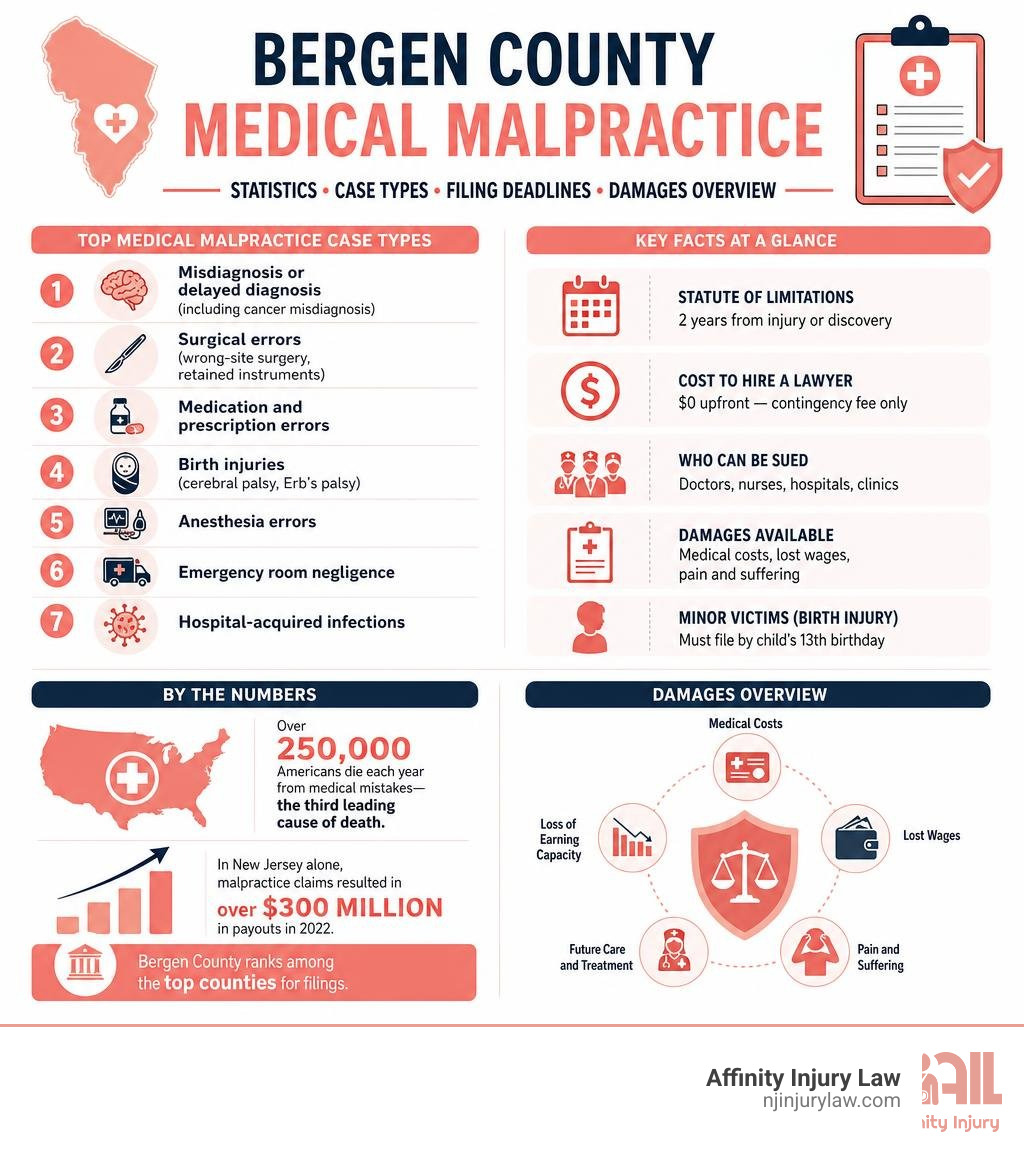
Top medical malpractice case types handled in Bergen County:
- Misdiagnosis or delayed diagnosis (including cancer misdiagnosis)
- Surgical errors (wrong-site surgery, retained instruments)
- Medication and prescription errors
- Birth injuries (cerebral palsy, Erb’s palsy)
- Anesthesia errors
- Emergency room negligence
- Hospital-acquired infections
Key facts at a glance:
| Topic | Quick Answer |
|---|---|
| Statute of limitations | 2 years from injury or discovery |
| Cost to hire a lawyer | $0 upfront — contingency fee only |
| Who can be sued | Doctors, nurses, hospitals, clinics |
| Damages available | Medical costs, lost wages, pain and suffering |
| Minor victims (birth injury) | Must file by child’s 13th birthday |
Medical errors are far more common than most people realize. Studies estimate that over 250,000 Americans die each year from medical mistakes — making them the third leading cause of death in the United States. In New Jersey alone, malpractice claims resulted in over $300 million in payouts in 2022, with Bergen County ranking among the top counties for filings.
When you walk into a doctor’s office or a hospital, you are putting your trust in someone else’s hands. That trust deserves to be honored. When it isn’t — when a preventable mistake leaves you in pain, out of work, and buried in medical bills — you have every right to hold the responsible party accountable.
But medical malpractice cases are not simple. Healthcare providers and their insurers have experienced legal teams working to minimize your claim from day one. You need someone equally experienced in your corner.
I’m Ioana Enescu, Esq., a founding member of Affinity Injury Law and the daughter of two physicians — a background that gives me a uniquely informed perspective when advocating for victims who need a medical error lawyer in Bergen County. I’ve dedicated my practice to making sure injured New Jersey residents get the skilled, compassionate representation they deserve, without any upfront cost.
Understanding Medical Malpractice and Common Medical Errors in Bergen County
To understand whether you have a claim, it helps to distinguish between a bad medical outcome and actual medical malpractice. Medicine is not an exact science, and even with the best care, patients do not always recover. However, when a healthcare provider fails to meet the accepted “standard of care,” and that failure causes direct harm, it crosses the line into negligence.
The standard of care is defined as the level of care, skill, and treatment that is recognized as acceptable and appropriate by reasonably prudent healthcare providers under similar circumstances.
In New Jersey, medical malpractice is a highly specialized form of negligence. While ordinary negligence might involve a slip-and-fall in a supermarket, medical negligence requires proving that a licensed professional breached their specific professional duty.
Some of the most common medical errors we see in Bergen County include:
- Diagnostic Errors: This accounts for roughly 33% of all medical malpractice claims. It includes misdiagnosing a condition (such as telling a patient their chest pain is acid reflux when they are having a heart attack) or a delayed diagnosis (failing to recognize cancer symptoms until the disease has progressed to an untreatable stage).
- Surgical Mistakes: These are often referred to as “never events” because they should never happen. Examples include performing surgery on the wrong body part, leaving surgical instruments or sponges inside a patient, or accidentally puncturing an organ.
- Medication Errors: Administering the wrong dosage, prescribing a medication that causes a dangerous interaction with a patient’s existing drugs, or failing to check a patient’s allergy history.
- Hospital Liability: This occurs when systemic failures within a hospital lead to patient injuries. Examples include poor sanitation leading to hospital-acquired infections, understaffed emergency rooms, or failing to monitor a patient in critical condition.
If you suspect that a healthcare provider’s mistake has worsened your condition, you should seek More info on New Jersey medical malpractice to understand your rights and begin evaluating your options.
Proving Negligence with a Medical Error Lawyer in Bergen County
Proving that a medical error occurred requires establishing four critical elements:
- Duty of Care: A physician-patient relationship existed, meaning the provider had a legal obligation to treat you competently.
- Breach of Duty: The provider deviated from the accepted standard of care (negligence).
- Causation: This deviation directly caused your injury (referred to as “proximate cause”).
- Damages: You suffered actual physical, financial, or emotional harm as a result.

Causation is often the hardest element to prove. Insurance defense lawyers will frequently argue that your injuries were caused by an underlying pre-existing condition rather than the medical provider’s mistake.
To overcome these defenses, New Jersey law requires the filing of an Affidavit of Merit early in the lawsuit. This is a sworn statement from an independent, licensed medical expert in the same specialty as the defendant, certifying that there is a reasonable probability that the care fell below acceptable professional standards. Without this expert support, your case will be dismissed almost immediately. Partnering with a dedicated local advocate ensures you have access to the medical experts needed to build a compelling case.
Can You Sue a Hospital for a Medical Error?
Yes, you can often sue both the individual healthcare provider and the hospital or medical facility where the error occurred.
Under the legal doctrine of respondeat superior (vicarious liability), an employer can be held liable for the negligent actions of its employees performed within the scope of their employment. This means if a hospital-employed nurse, technician, or resident makes a critical error, the hospital itself can be named in the lawsuit.
Additionally, hospitals can be held liable for systemic negligence, such as:
- Failing to properly vet or credential medical staff.
- Maintaining inadequate staffing levels, leading to exhausted and overworked nurses and doctors.
- Failing to establish or enforce proper safety protocols, resulting in severe emergency room errors or widespread infections.
Because medical systems in northern New Jersey operate within a highly competitive and complex regional network, understanding Why Bergen County claims need local context is essential. Local hospitals, from Hackensack University Medical Center to Valley Hospital, have their own administrative procedures, and a lawyer with local experience knows how to navigate these specific institutions.
The Legal Process: Timelines, Damages, and the Statute of Limitations
For most adults in New Jersey, the statute of limitations for filing a medical malpractice lawsuit is two years from the date the malpractice occurred.
However, New Jersey applies the discovery rule. If the injury or the connection between the medical treatment and the injury was not immediately apparent, the two-year clock may not begin until you reasonably should have discovered that you were harmed by a medical error.
If you win or settle your case, you may be entitled to recover both economic and non-economic damages.
| Type of Damages | What It Covers | Examples |
|---|---|---|
| Economic Damages | Direct, quantifiable financial losses | Additional medical bills, future corrective surgeries, physical therapy, lost wages, and loss of earning capacity. |
| Non-Economic Damages | Subjective, non-monetary losses | Physical pain and suffering, emotional distress, loss of enjoyment of life, and loss of consortium (impact on your relationship with your spouse). |
Navigating these legal requirements can be overwhelming while recovering from an injury. Utilizing local Bergen County personal injury resources can help you find the professional guidance needed to protect your claim.
How Long Does a Medical Malpractice Case Take in New Jersey?
Medical malpractice lawsuits are among the most complex civil cases in New Jersey. On average, a medical malpractice case can take anywhere from one to three years (and sometimes longer) to resolve.
The timeline typically involves:
- Investigation & Record Gathering (3–6 months): Collecting all medical records, hiring medical experts, and drafting the Affidavit of Merit.
- Filing the Lawsuit & Discovery (12–24 months): Both sides exchange evidence, take depositions of witnesses, and consult with experts.
- Settlement Negotiations & Trial (3–12 months): Many cases settle once the discovery process reveals the strength of the plaintiff’s case. However, if the insurance company refuses to offer a fair settlement, we must be fully prepared to present your case to a jury.
Moving too quickly or attempting to settle without legal representation can lead to devastating errors. To protect your rights, familiarize yourself with the 5 mistakes that can hurt your personal injury claim before speaking with insurance adjusters.
How to Choose the Right Medical Error Lawyer in Bergen County
Choosing the right attorney is the single most important decision you will make in your pursuit of justice. Because medical malpractice defense firms are highly aggressive, you cannot rely on a general practice attorney. You need a lawyer who understands the intersection of medicine and law.
When searching for a medical error lawyer in Bergen County, look for a firm with a proven track record of handling complex medical claims. Trying to handle these claims on your own often leads to common pitfalls. Reading about Common mistakes without accident injury lawyers highlights why professional representation is so critical in these specialized disputes.
What to Look for in a Medical Error Lawyer in Bergen County
When evaluating potential attorneys, consider the following criteria:
- Trial Readiness: Many personal injury lawyers prefer quick settlements and rarely go to court. Because malpractice insurers fight claims aggressively, you need a lawyer who is prepared to take your case to trial if necessary.
- The Contingency Fee Structure: You should never have to pay upfront legal fees. Your attorney should work on a contingency basis, meaning they only get paid if they successfully recover compensation for you.
- Adherence to New Jersey Fee Caps: Under New Jersey law, medical malpractice contingency fees are strictly capped on a sliding scale to protect plaintiffs:
- 33.3% (one-third) of the first $500,000 recovered.
- 30% of the next $500,000.
- 25% of the next $500,000.
- 20% of the next $500,000.
- A reasonable fee determined by the court for any amount recovered over $2,000,000.
- For minors, the fee is capped at 25% for settlements reached without a trial.

What Happens During Your Free Consultation?
A free consultation is a zero-risk opportunity for you to share your story and for us to evaluate the viability of your claim. During this meeting, we will review the timeline of your medical treatment, discuss the impact the injury has had on your life, and outline the legal steps required to move forward.
To get the most out of your free consultation, we recommend preparing a few key items:
- A Detailed Timeline: Write down a chronological journal of your medical visits, symptoms, surgeries, and conversations with your doctors.
- Medical Records: Bring any discharge papers, diagnostic test results, prescriptions, or medical bills you currently have.
- Your Pain Journal: If you have kept a log of your daily pain levels and physical limitations, share it with your attorney.
What to bring to your consultation:
- Copies of all relevant medical records and bills.
- Contact information for all healthcare providers involved.
- A written list of questions you have for the attorney.
- Any correspondence you have received from insurance companies.
Frequently Asked Questions About Bergen County Medical Malpractice
What is the statute of limitations for a birth injury claim in New Jersey?
While the standard personal injury statute of limitations is two years, New Jersey provides special protections for minors who suffer birth injuries due to medical negligence.
For any child injured during birth, a medical malpractice lawsuit must be filed by the child’s 13th birthday. However, parents seeking to recover their own damages related to the birth injury (such as medical expenses they paid on behalf of the child) must still file their claims within the standard two-year window from the date of birth.
Does signing a consent form prevent me from filing a medical malpractice lawsuit?
No. A signed informed consent form simply indicates that you were made aware of the known, inherent risks of a procedure and agreed to proceed. It does not give the doctor permission to perform the procedure negligently.
If your surgeon deviates from the accepted standard of care and causes you harm, the consent form is not a waiver of your right to sue for negligence.
How are attorney fees structured for medical malpractice cases in NJ?
As mentioned, medical malpractice attorneys in New Jersey operate on a contingency fee basis. This means we cover all the upfront costs of litigating your case — including the expensive fees required to hire top-tier medical experts and obtain medical records.
If we do not win your case or secure a settlement, you owe us absolutely nothing for our time or the advanced expenses.
Conclusion
A serious medical error can turn your life upside down in an instant, leaving you to deal with physical pain, emotional trauma, and mounting financial stress. You do not have to carry this burden alone.
At Affinity Injury Law, we believe in leveling the playing field for injured patients in Bergen County and across New Jersey. We provide aggressive, trial-ready representation on a strict no-fee-unless-we-win basis. Furthermore, because we understand that navigating the legal system can be even more difficult if English is not your first language, our firm is proud to offer robust multilingual support to ensure you feel heard and protected every step of the way.
As we move through 2026, healthcare systems are more complex than ever, and insurance companies are finding new ways to devalue patient claims. Let us handle the legal battle while you focus on your healing.
If you or a loved one has suffered due to a medical mistake, contact us today to schedule your free, confidential case evaluation. We are here to help you find answers, seek accountability, and secure the compensation you deserve.