


Help After a Family Death: Know Your Legal Options
If someone else’s negligence, recklessness, or intentional act caused your loved one’s death, a wrongful death lawyer can help your family protect its rights. The most important first steps are to preserve records, avoid giving insurers a recorded statement or accepting a fast settlement, and get legal advice before filing deadlines run out.
Families may be able to seek compensation for funeral costs, medical bills, lost financial support, and the losses caused by losing a spouse, parent, or child. A wrongful death case is a civil claim, separate from any criminal case, and the rules about who can file and how long they have vary by state.
I am Ioana Enescu, Esq., a founding member of Affinity Injury Law and a New Jersey attorney focused on helping injured people and families navigate difficult legal decisions. As one of the lawyers for death in family matters, I bring a client-centered approach informed by my background in advocating for people who need clear, accessible legal support.
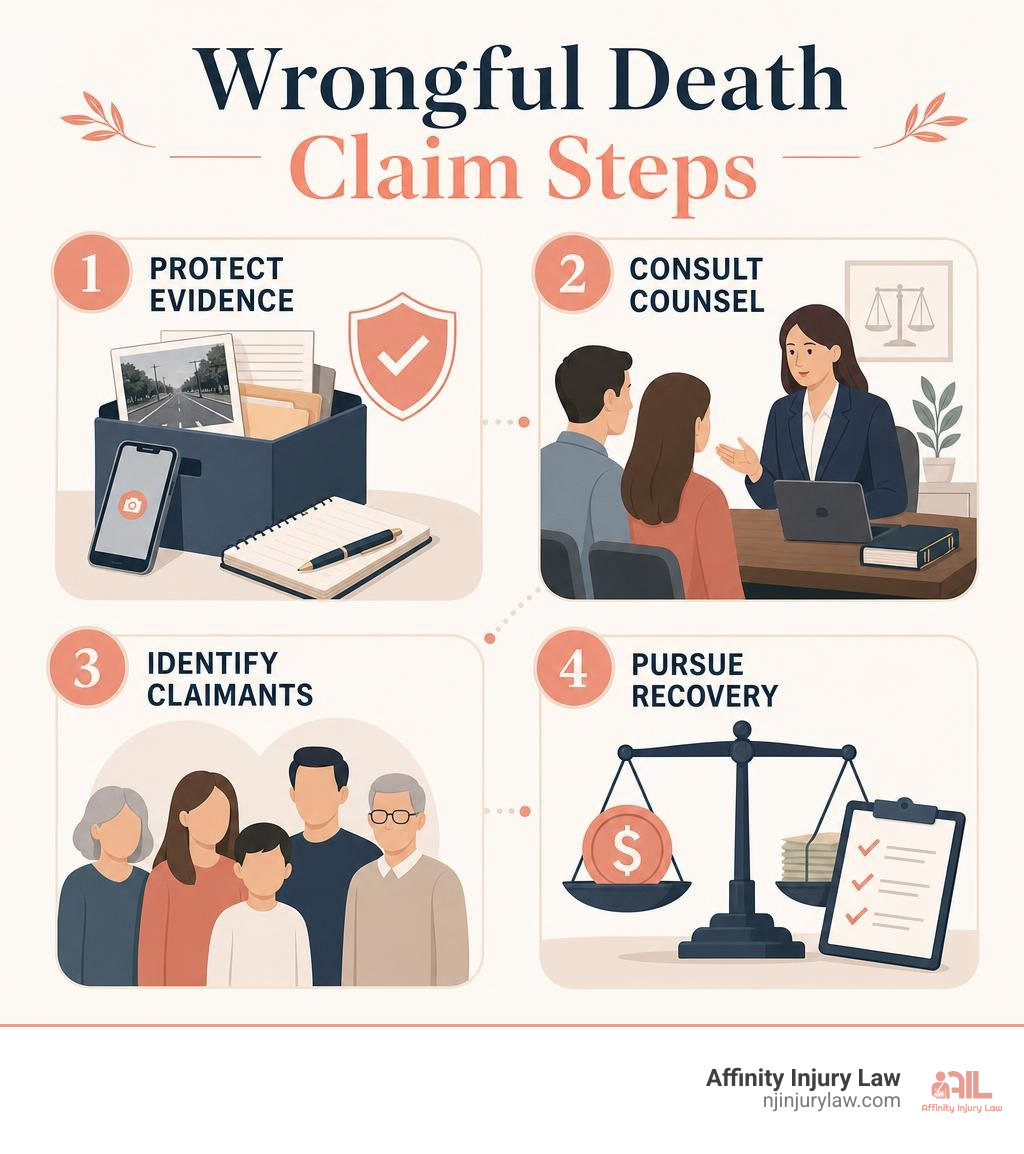
Lawyers for death in family terms explained:
Understanding Wrongful Death Claims and Legal Eligibility
When a loved one passes away due to an unexpected, preventable event, the emotional weight can feel suffocating. Dealing with paperwork, insurance adjusters, and funeral logistics while processing grief is overwhelming. Learning about navigating a wrongful death claim in nj without losing your mind can give surviving family members the clarity needed to make sound decisions.
A wrongful death claim is a specialized civil lawsuit filed when a person dies as a direct consequence of the legal fault, recklessness, or intentional conduct of another party. In practical terms, it allows families to hold wrongdoers accountable for the financial and personal disruption caused by their actions.
What Legally Constitutes a Wrongful Death Action
A wrongful death claim arises from various preventable circumstances where someone breaches their duty of safety. The most frequent causes include:
- Motor Vehicle Collisions: Fatal crashes involving passenger vehicles, commercial semi-trucks, motorcycles, bicycles, and pedestrians on major corridors like Route 4, Route 17, and the Garden State Parkway.
- Medical Malpractice: Fatal surgical errors, misdiagnoses, delayed treatments, medication overdoses, and birth-related trauma occurring in healthcare facilities.
- Workplace and Construction Incidents: Falls from heights, equipment malfunctions, structural collapses, and electrocutions on industrial and commercial job sites.
- Premises Liability Fatalities: Severe slip, trip, and fall incidents, inadequate security leading to violent crimes, or structural failures in residential or commercial buildings.
- Defective Products: Malfunctioning auto parts, hazardous machinery, or dangerous pharmaceuticals that fail to perform safely.
Who Holds the Legal Standing to File a Claim
State laws define who is legally allowed to pursue compensation after a fatal accident. In New Jersey, the lawsuit is formally brought by the personal representative (the executor named in a valid will or an administrator appointed by the county Surrogate’s Court if there is no will).
While the personal representative files the legal paperwork, the financial recovery is distributed to statutory beneficiaries who suffered actual financial and pecuniary losses due to the passing:
- Surviving Spouse and Domestic Partners: Priority individuals who depended on the deceased for financial support and household contributions.
- Surviving Children and Stepchildren: Entitled to recovery for lost financial provision, parental care, guidance, and educational support.
- Surviving Parents: Eligible claimants, especially when the deceased was an unmarried child without dependents.
- Other Dependent Relatives: Siblings, nieces, nephews, or other family members who can prove direct financial reliance on the deceased.
Families seeking local legal guidance in municipal areas can connect with qualified professionals through regional directories such as Best Lawyers in Paterson, NJ – Justia, Best Family Lawyers in Paramus, NJ, or Best Lawyers in Fair Lawn, NJ to understand their standing.
Wrongful Death vs. Survival Actions: Key Differences and Recoverable Damages
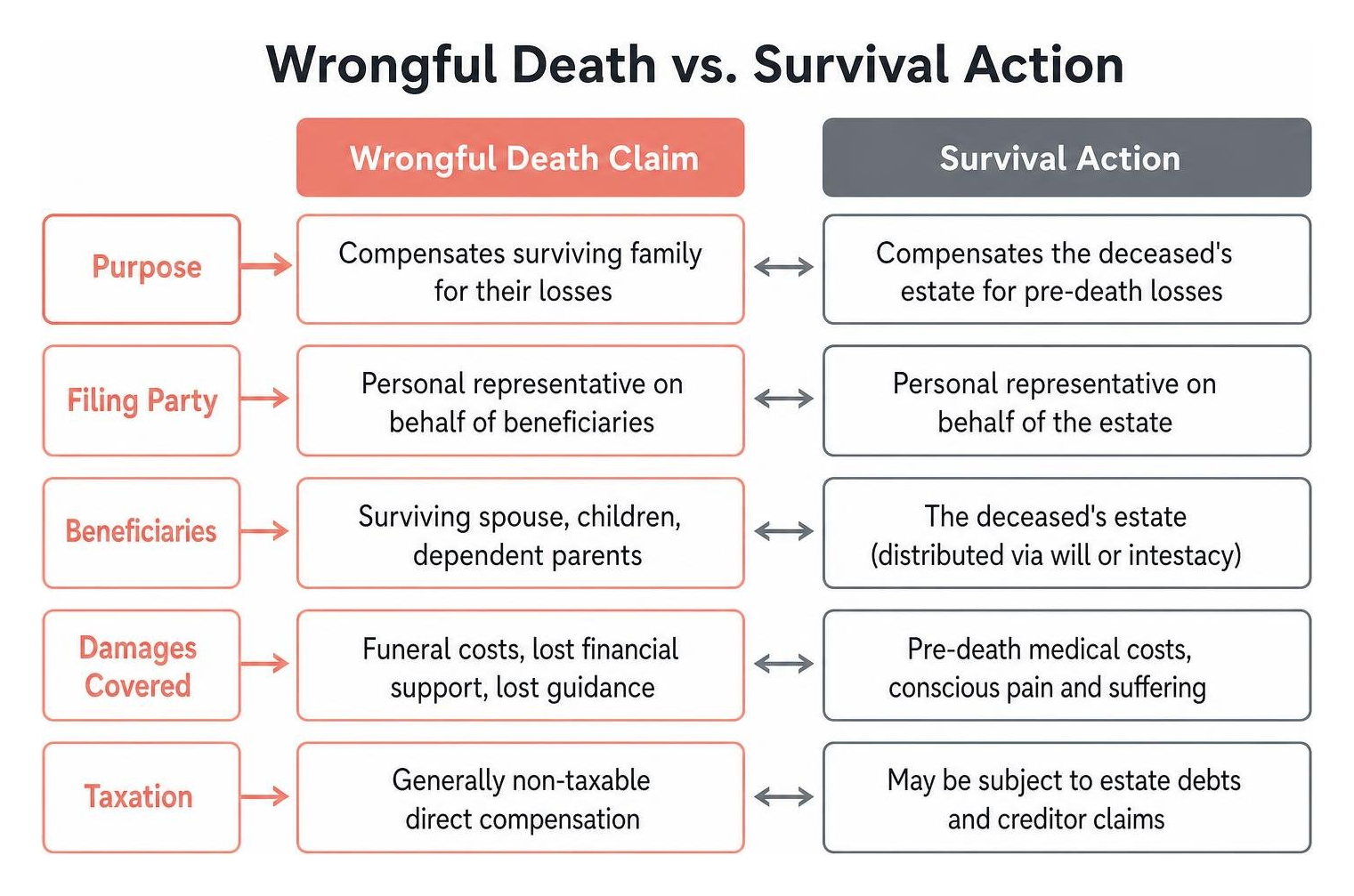
Many families assume that a single legal action covers all losses after a fatal accident. In reality, modern legal systems recognize two distinct types of claims that operate side by side: wrongful death actions and survival actions.
| Aspect | Wrongful Death Claim | Survival Action |
|---|---|---|
| Purpose | Compensates surviving family for their losses | Compensates the deceased’s estate for pre-death losses |
| Filing Party | Personal representative on behalf of beneficiaries | Personal representative on behalf of the estate |
| Beneficiaries | Surviving spouse, children, dependent parents | The deceased’s estate (distributed via will or intestacy) |
| Damages Covered | Funeral costs, lost financial support, lost guidance | Pre-death medical costs, conscious pain and suffering |
| Taxation | Generally non-taxable direct compensation | May be subject to estate debts and creditor claims |
Knowing how to handle these dual pathways is much easier when finding accidental death lawyers without losing your mind who can manage both claims simultaneously.
Comparing Wrongful Death Claims and Survival Actions
The core distinction between these actions lies in timing and perspective:
- Wrongful Death Claims focus on the future losses sustained by the living survivors from the moment of death onward.
- Survival Actions step into the shoes of the deceased, allowing the estate to recover damages the person could have claimed had they survived the initial injury. This includes medical bills incurred between the accident and death, as well as the conscious pain and suffering endured during that window.
Economic and Non-Economic Damages Families Can Recover
The law provides several avenues to calculate and restore the stability of surviving dependents:
- Funeral and Burial Costs: Reasonable expenses associated with memorial services, cremation, or burial.
- Lost Financial Earnings and Benefits: The wages, salary, pension contributions, health insurance, and retirement benefits the deceased would have provided throughout their working life.
- Loss of Household Services: The monetary replacement value of daily tasks provided by the deceased, including childcare, eldercare, property maintenance, cooking, and administrative support.
- Loss of Companionship and Guidance: The pecuniary value of parental counsel, advice, moral training, and companionship provided to children and spouses.
- Punitive Damages: Awarded in rare cases involving gross negligence or intentional malice to penalize wrongdoers and deter future misconduct.
Proving Negligence and Essential Evidence in Fatal Accident Claims

Prevailing in a wrongful death matter requires establishing legal responsibility by a preponderance of the evidence—showing that it is more likely than not that the defendant caused the fatal harm.
The Four Elements of Negligence in Fatal Cases
To build a solid claim, four foundational elements must be established:
- Duty of Care: The defendant had an obligation to act prudently (such as a driver obeying traffic signals or a surgeon adhering to standards of care).
- Breach of Duty: The defendant failed in that duty through a careless action or failure to act.
- Proximate Causation: The specific breach directly caused the fatal injuries, without an intervening, superseding cause.
- Quantifiable Damages: The death caused measurable financial, emotional, and pecuniary losses.
Under comparative negligence principles, recovery is still possible even if the deceased held minor partial fault for the incident, provided their share of liability does not exceed that of the defendants.
Crucial Evidence and Common Pitfalls to Avoid
Establishing liability demands swift action in gathering critical evidence before it disappears or degrades. Essential components include:
- Official police crash reports and incident documentation
- Medical records, trauma care charts, and autopsy findings
- Eyewitness testimony and recorded depositions
- Electronic data, including black box recorders, dashcam footage, and municipal surveillance
- Forensic collision reconstruction and professional medical testimony
Learning about building an unshakable case the essential wrongful death evidence needed protects families from common insurance pitfalls. Insurers often attempt to contact grieving families early to secure unrepresented recorded statements or offer low settlements before the full scope of financial loss is understood.
When to Consult Lawyers for Death in Family and How They Help

Navigating a fatal accident claim demands meticulous attention to civil procedure while balancing the realities of grief. Securing proper guidance via a hire a wrongful death lawyer a practical guide ensures your family remains protected from day one.
Why Retaining Lawyers for Death in Family Protects Your Rights
Experienced attorneys lift the administrative burden from grieving relatives by handling all communications, filings, and inquiries. Dedicated legal representation involves:
- Coordinating independent investigations to establish clear liability
- Preserving physical evidence, video recordings, and phone records
- Engaging forensic economists and medical specialists to calculate future lifetime losses
- Managing aggressive insurance adjusters and preventing premature lowball settlements
- Assisting in Surrogate’s Court probate filings to appoint the legal estate representative
Our dedicated team focuses on standing up for your loved one with an nj wrongful death lawyer to give every family the compassionate and assertive advocacy they deserve.
The Litigation Process from Consultation to Trial
Understanding the legal roadmap helps eliminate uncertainty during a complex lawsuit:
- Initial Case Evaluation: A thorough assessment of the accident circumstances, insurance coverages, and eligible beneficiaries.
- Estate Representation Setup: Formal appointment of the administrator or executor through the local Surrogate’s Court.
- Pre-Suit Investigation & Demand: Comprehensive assembly of evidence, economic assessments, and initial settlement discussions.
- Filing the Complaint: Initiating the formal civil lawsuit in court against all liable entities.
- Discovery Phase: Exchanging records, interrogatories, depositions, and independent expert evaluations.
- Mediation and Negotiation: Structured settlement conferences to resolve the claim fairly outside the courtroom.
- Trial Verdict: Presenting the full case before a jury if the defense refuses a fair resolution.
Questions to Ask Lawyers for Death in Family During a Consultation
When choosing legal counsel, ask direct questions to ensure the firm matches your expectations:
- What direct experience do you have with fatal accident claims in New Jersey?
- How do you assess the economic and non-economic value of our case?
- Do you have the resources to take this claim through jury trial if an insurer refuses a fair settlement?
- What languages does your legal team speak to assist our family directly?
- How will your office communicate case updates and milestone developments to us?
Frequently Asked Questions About Wrongful Death Lawsuits
How long do families have to file a wrongful death claim?
Under New Jersey law, the statute of limitations for filing a wrongful death lawsuit is typically two years from the exact date of death. Missing this legal deadline generally bars the family from seeking financial recovery forever.
In claims involving public entities or municipal vehicles (such as city buses or police cruisers), formal notice of claim requirements are much shorter—often requiring a Title 59 notice within just 90 days. Acting quickly preserves critical witness testimony and physical proof.
How do contingency fees work in fatal accident cases?
Reputable wrongful death attorneys handle cases on a contingency fee arrangement. This means:
- There are zero upfront retainer fees or out-of-pocket costs for your family.
- The law firm covers all costs related to filing, investigation, depositions, and expert economists.
- The firm only collects legal fees if they secure a successful financial settlement or trial award.
- If no financial recovery is obtained, your family owes nothing in attorney fees.
Can a wrongful death lawsuit be filed alongside criminal charges?
Yes. Civil wrongful death claims and criminal proceedings operate independently in separate court systems:
- Criminal cases are brought by government prosecutors to penalize illegal conduct through imprisonment or fines, requiring proof beyond a reasonable doubt.
- Civil wrongful death claims are brought by the family to obtain financial compensation for their losses, evaluated on a lower standard of proof (preponderance of the evidence).
A defendant can be held civilly liable for wrongful death even if they are acquitted of criminal charges or if prosecutors decide not to pursue an indictment.
Conclusion
Losing a loved one to someone else’s carelessness alters a family’s future in an instant. While legal compensation cannot replace a beloved family member, it provides essential financial security, covers sudden debts, and holds negligent parties accountable.
At Affinity Injury Law, we represent families across New Jersey—including Lyndhurst, Hackensack, Paterson, Fort Lee, Paramus, Fair Lawn, Passaic, Clifton, Wayne, and throughout Bergen and Passaic Counties. With multilingual legal support, 24/7 availability, and a strict no-win, no-fee guarantee, our team provides the compassionate advocacy your family needs.
If your family is navigating the aftermath of a fatal accident, connect with our team for experienced wrongful death legal representation and schedule your free, confidential consultation today.