

What to Do After an Uber Accident in New Jersey
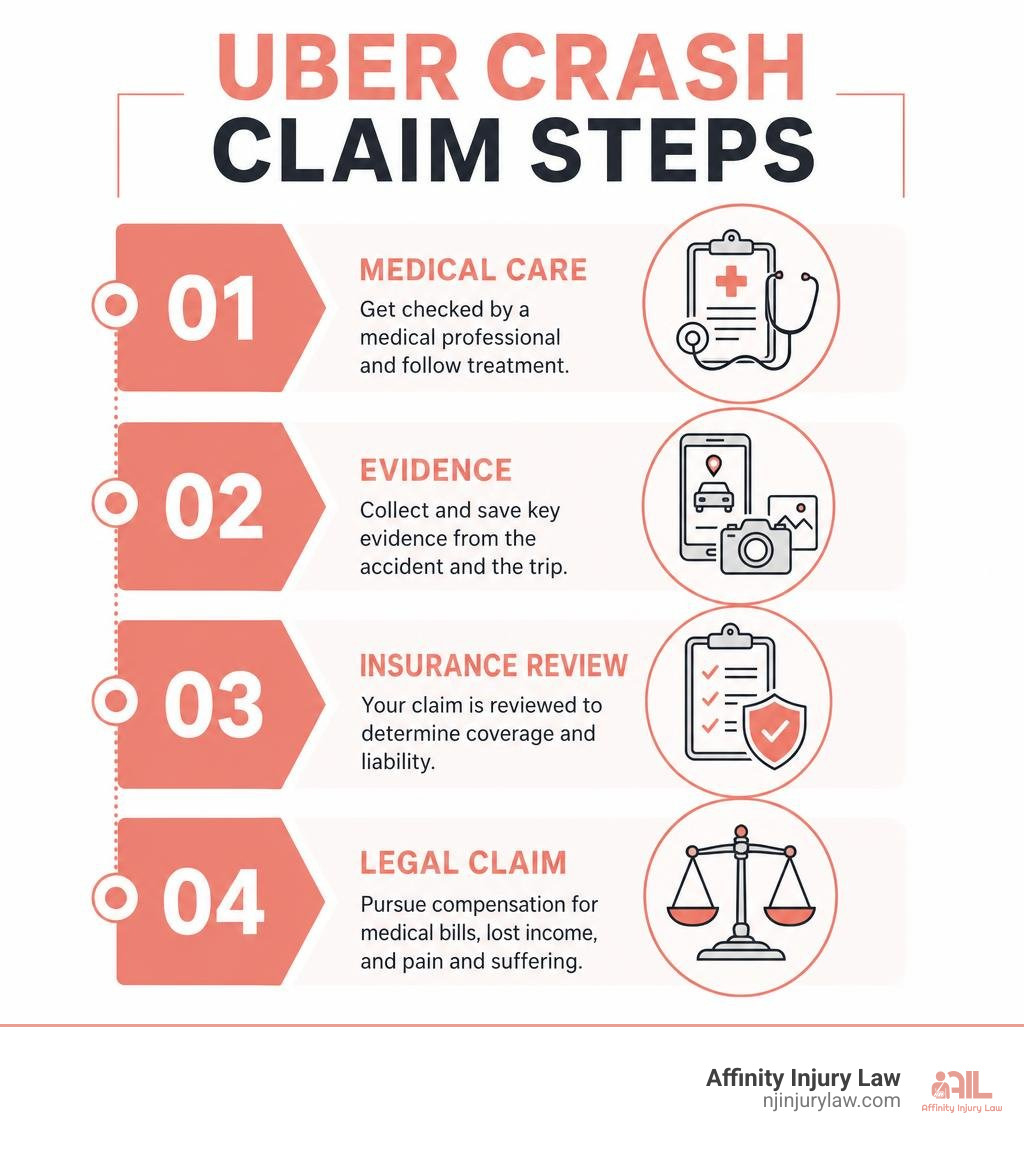
After an Uber crash, protect your health and claim first: call 911, get medical care, save screenshots of the trip, and avoid giving a recorded statement to an insurer before you understand your options. An Uber accident injury attorney can identify which insurance policy applies, preserve evidence from the app, and pursue compensation for medical bills, lost income, and pain caused by the crash.
Uber claims can be more complex than ordinary car accident cases because coverage often depends on what the driver was doing in the app at the exact time of impact. Was the driver offline, waiting for a ride request, heading to pick up a rider, or carrying a passenger? That answer can change the available coverage substantially, including whether Uber’s commercial policy may apply.
Do not wait to document what happened. Take photos, get witness contact information, request the police report, and keep every medical record and bill. Prompt treatment also matters: Florida’s PIP system has a 14-day treatment rule, while New Jersey claims have their own insurance and lawsuit rules that require careful review.
I am Ioana Enescu, Esq., a founding member of Affinity Injury Law and a New Jersey attorney focused on helping injured people obtain the care and legal support they need. As an Uber accident injury attorney, I bring a client-centered approach shaped by my background in advocacy and my understanding of how medical issues affect real lives.
Understanding Insurance Coverage and the Three Driver App Phases
Determining who pays for your medical treatment and vehicle repairs after a rideshare collision is rarely straightforward. Unlike a standard collision involving two private motorists, rideshare liability is directly tied to the digital status of the rideshare driver at the exact second of impact. When you work with skilled Car Accidents Lawyers New Jersey, one of the very first investigative steps we take is demanding the electronic telematics and log data from Uber to verify the driver’s operational phase.
The legal framework governing transportation network companies establishes distinct tiers of coverage based on whether the app was completely off, actively scanning for fares, or handling a fare from dispatch through drop-off.
| Driver App Status | Applicable Insurance Policy | Primary Coverage Limits |
|---|---|---|
| Phase 1: App Offline | Driver’s Personal Auto Insurance | Driver’s individual policy limits (Uber provides zero coverage) |
| Phase 2: App Online, Waiting for Match | Contingent Commercial Liability | $50,000 per person / $100,000 per accident for bodily injury; $25,000 property damage |
| Phase 3: Ride Accepted or Passenger Onboard | Uber Primary Commercial Policy | Up to $1,000,000 combined single limit liability and UM/UIM |
Understanding which policy applies ensures you do not waste critical time negotiating with a personal auto carrier that will quickly deny the claim due to commercial delivery or rideshare exclusions.
When Does the $1 Million Commercial Policy Apply?
Uber provides an extensive $1,000,000 commercial liability policy, but this top tier of coverage activates only during specific windows of time. The $1 million policy is triggered the instant a driver accepts a ride request in the app and remains active while they are driving to pick up the rider, as well as throughout the entire duration that a passenger is in the vehicle.
This coverage protects:
- Passengers: If you are paying for a ride and your driver causes a collision or is struck by another vehicle.
- Third-Party Drivers and Motorcyclists: If an Uber driver on an active trip hits your car.
- Pedestrians and Cyclists: If an on-duty Uber driver strikes a pedestrian or bicyclist while en route to pick up a passenger or during a trip.
Furthermore, this commercial tier contains robust Uninsured/Underinsured Motorist (UM/UIM) coverage. If another motorist causes the wreck while you are riding in an Uber and that driver lacks sufficient insurance—or flees the scene entirely—Uber’s $1,000,000 UM/UIM policy steps in to cover your injuries.
Driver App Offline vs. Waiting for a Ride Request
When an Uber driver is behind the wheel with the driver app turned off, Uber assumes zero financial responsibility. In this scenario, any crash is treated like a standard collision, and the driver’s personal auto policy is the sole source of recovery.
The middle ground—known as Phase 2 or Period 1—occurs when the driver has logged into the app and is actively waiting to be matched with a passenger. During this phase:
- Personal Auto Exclusion: Most personal insurance policies contain a strict “business use” or “public livery” exclusion and will refuse to cover the collision.
- Contingent Commercial Coverage: Uber provides contingent liability coverage up to $50,000 per person for bodily injury, $100,000 total bodily injury per accident, and $25,000 for property damage.
Because these lower limits can be quickly exhausted by a severe injury, proving whether a driver had already accepted a dispatch before impact is a crucial part of maximizing your recovery.
Critical Steps to Take Immediately Following a Rideshare Crash
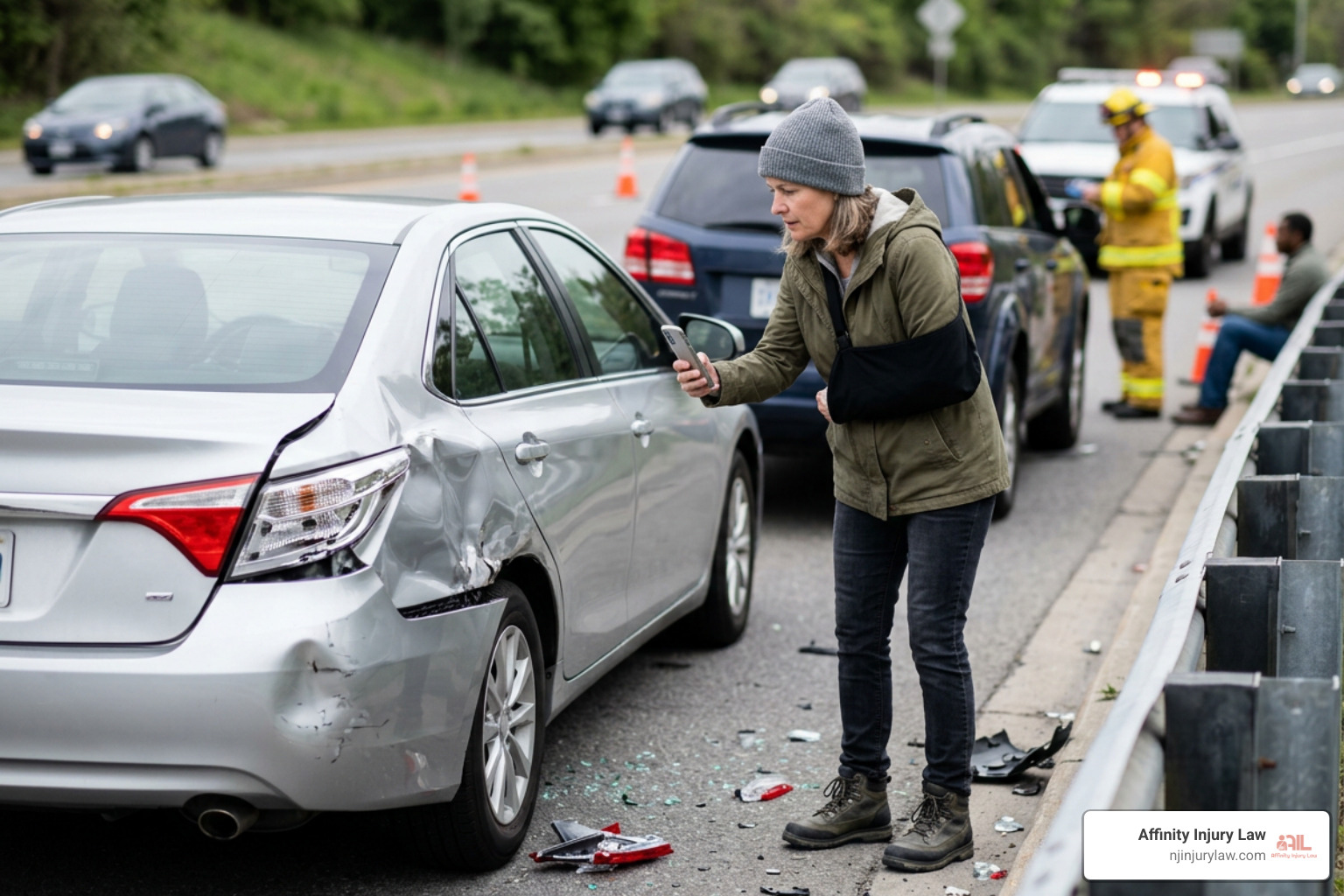
The moments following a crash in Lyndhurst, Paterson, or anywhere across Bergen and Passaic counties can be disorienting. However, early missteps can severely harm your ability to recover fair compensation. Learning about Common Mistakes Without Accident Injury Lawyers can help protect you from common insurance adjuster traps.
Preserving App Ride Data and Physical Evidence
To build an airtight legal claim, physical and digital evidence must be secured before it is altered, lost, or overwritten:
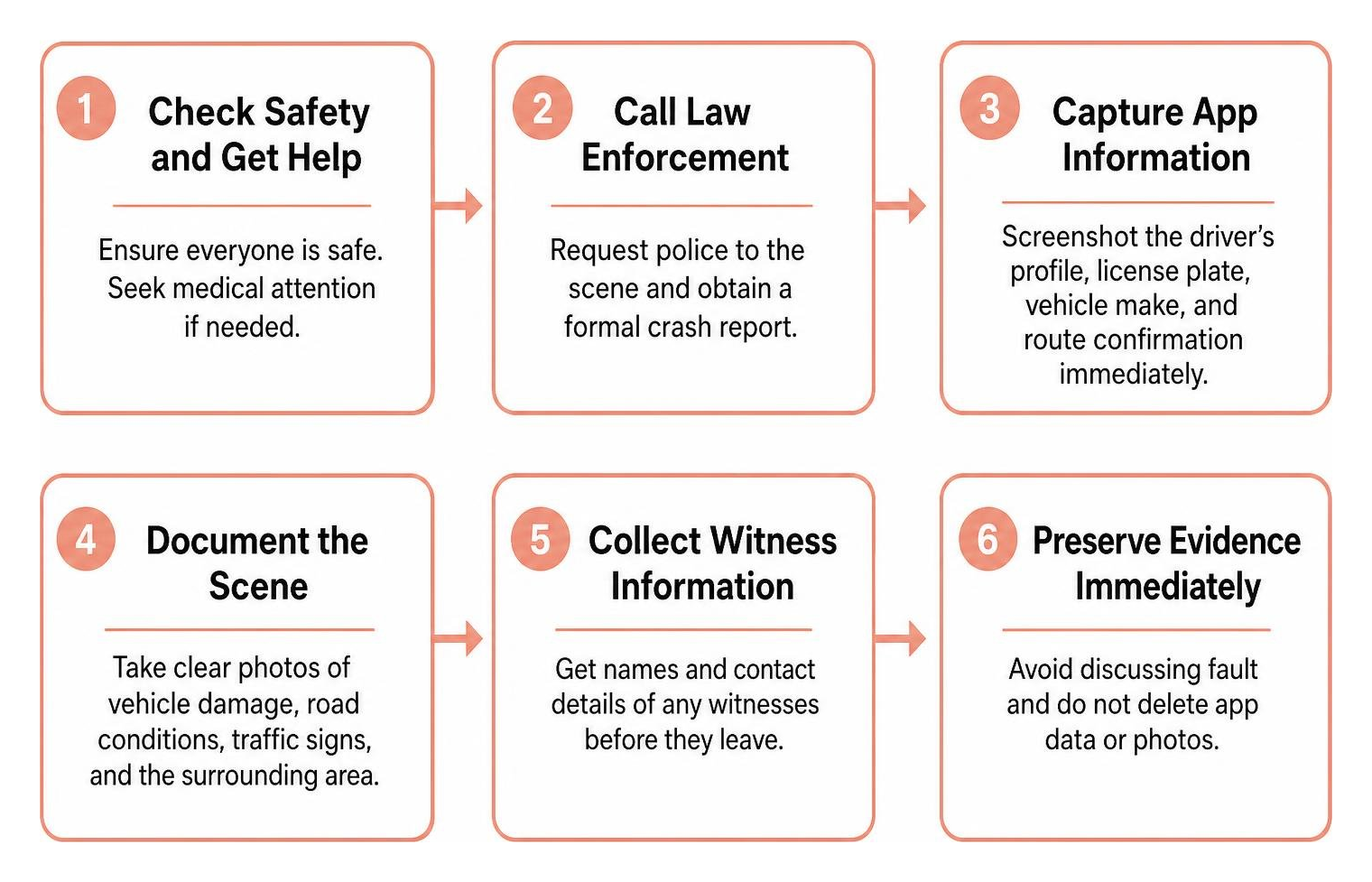
- Take App Screenshots Immediately: Once a trip ends or the app crashes, your active ride screen can vanish. Screenshot the driver’s profile, license plate number, vehicle make, and route confirmation.
- Call Law Enforcement: Ensure a formal police crash report is generated by local police or state troopers.
- Document the Scene: Take wide-angle photos and close-ups of vehicle damage, road skid marks, traffic signals, and weather conditions.
- Gather Witness Information: Collect names, phone numbers, and statements from neutral bystanders or fellow passengers.
- Save Trip Receipts: Retain the emailed trip receipt and credit card billing details confirming your ride status.
Seeking Medical Evaluation and Understanding the 14-Day PIP Rule
Seeking prompt medical treatment is vital not only for your physical recovery but also for your legal claim. In no-fault insurance environments, strict statutory timelines apply. For example, Florida enforces a strict 14-day rule requiring injured individuals to receive an initial medical evaluation within two weeks to retain personal injury protection benefits.
Regardless of the jurisdiction, seeking an evaluation immediately at an urgent care or emergency room creates a direct, contemporaneous medical link between the collision and your injuries. Delayed treatment gives commercial insurers an opening to argue that your injuries stemmed from a pre-existing condition or an unrelated incident.
How an Experienced Uber Accident Injury Attorney Maximizes Claim Value
Rideshare companies and their third-party administrators (such as James River Insurance or Progressive Commercial) employ dedicated teams of adjusters and defense lawyers whose primary objective is to minimize payouts. To protect your rights, reading Dont Settle For Less Finding The Best Car Accident Attorneys In Nj will give you a clear roadmap of what high-caliber legal advocacy looks like.

Valuing Economic and Non-Economic Damages Under Comparative Fault
A successful claim must accurately measure both your out-of-pocket losses and the human cost of your injuries:
- Economic Damages: Past and future medical expenses, emergency transportation, physical therapy, prescription costs, lost earnings, and loss of future earning capacity.
- Non-Economic Damages: Physical pain and suffering, emotional distress, loss of enjoyment of life, and permanent impairment or scarring.
Additionally, under modified comparative fault rules, an injured party’s financial recovery is reduced by their percentage of fault. If an injured person is found to be more than 50% or 51% responsible (depending on state law), they are completely barred from recovering compensation. We work with accident reconstructionists and medical experts to establish clear third-party liability and protect your compensation from unfair fault allocation.
Overcoming Insurer Tactics with an Uber Accident Injury Attorney
Insurance adjusters often reach out to injured victims within days of a crash, offering quick nominal settlements in exchange for a signed liability release. They may also ask for a recorded statement, hoping you will inadvertently make remarks that weaken your claim.
Our firm handles all insurance communications directly. Understanding the mechanisms outlined in The Ultimate Guide To Hiring A Contingency Fee Accident Lawyer allows you to retain top-tier legal representation without paying any out-of-pocket legal fees unless we win your case.
Frequently Asked Questions About Rideshare Crash Claims
When should you hire an Uber accident injury attorney?
You should consult legal counsel immediately after receiving emergency medical care. When dealing with complex multi-vehicle crashes, severe injuries, or disputed app statuses, experienced Personal Injury Lawyers New Jersey can step in to issue formal spoliation letters, preventing the rideshare company from deleting GPS logs, internal app communications, or driver background check records.
Whose insurance pays if another driver caused the crash?
If a negligent third-party driver hits your rideshare vehicle, that driver’s personal auto liability policy is primary. However, if that driver is uninsured or carries insufficient policy limits to cover your catastrophic medical bills, Uber’s $1,000,000 UM/UIM policy can be tapped to bridge the financial gap.
What is the statute of limitations for filing a rideshare claim?
Statutes of limitations vary by jurisdiction, and recent legislative reforms have shortened these deadlines in many areas. For example, some states have reduced their personal injury filing windows from four years down to two years. Because gathering evidence, deposing drivers, and calculating long-term medical damages requires substantial preparation, waiting until the deadline approaches can severely compromise your case.
Conclusion
A rideshare accident can disrupt your physical well-being, your career, and your financial security in an instant. Navigating the maze of personal policies, contingent limits, and $1,000,000 commercial tiers requires dedicated, experienced legal representation.
At Affinity Injury Law, we pride ourselves on providing accessible, compassionate, and aggressive representation on a contingency fee basis—meaning you pay nothing unless we recover compensation for you. We also offer comprehensive multilingual support to ensure clear communication every step of the way. If you were injured in Hackensack, Clifton, Fort Lee, Paramus, Fair Lawn, Wayne, or anywhere across New Jersey, schedule a free consultation with our legal team today to protect your rights and claim the full compensation you deserve.