


When a Handicap Ramp Fail Injures You: What You Need to Know Right Now
If you need a handicap ramp fall lawyer, here is the short answer:
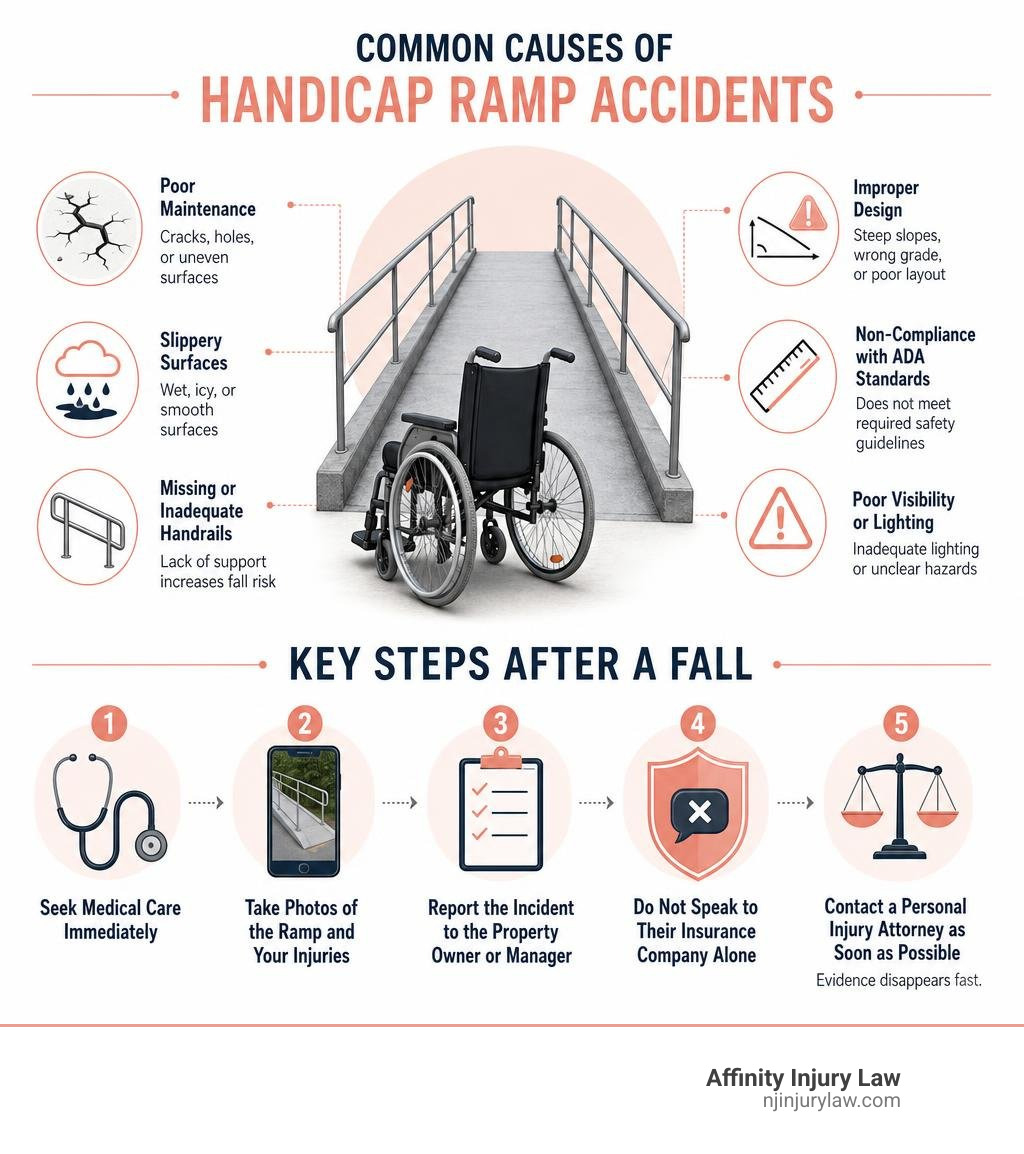
You may have a valid premises liability claim if:
- The ramp was poorly maintained, improperly designed, or violated ADA standards
- The property owner knew — or should have known — about the hazard
- You suffered injuries and damages as a result
What to do right now:
- Seek medical care immediately
- Take photos of the ramp and your injuries
- Report the incident to the property owner or manager
- Do not speak to their insurance company alone
- Contact a personal injury attorney as soon as possible — evidence disappears fast
Falls on handicap ramps are more common — and more serious — than most people realize. In 2022 alone, more than 8.5 million people visited U.S. emergency rooms after unintentional falls. For wheelchair users and people with mobility limitations, a deteriorating or non-compliant ramp is not just an inconvenience. It is a genuine safety hazard that can cause fractures, spinal injuries, and worse.
Handicap ramps are supposed to make buildings more accessible. When they are poorly built, badly maintained, or missing required safety features like handrails and edge protection, they become one of the most dangerous surfaces a disabled person can encounter.
Property owners — whether private landlords, businesses, or government agencies — have a legal duty to keep these ramps safe. When they fail, New Jersey premises liability law gives injured people the right to seek compensation.
You should not have to fight that battle alone, especially while dealing with pain, medical bills, and missed work.
I’m Ioana Enescu, Esq., a founding member of Affinity Injury Law and a lifelong New Jersey resident with hands-on experience representing injured clients in handicap ramp fall lawyer cases and premises liability claims across the state. I understand both the medical and legal sides of these cases — and I’m here to make sure you get the guidance you deserve.
Understanding Liability: Who is Responsible for Handicap Ramp Maintenance?
When you or a loved one is hurt on a ramp, the first question that usually comes up is: Who let this happen? Under New Jersey law, the answer is rooted in premises liability. This is the legal concept holding property owners, managers, and tenants responsible for accidents that happen on their land due to unsafe conditions.
Every property owner owes a “duty of care” to visitors. They are legally required to keep their walkways, stairs, and ramps in a reasonably safe condition. If they ignore a broken handrail, let the concrete crack and crumble, or fail to clear away ice, they have breached that duty. Our experienced Premises Liability Lawyers New Jersey can help you cut through the excuses and identify exactly who had the legal obligation to keep that ramp safe.
Private Property vs. Public Property Liability
Determining who is responsible for a deteriorating handicap ramp depends largely on where the ramp is located:
- Private Residential Property (Landlords and Tenants): If you rent an apartment or a house in New Jersey, your landlord is generally responsible for keeping common areas safe. If a landlord is notified that a wheelchair ramp is deteriorating, too steep, or lacks railings, they are obligated to fix it. This is especially true under the Fair Housing Act, which protects tenants with disabilities.
- Commercial Properties (Businesses and Retailers): Businesses—like grocery stores, medical offices, and shopping centers—invite the public onto their premises. Because of this, they owe the highest duty of care to their customers. They must conduct routine inspections to find and fix hazards like cracked concrete or slippery surfaces on their accessibility ramps. When they fail, severe wheelchair tip-over hazards can occur, leading to catastrophic injuries.
- Public Property (Government Entities): Ramps located at public schools, municipal buildings, county parks, or along public sidewalks are owned and maintained by government entities. Suing a public entity in New Jersey is highly complex because they are protected by “design immunity” and strict procedural rules under the New Jersey Tort Claims Act.
How New Jersey Premises Liability Law Applies to Ramp Falls
To win a slip and fall or trip and fall claim in New Jersey, you cannot simply point to a broken ramp and expect a payout. You must prove negligence. This requires showing that the property owner had “notice” of the dangerous condition. Under New Jersey tort law, notice is divided into two categories:
- Actual Notice: The property owner knew about the hazard. For example, a tenant sent an email to the landlord stating, “The wood on the handicap ramp is rotting and slippery.” If the landlord did nothing, they had actual notice.
- Constructive Notice: The hazard existed for such a long time that the property owner should have known about it if they were doing reasonable inspections. If a concrete ramp has been slowly cracking and crumbling over several months, a business owner cannot claim ignorance. They should have spotted it.
Proving notice requires a deep dive into maintenance logs, sweep sheets, and previous complaints. Working with dedicated Slip and Fall Lawyers New Jersey ensures that these critical pieces of evidence are secured before they are deleted or altered.
If you have been injured, consulting an experienced New Jersey slip and fall lawyer can help you establish the necessary elements of notice and secure the compensation you deserve.
ADA Compliance and Its Impact on Your Injury Claim
The Americans with Disabilities Act (ADA) is a federal civil rights law passed to protect individuals with disabilities from discrimination. One of its most tangible impacts is the strict set of design and construction standards it mandates for physical spaces, including handicap ramps. The U.S. Department of Justice publishes the 2010 ADA Standards for Accessible Design, which include detailed accessibility requirements for ramps, routes, landings, handrails, and related features.
In a personal injury lawsuit, an ADA violation is incredibly powerful evidence. Under New Jersey law, proving that a property owner violated a federal safety standard like the ADA can be used to establish “negligence per se” or, at the very least, serve as strong evidence of a failure to maintain a safe environment.
Key ADA Standards for Handicap Ramps
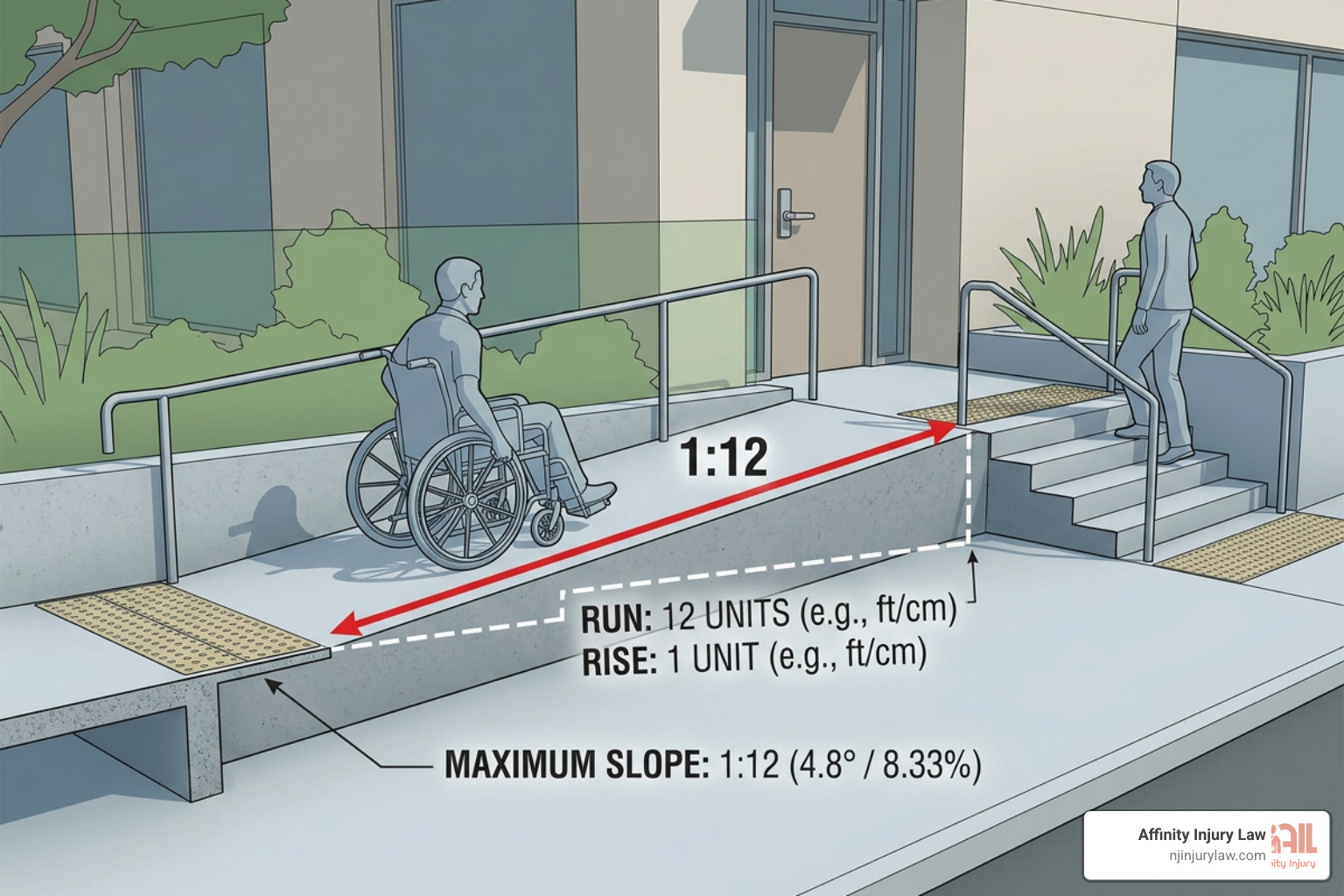
The ADA does not just say “build a ramp.” It outlines highly specific, mathematically precise measurements that must be followed. When builders cut corners, or when property owners let these structures deteriorate, the risk of a severe fall skyrockets.
| ADA Feature | Compliant Specification | Non-Compliant Hazard |
|---|---|---|
| Slope Ratio | Maximum 1:12 slope (1 inch of rise for every 12 inches of length) | Too steep; causes wheelchairs to tip backward or lose control |
| Ramp Width | Minimum of 36 inches between handrails | Too narrow; wheels can slip off or trap the user |
| Handrails | Required on both sides for rises over 6 inches; must be continuous | Missing or loose rails; leaves users with no way to stabilize themselves |
| Landing Platforms | Must have at least a 60″ x 60″ flat landing at the top and bottom | Sloped or tiny landings; causes tipping or roll-offs |
| Edge Protection | Curbs or barriers to prevent wheelchairs from slipping off the edge | No edge protection; wheels drop off the side, throwing the user |
If you fell on a ramp that did not meet these precise specifications, the property owner may be held liable for your medical bills and pain. Consulting with experienced personal injury attorneys can help you determine if a structural ADA violation caused your accident.
How ADA Violations Prove Negligence in a Ramp Fall Case
When a ramp fails to meet these federal guidelines, it is a design defect. If a business builds a ramp with a 1:8 slope instead of the required 1:12, it is simply too steep for a wheelchair user to navigate safely.
To prove this in court, we often work with professional engineers and accident reconstruction experts. They will visit the scene of your fall, measure the slope, examine the handrails, and document the exact deviations from the law. We then present these findings to show the insurance company, or a jury, that the property owner’s failure to comply with building codes directly caused your injuries.
What to Do After a Fall: Steps to Protect Your Rights
The moments immediately following a fall are chaotic, painful, and overwhelming. However, the steps you take in the hours and days after an accident will directly impact your ability to recover compensation. If you want to build a strong foundation for your claim, you must know How to Document Your Slip Fall Accident for Max Comp.
Immediate Steps to Take After a Handicap Ramp Fall
If you are injured on a handicap ramp, try to follow these steps to protect both your health and your legal rights:
- Seek Medical Care Immediately: Your health is the absolute priority. Even if you think you just have a few bruises, seek a medical evaluation the same day. Adrenaline can mask serious injuries like hairline fractures, internal bleeding, or traumatic brain injuries. Plus, insurance companies will use any delay in medical treatment to argue that you weren’t actually hurt in the fall.
- Report the Incident: Tell the property owner, store manager, or landlord what happened immediately. Ask them to write a formal incident report and demand a copy.
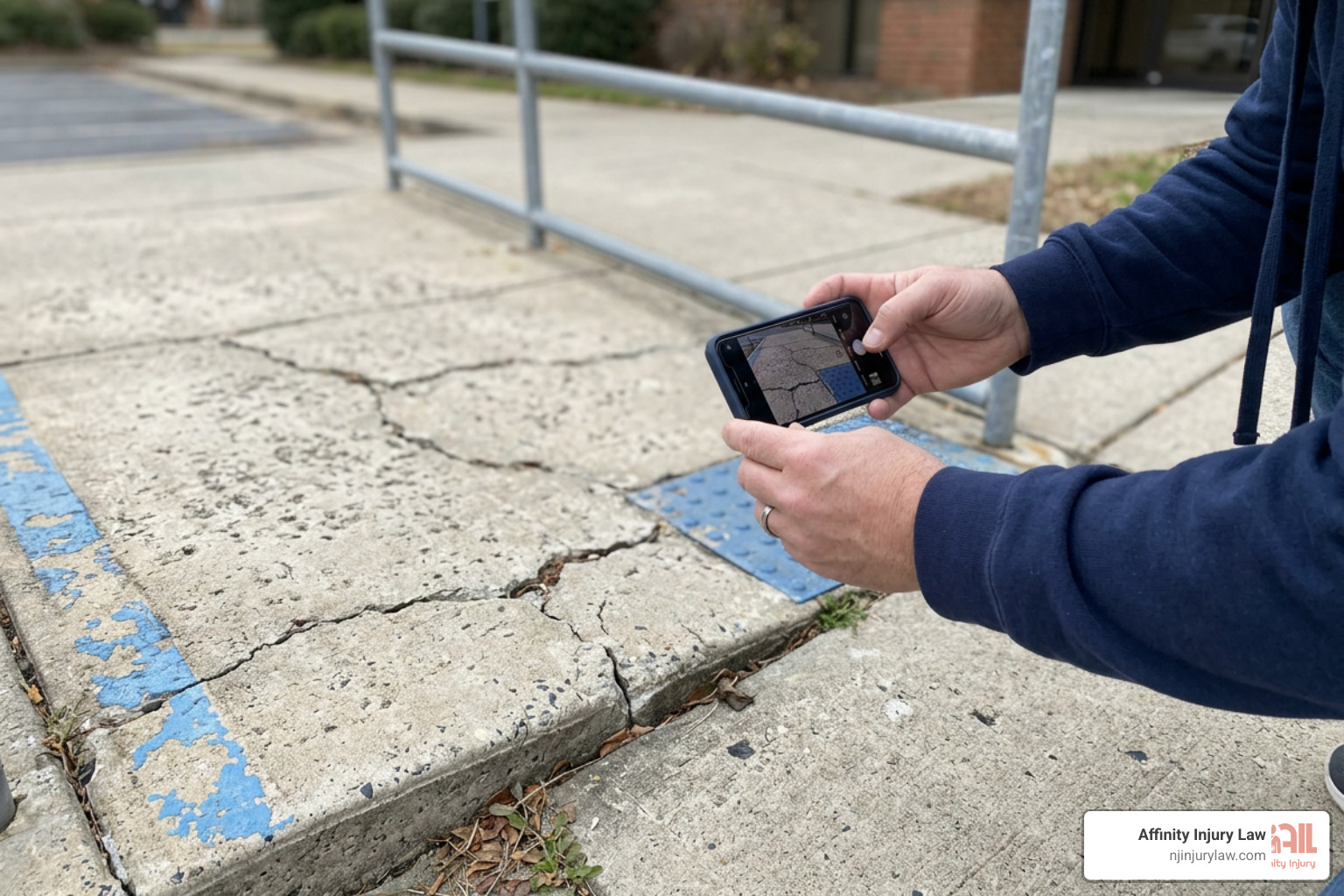
- Take Photos and Video: If you are physically able, or if you have a companion with you, take detailed photos of the ramp. Capture the crumbling concrete, the missing handrail, the lack of edge protection, or the patch of ice that caused you to fall. Also, take photos of your injuries and any damage to your wheelchair or mobility device.
- Gather Witness Information: If anyone saw you fall or helped you up, get their names and phone numbers. Their unbiased testimony can be invaluable later on.
- Avoid Common Pitfalls: Do not sign any statements, do not accept quick cash offers, and avoid admitting fault (even a simple “I’m sorry, I should have been looking where I was going” can be weaponized against you). Reviewing the 5 Mistakes That Can Hurt Your Personal Injury Claim in New Jersey will help keep your case on track.
Crucial Evidence Your Attorney Will Need
Once you hire a handicap ramp fall lawyer, we will immediately launch an investigation to preserve key evidence before it is destroyed.
This evidence includes:
- Surveillance Footage: Many commercial properties have outdoor security cameras. However, this footage is often overwritten within 14 to 30 days. We immediately send a formal spoliation letter demanding that the property owner preserve all video recordings of the area.
- Maintenance Logs and Sweep Sheets: These documents show whether the owner was actually inspecting the ramp or ignoring it.
- Prior Complaints: We will look into whether other visitors had previously complained to the building department or the landlord about the unsafe ramp.
How a Handicap Ramp Fall Lawyer Proves Negligence and Secures Compensation
Navigating a premises liability claim on your own is an uphill battle. Insurance adjusters are trained to minimize payouts, and they will use every trick in the book to blame you for your own fall. When you work with our Personal Injury Lawyers New Jersey, we handle the heavy lifting so you can focus on healing.
Recoverable Damages in a Handicap Ramp Injury Claim
If your fall was caused by a property owner’s negligence, you are entitled to “damages”—which is the legal term for financial compensation. Depending on the severity of your injuries, you may recover:
- Medical Expenses: Coverage for emergency room visits, surgeries, hospital stays, physical therapy, and any future medical care you will need.
- Lost Wages: If your injuries forced you to miss work, you can recover your lost income. If you can no longer work at the same capacity, you can seek compensation for lost earning potential.
- Pain and Suffering: This compensates you for the physical pain, emotional distress, and loss of enjoyment of life caused by the accident. To understand how these damages are calculated, consulting an experienced slip and fall lawyer is highly recommended.
- Mobility Device Replacement: If your wheelchair, walker, or scooter was damaged or destroyed in the fall, the negligent party must pay to repair or replace it.
Filing Deadlines: Private Owners vs. Government Entities
Time is not on your side after a slip and fall. In New Jersey, the statute of limitations for most personal injury claims is two years from the date of the accident. If you do not file a lawsuit within this window, you lose your right to seek compensation forever.
However, if your fall occurred on government property (such as a public school, municipal park, or state building), the rules are vastly different. Under New Jersey’s Title 59 (the Tort Claims Act), you must file a formal Notice of Claim within 90 days of the accident. If you miss this incredibly tight 90-day deadline, your claim against the government will almost certainly be barred. If you live in or near Lyndhurst, speaking with a local personal injury lawyer can help ensure you meet these strict deadlines.
When to Consult a Handicap Ramp Fall Lawyer
You should consult an attorney as soon as possible after your fall. Early legal intervention is especially critical if:
- Your injuries are severe (such as broken bones, head trauma, or spinal damage).
- The property owner denies responsibility or blames you for the fall.
- The insurance company offers a quick, lowball settlement.
- The accident happened on government property.
For personalized support in northern New Jersey, don’t hesitate to reach out to an experienced personal injury lawyer to evaluate your options.
Frequently Asked Questions About Handicap Ramp Falls
FAQ 1: Can I sue if the ramp was wet from rain or snow?
Yes, but it depends on the circumstances. Under New Jersey’s “storm-in-progress” doctrine, property owners are generally given a reasonable amount of time after a snow or ice storm ends to clear their walkways. However, if the ramp has poor drainage that causes water to pool and freeze into black ice, or if the ramp surface lacks the required slip-resistant texture, the owner can still be held liable even during inclement weather.
FAQ 2: What if I was partially at fault for my fall on the ramp?
New Jersey follows a modified comparative negligence rule (specifically, the 50 percent rule). This means you can still recover compensation as long as you were not more than 50% responsible for your own fall. However, your financial recovery will be reduced by your percentage of fault. For example, if a jury finds you were 20% at fault because you were distracted, and your total damages are $100,000, you will receive $80,000.
FAQ 3: How much does it cost to hire a handicap ramp fall lawyer?
At Affinity Injury Law, we work on a contingency fee basis. This means there are absolutely no upfront costs or hourly fees. We only get paid if we successfully secure a settlement or jury verdict for you. If we don’t win, you don’t owe us a dime. Your initial consultation is always 100% free.
Conclusion
When accessibility features fail, the consequences can be life-altering. A poorly built or badly maintained handicap ramp isn’t just a minor hazard—it is a betrayal of the safety and independence that individuals with mobility challenges deserve.
At Affinity Injury Law, we are proud to stand up for injury victims across New Jersey, including Lyndhurst, Bergen County, and Passaic County. We understand how overwhelming the legal process can feel, which is why we offer compassionate, relentless representation. As a key differentiator, we provide multilingual support to ensure that language barriers never stand in the way of justice for our clients.
If you or a loved one has been hurt in a ramp fall, let us help you hold the negligent parties accountable. Schedule a consultation with our Premises Liability Lawyers New Jersey today for a free, no-obligation case evaluation. We are here to fight for the maximum compensation you deserve.