

When to Call a Lyndhurst Medical Malpractice Attorney
If you suspect a medical error harmed you in Lyndhurst, get the care you need, request your medical records, and speak with a New Jersey medical malpractice attorney promptly. You may be able to seek payment for medical bills, lost income, and pain. To bring a claim, you must show that a healthcare provider’s care fell below accepted standards and caused your injury. New Jersey generally gives you two years to file a lawsuit, though exceptions may apply.
I’m Ioana Enescu, Esq., a founding member of Affinity Injury Law and a New Jersey native; growing up with two physician parents shaped how I think about patient care. If you’re looking for a Lyndhurst medical malpractice attorney, this guide will help you understand what to save, what to ask, and what to expect.
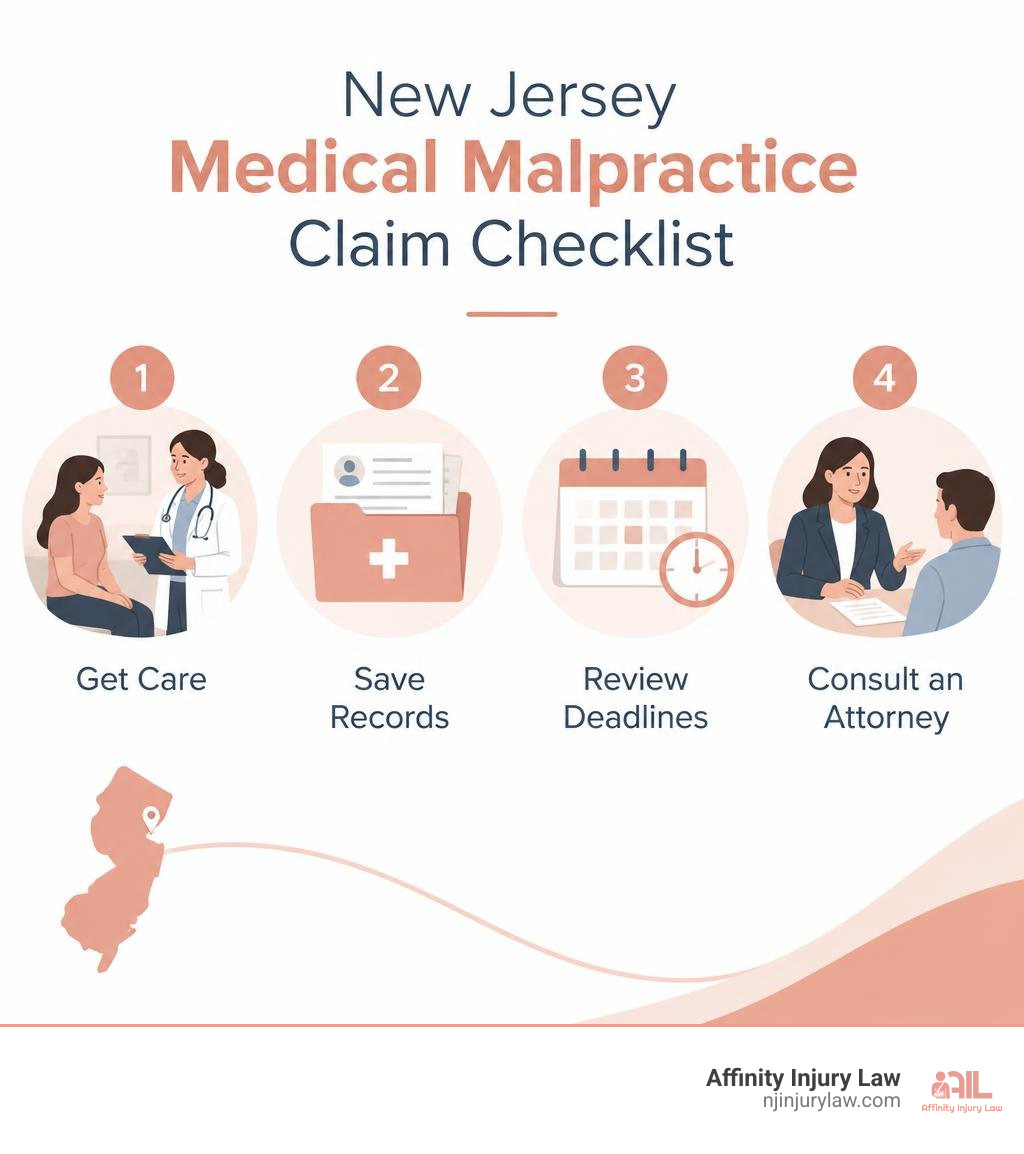
Easy lyndhurst medical malpractice attorney word list:
Understanding Medical Negligence and Legal Standards in New Jersey
Medical malpractice occurs when a doctor, nurse, surgeon, hospital, or other medical provider deviates from the recognized standard of care, directly causing harm to a patient. In New Jersey, proving medical negligence requires demonstrating four distinct legal pillars:
- Duty of Care: A direct healthcare provider-patient relationship existed, establishing the professional obligation to treat you competently.
- Breach of the Standard of Care: The professional failed to provide the level of skill, care, and diligence that a reasonably prudent specialist in the same field would provide under similar circumstances.
- Causation (Proximate Cause): The breach directly resulted in your illness, delayed diagnosis, physical injury, or worsened prognosis, rather than an underlying natural condition.
- Actual Damages: You experienced measurable losses, including corrective medical bills, lost wages, reduced earning capacity, or physical pain and suffering.
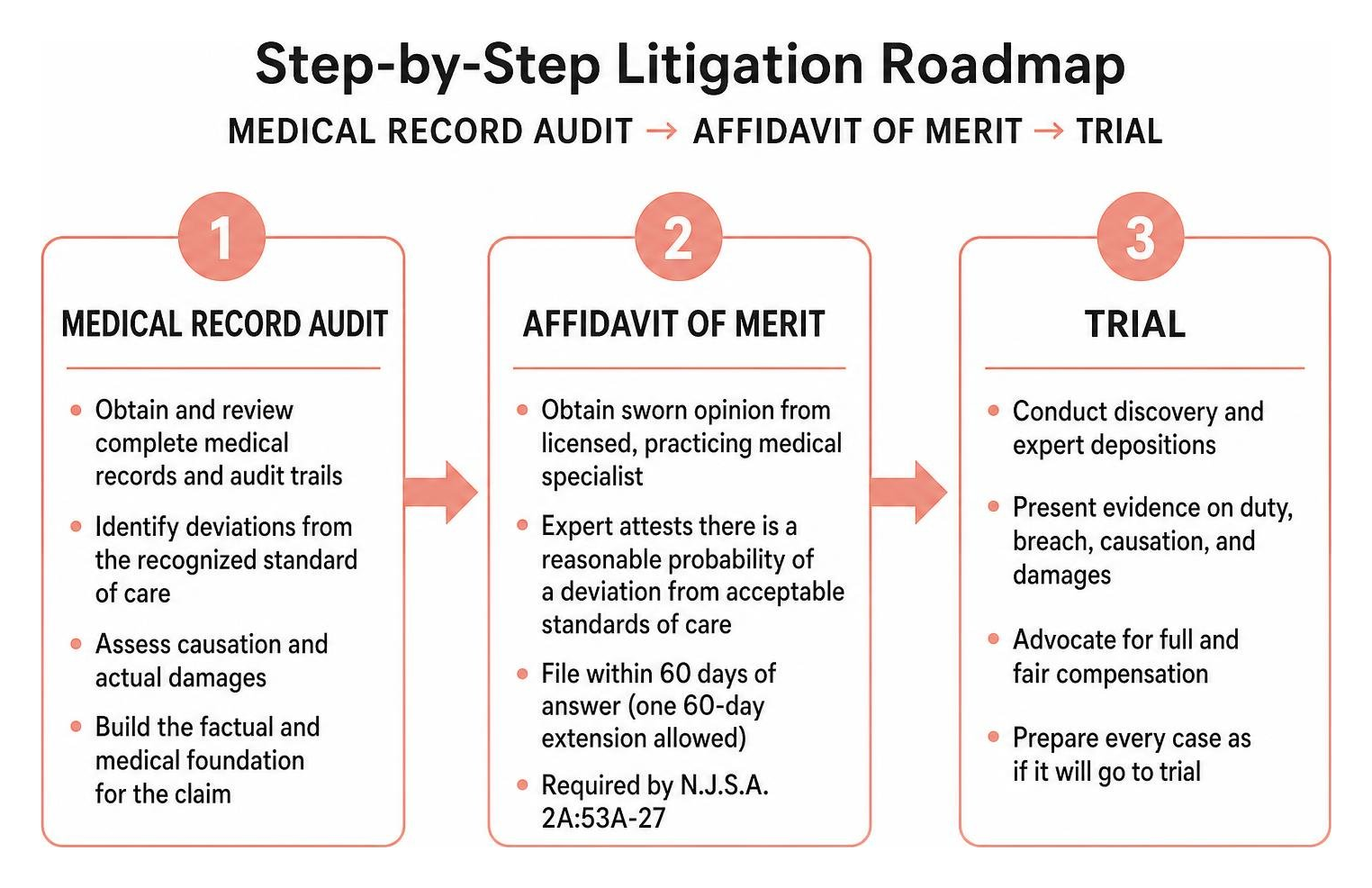
In New Jersey, medical malpractice claims carry a specific procedural hurdle: the Affidavit of Merit (N.J.S.A. 2A:53A-27). Within 60 days of the defendant filing their answer to your complaint (with a potential one-time 60-day extension), our legal team must submit a sworn statement from an appropriately licensed, practicing medical specialist. This expert must attest under oath that there is a reasonable probability that the care delivered by the defendant violated acceptable professional treatment standards. Failing to file a valid Affidavit of Merit can lead to an immediate dismissal of your case with prejudice.
While some patients start their search via resources like the Lyndhurst medical malpractice legal directory, navigating state procedural hurdles requires focused trial readiness.
| Feature / Requirement | Standard Personal Injury Claim (e.g., Auto Accident) | Medical Malpractice Lawsuit |
|---|---|---|
| Standard of Proof | Reasonable person standard of ordinary care | Recognized medical specialty standard of care |
| Expert Requirement | Often optional or limited to accident reconstruction | Mandatory licensed medical expert Affidavit of Merit |
| Pre-Suit Discovery | Standard police reports and insurance claims | In-depth audit of electronic health records (EHR) & audit trails |
| Complexity Level | Straightforward liability determinations | Highly technical scientific and anatomical disputes |
| Filing Deadlines | 2 years from date of incident | 2 years with strict application of the discovery rule |
Common Types of Medical Errors Handled in Bergen County
Medical malpractice can occur in outpatient clinics, regional medical centers, emergency departments, and ambulatory surgery centers throughout Bergen County and Passaic County. Knowing when an unfavorable medical outcome is the result of preventable negligence often requires guidance from a personal injury lawyer in Lyndhurst NJ.
Common medical errors include:
- Diagnostic Failures: Delayed diagnosis or complete misdiagnosis of aggressive cancers, heart attacks, strokes, pulmonary embolisms, and appendicitis.
- Surgical Mistakes: Wrong-site surgery, accidental puncture or perforation of adjacent internal organs, anesthesia dosage miscalculations, and foreign objects (such as surgical sponges or clamps) left inside a patient.
- Obstetric and Birth Injuries: Inadequate fetal heart rate monitoring leading to oxygen deprivation, hypoxic-ischemic encephalopathy (HIE), cerebral palsy, or improper use of delivery instruments causing brachial plexus injuries.
- Medication and Prescription Errors: Administering the incorrect pharmaceutical agent, administering lethal dosage levels, or failing to check known patient drug allergies and severe contraindications.
- Emergency Department Oversight: Premature patient discharge without completing essential diagnostic lab work or imaging, or failing to recognize classic signs of acute cardiovascular distress.
How Modified Comparative Negligence and Damage Caps Apply
When evaluating damages, New Jersey applies a modified comparative negligence rule (N.J.S.A. 2A:15-5.1). Under this framework, an injured plaintiff can recover financial compensation as long as their share of responsibility does not exceed 50%. If you are determined to be 20% responsible—for instance, by failing to follow vital post-operative discharge instructions—your final award is reduced by 20%. If your fault is determined to be 51% or higher, state law bars you from collecting any compensation.
Compensation in New Jersey medical malpractice lawsuits is broken down into three categories:
- Economic Damages: Direct, quantifiable financial losses including past and future hospital expenses, rehabilitation therapies, medical equipment, lost wages, and loss of future earning potential.
- Non-Economic Damages: Compensation for intangible harm such as physical pain, emotional distress, loss of life enjoyment, permanent disability, and disfigurement. New Jersey places no cap on compensatory economic or non-economic damages.
- Punitive Damages: Reserved for rare instances involving willful, wanton, or malicious misconduct. Under the New Jersey Punitive Damages Act (N.J.S.A. 2A:15-5.14), punitive damages are capped at five times the compensatory damages award or $350,000, whichever amount is greater.
For a deeper look into compensation structures across Bergen County, consult our comprehensive guide to Lyndhurst accident claims and legal representation.
How a Lyndhurst Medical Malpractice Attorney Builds a Strong Claim

Successfully resolving a medical malpractice case demands extensive investigation and technical precision. Healthcare facilities and malpractice insurance carriers deploy well-funded defense teams to deny accountability. When we take on a medical injury claim, we implement a thorough preparation process:
- Comprehensive Medical Audits: We secure and examine every page of your medical history, including physician notes, nursing logs, pharmacy administration sheets, laboratory results, and electronic health record (EHR) metadata audit trails that show when records were entered or altered.
- Retaining Top-Tier Medical Specialists: We partner with actively practicing, board-certified physicians in the exact medical specialty involved to evaluate standard-of-care adherence, write expert reports, and prepare the mandatory Affidavit of Merit.
- Deposition and Fact Gathering: We depose treating physicians, nurses, surgical assistants, and hospital administrators to expose inconsistencies between their testimony and the medical chart.
- Financial and Life Care Projections: We collaborate with forensic economic analysts and certified life-care planners to calculate the true lifetime cost of long-term medical care, ongoing physical therapies, and lost career earnings.
- Aggressive Negotiation and Trial Readiness: Preparing every case for trial gives us the leverage required to achieve maximum compensation during settlement negotiations. We guide you through every stage of understanding your options for an injury settlement.
Why Hiring a Lyndhurst Medical Malpractice Attorney Early Is Essential
In New Jersey, the general statute of limitations for medical malpractice lawsuits is two years from the date the negligent act occurred (N.J.S.A. 2A:14-2). However, under New Jersey’s discovery rule, if the injury or its connection to medical negligence could not reasonably have been discovered immediately, the two-year clock begins on the date you knew, or through reasonable diligence should have known, that you suffered harm due to medical wrongdoing.
Exceptions also exist for minors: a child injured by medical malpractice before their 18th birthday generally has until their 20th birthday to file an action, while birth injury claims must typically be brought before the child turns 13.
Reaching out promptly to a legal team is essential because medical evidence deteriorates quickly. Hospital staffing changes can make witnesses difficult to locate, electronic data can be overwritten according to standard document retention policies, and physical diagnostic specimens can be discarded. Understanding early on what an injury case lawyer can do for you ensures your rights remain protected from the start.
Overcoming Common Healthcare Provider Defenses
Healthcare defense lawyers rely on predictable arguments to deflect liability:
- Informed Consent Sign-Offs: Providers often claim that because you signed an informed consent form detailing surgical risks, you waived your right to take legal action. However, signing a consent form does not give a doctor permission to perform a procedure negligently.
- Pre-Existing Health Conditions: Insurers often argue your pain or disability stems from an underlying health issue rather than their client’s error. We counter this by using diagnostic imaging comparisons to illustrate the clear deviation caused by the error.
- Known Complication Defenses: Doctors frequently argue that an adverse event was an unavoidable, recognized complication of treatment. We counter this defense by demonstrating that the complication went unmonitored, undiagnosed, or mismanaged.
- Sovereign Immunity Limits: If your treatment occurred at a state, county, or municipal healthcare facility, the New Jersey Tort Claims Act (N.J.S.A. 59:8-8) requires filing a formal Notice of Claim within 90 days of the injury. Missing this deadline forfeits your ability to recover damages entirely.
Immediate Steps to Take if You Suspect Medical Malpractice
Protecting your physical health and your legal rights after a medical error requires prompt, deliberate action:
- Prioritize Your Health with an Independent Doctor: Seek immediate medical evaluation from an unaffiliated physician or hospital system to stabilize your condition and create an objective, unbiased medical record of your injuries.
- Request Complete Copies of Your Medical Records: Request copies of your complete medical charts, surgical notes, diagnostic imaging discs (CT, MRI, X-ray), pathology reports, and discharge summaries before records can be altered or lost.
- Keep a Detailed Daily Symptom Journal: Document your physical pain levels, emotional struggles, limitations in daily activities, and missed workdays in a private journal.
- Preserve Financial Evidence: Maintain a folder containing all prescription receipts, out-of-pocket medical expenses, co-pay receipts, travel costs for specialist visits, and communications from insurance providers.
- Do Not Speak to Hospital Risk Management: Do not give recorded statements, sign liability releases, or accept informal financial accommodations from hospital risk managers or insurance adjusters without first consulting an attorney.
Choosing the Right Legal Representation for Your Medical Claim
Lyndhurst is a tight-knit Bergen County community of 20,554 residents, spanning 4 square miles with a median age of 40, an average home value of $410,400, and an average income of $71,369. While local directories and Lyndhurst law firm resources highlight various general legal practitioners, there are currently no dedicated medical malpractice litigation firms physically headquarted directly within Lyndhurst’s borders.
Medical malpractice cases require significant financial resources, access to elite medical expert networks, and extensive courtroom experience. Choosing legal representation across Bergen and Passaic Counties ensures you have the resources necessary to challenge major hospital systems.
When finding the best Lyndhurst injury law office for a free consultation, ensure the firm operates on a contingency fee basis—meaning you pay zero legal fees unless your legal team successfully secures a financial settlement or trial verdict on your behalf.
Questions to Ask a Lyndhurst Medical Malpractice Attorney During Consultation
Before retaining counsel, ask these essential questions during your initial case review:
- How many medical malpractice cases have you successfully settled or tried to verdict in New Jersey?
- Do you have the financial resources to front all upfront litigation expenses, including retaining top medical specialists?
- How does your firm handle the New Jersey Affidavit of Merit requirement?
- Who will be the lead attorney handling my day-to-day case and preparing it for trial?
- What are your communication policies, and do you offer multilingual client support for my family?
Frequently Asked Questions About Lyndhurst Medical Malpractice Claims
What is the statute of limitations for medical malpractice in New Jersey?
In New Jersey, the general statute of limitations for medical malpractice is two years from the date the negligent medical care occurred. Under the discovery rule, this deadline may be extended to two years from the date you discovered (or reasonably should have discovered) the injury and its relationship to the medical provider’s error. For minor children, the statute of limitations is extended: standard medical negligence claims can typically be filed until the child reaches age 20, while birth-related injuries must be initiated before the child’s 13th birthday.
How much does it cost to hire a medical malpractice lawyer?
At Affinity Injury Law, we handle medical malpractice cases on a contingency fee basis. This means there are no upfront expenses, out-of-pocket costs, or hourly retainers for you. Our firm advances all costs necessary to investigate, build, and litigate your claim—including acquiring medical records, hiring expert witnesses, and court filing fees. We only receive a legal fee if we secure a financial recovery through a negotiated settlement or courtroom verdict.
What evidence is required to prove medical negligence?
Proving medical negligence requires comprehensive documentation showing that your healthcare provider’s actions deviated from the accepted standard of care and caused direct harm. Essential evidence includes:
- Complete electronic health records, nursing flow sheets, and prescription logs
- Diagnostic imaging studies, lab results, and pathology slides
- A sworn Affidavit of Merit from a board-certified medical specialist in the same field
- Expert medical testimony establishing standard-of-care violations and physical causation
- Employment records and wage statements proving lost income and diminished future earning capacity
- Detailed personal symptom documentation illustrating pain, physical disability, and loss of life quality
Conclusion
Suffering harm from a healthcare provider you trusted can turn your life upside down. Holding negligent medical professionals and hospital systems accountable is vital not only for your financial recovery, but also for upholding patient safety across our communities.
At Affinity Injury Law, our deep roots in New Jersey healthcare—and our founding attorney’s perspective as the child of two physicians—give us insight into the nuances of complex medical records. We are committed to protecting your rights, securing the necessary Affidavit of Merit, and providing clear, multilingual legal counsel every step of the way.
If you or a loved one suffered harm due to a medical mistake in Lyndhurst, Hackensack, Paterson, Clifton, or anywhere in Bergen and Passaic Counties, do not navigate this challenging process alone. Protect your future by consulting experienced personal injury lawyers in New Jersey today for your free, no-obligation case evaluation.