

How to Evaluate a Lyndhurst Injury Case Settlement
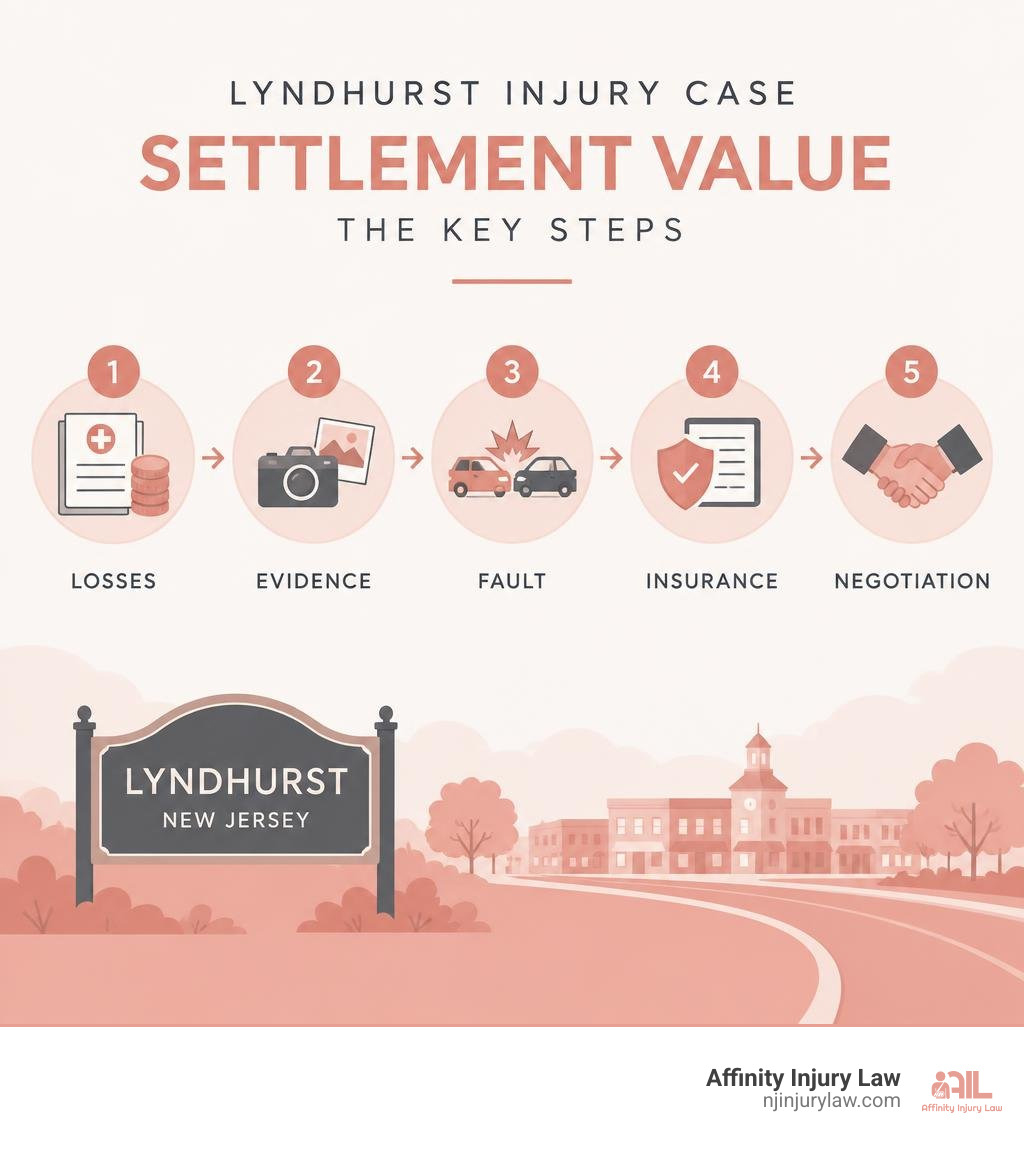
A Lyndhurst injury case settlement is based on proof, not a standard average. To estimate a fair value, add your medical bills and lost income, document how the injury affects your daily life and future work, then compare those losses with the available insurance coverage and evidence of fault. Serious cases involving surgery, brain injury, lasting disability, or clear negligence may be worth far more than minor-injury claims, while shared fault or limited insurance can reduce recovery.
A $735,000 Lyndhurst, New Jersey motor-vehicle settlement illustrates the point: the claim involved an illegal U-turn, a concussion, aggravated spinal conditions, and cervical fusion surgery. It is not a guaranteed result or a local “average,” but it shows why detailed medical records and strong liability evidence matter.
I am Ioana Enescu, Esq., a founding attorney at Affinity Injury Law with a background shaped by close familiarity with medical care and patient advocacy. I help New Jersey injury victims understand the records, insurance issues, and proof that can affect a Lyndhurst injury case settlement.
Common lyndhurst injury case settlement vocab:
- Lyndhurst Car Crash Attorney
- Lyndhurst Catastrophic Injury Lawyer
- Personal Injury Lawyer in Lyndhurst NJ
Factors Influencing a Lyndhurst Injury Case Settlement

When an accident happens in Lyndhurst or anywhere in Bergen County, calculating the value of your claim is rarely a straightforward mathematical exercise. Every injury claim is as unique as the person who suffered the harm. Insurance adjusters like to run baseline numbers through algorithmic software, but real recovery depends on human factors, medical realities, and demonstrable financial loss.
To understand where your claim stands, it is helpful to look at how different categories of losses are split:
| Damage Category | Economic Damages | Non-Economic Damages |
|---|---|---|
| Definition | Direct, quantifiable financial losses resulting from the accident. | Intangible, subjective harms impacting quality of life and well-being. |
| Examples | Emergency room visits, surgeries, physical therapy, lost wages, vehicle repairs. | Physical pain, emotional trauma, loss of companionship, sleep disruption, anxiety. |
| Documentation | Medical bills, pay stubs, tax returns, receipts, life care plans. | Personal pain journals, psychiatric evaluations, testimony from friends and family. |
| Calculation Method | Direct mathematical addition of past and projected future expenses. | Multipliers or daily rates based on injury severity and life disruption. |
Key Elements That Determine a Lyndhurst Injury Case Settlement
The baseline value of any claim rests on the severity of the harm done and the clarity of fault. When an accident leads to life-altering outcomes—such as traumatic brain injuries (TBIs), severe spinal damage requiring spinal fusion, or herniated discs that pinch nerves—the compensation sought must account for long-term care. You can explore what compensation can a Lyndhurst catastrophic injury lawyer help you recover to see how severe physical harm elevates total case valuation.
To maximize financial recovery, we focus on establishing clear liability while presenting comprehensive medical evidence. An insurance adjuster will look closely at:
- The permanence of your physical impairment and whether surgery (such as an anterior cervical discectomy) was required.
- Current medical costs alongside projected lifetime therapy or prescription needs.
- Total lost income from missed work, as well as diminished future earning capacity.
- Available insurance policy limits carried by the at-fault driver or property owner.
Addressing Aggravated Pre-Existing Conditions and Delayed Symptoms
One of the most frequent defense tactics used by insurance carriers in Bergen County is claiming that a victim’s pain stems entirely from an “old injury” or natural degeneration. If you had a prior back problem from years ago, the insurance adjuster might argue they owe you nothing. Under New Jersey law, however, an at-fault party is responsible for the degree to which their negligence aggravated, accelerated, or worsened a pre-existing condition (often referred to under the “Eggshell Plaintiff” doctrine).
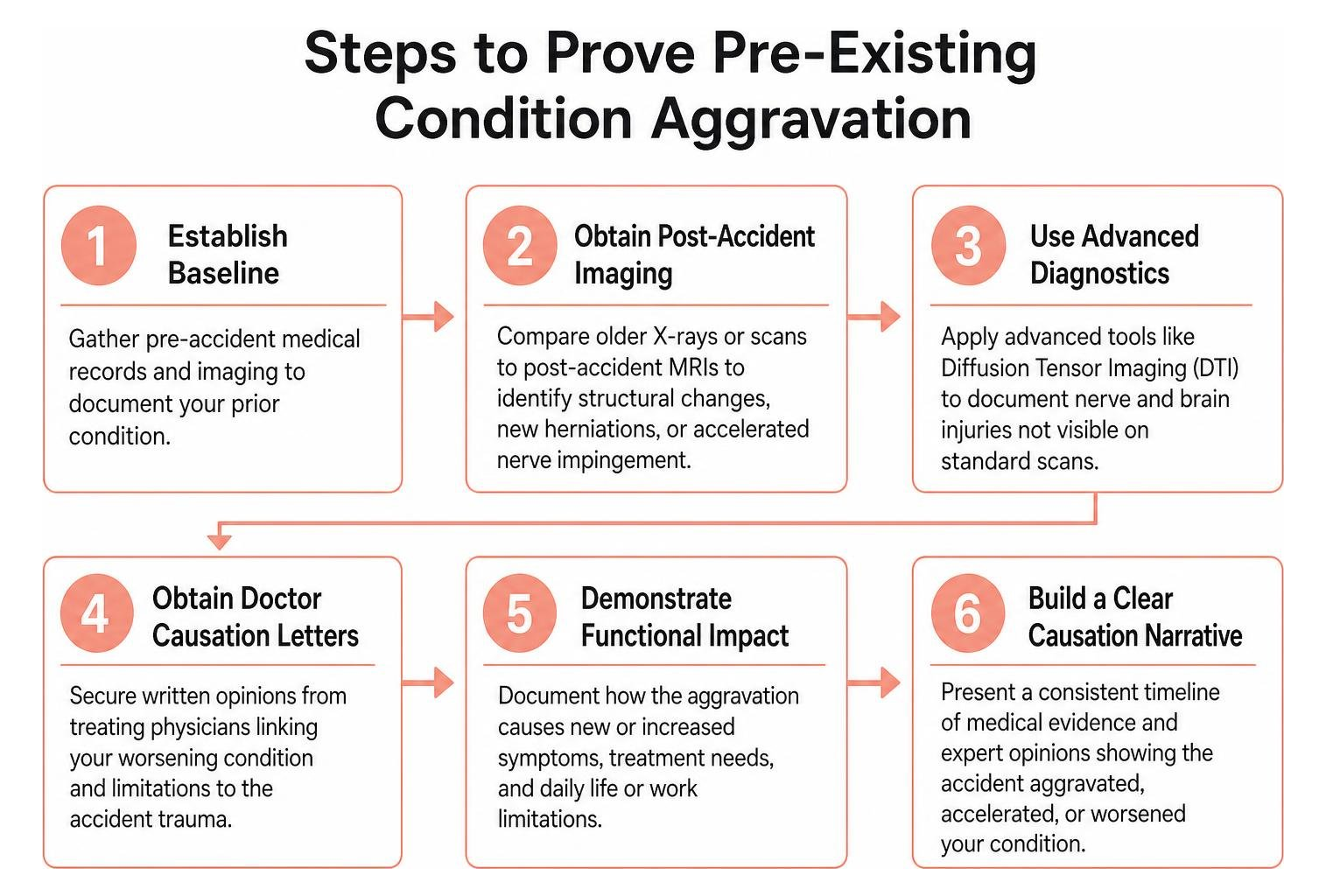
Establishing medical causation requires clear diagnostic imaging and detailed baseline comparisons:
- Pre-Accident vs. Post-Accident Imaging: Comparing older X-rays or scans against post-crash MRIs demonstrates structural changes, newly herniated discs, or accelerated nerve impingement.
- Advanced Diagnostics: Utilizing advanced tools like Diffusion Tensor Imaging (DTI) helps document mild traumatic brain injuries and microstructural nerve pathway disruption that standard CT scans might miss.
- Doctor Causation Letters: Treating physicians must explicitly connect the sudden onset of physical limitations to the trauma of the accident.
For a deeper dive into preserving these critical evidentiary links, review the ultimate guide to Lyndhurst accident claims and legal representation.
How to Calculate and Maximize Your Total Compensation

Calculating full compensation requires looking beyond current unpaid invoices. If a crash leaves you unable to perform your normal job duties or requires ongoing medical management for years to come, a fair settlement must encompass both immediate economic losses and projected future hardships.
When building your damages claim, we account for:
- Future Medical Costs: Ongoing physical therapy, future revision surgeries, pain management injections, home modifications, and assistive devices.
- Diminished Earning Capacity: If your physical limitations force you into a lower-paying role or prevent you from working overtime, economic experts calculate the lifetime difference in earnings.
- Life Care Planning: For catastrophic injuries, certified life care planners create an exhaustive breakdown of every medical and personal care expense you will face over your statistical lifespan.
Essential Evidence and Immediate Steps to Protect Your Claim
The strength of your claim is determined by the actions you take in the hours and days following an incident. To protect your rights and counter standard insurance company pushback:
- Call Law Enforcement: Ensure local police file an official crash report detailing vehicle positions, road conditions, and witness observations.
- Document the Scene Thoroughly: Photograph all property damage, skid marks, road signage, weather conditions, and visible injuries.
- Seek Immediate Medical Attention: Gaps in treatment provide insurance adjusters with an excuse to argue that your injuries were caused elsewhere or were not severe.
- Decline Recorded Statements: Insurance adjusters are trained to ask leading questions designed to get you to minimize your pain or unintentionally accept partial blame.
Securing immediate legal help from a Lyndhurst car crash attorney ensures that crucial physical evidence and surveillance camera footage are preserved before they are lost or overwritten.
Uninsured and Underinsured Motorist Coverage Options
New Jersey law mandates minimum liability limits, but minimum coverage is often insufficient when severe injuries occur. If you are hit by a driver who carries only bare-minimum insurance or no insurance at all, you may need to file a claim under your own Uninsured/Underinsured Motorist (UM/UIM) policy.
UM/UIM coverage acts as a safety net:
- Underinsured Motorist (UIM) Claims: When an at-fault driver’s policy limit is exhausted and cannot cover your total medical bills and pain, your own UIM coverage bridges the gap up to your policy’s limits.
- Uninsured Motorist (UM) Claims: If you are the victim of a hit-and-run driver or a motorist operating without valid insurance, your UM coverage steps into the shoes of the at-fault party.
Pursuing a UM/UIM claim does not increase your rates when you are not at fault, but your insurer will treat the claim adversarially. Understanding why you need a Lyndhurst car accident attorney to maximize your settlement helps ensure that all available coverage tiers are identified and leveraged.
Step-by-Step Process for Navigating Local Liability and Insurance Rules

Navigating a personal injury claim in New Jersey requires complying with state statutes and local procedural hurdles:
- Modified Comparative Negligence: Under New Jersey’s modified comparative negligence law, you can recover damages as long as you are not more than 50% at fault for the accident. If you are found to be 20% at fault, your total settlement or award is reduced by 20%. If your fault is 51% or greater, you are barred from any recovery.
- Statute of Limitations: In New Jersey, you generally have two years from the date of the injury to file a lawsuit in civil court. Missing this deadline permanently extinguishes your legal right to compensation.
- Special Municipal Notice Rules: If your claim involves a public entity or municipal employee (such as a Lyndhurst town vehicle or public roadway defect), New Jersey’s Title 59 (Tort Claims Act) requires you to file a formal Notice of Claim within 90 days of the incident before any lawsuit can be initiated. Procedural pitfalls involving public entities are highlighted in decisions such as Kenworthy v. Lyndhurst Police Dep’t, where claims faced strict pleading requirements and dismissal.
Deciding Between a Lyndhurst Injury Case Settlement and Trial
The overwhelming majority of personal injury cases resolve via negotiated settlement before reaching a courtroom verdict. However, deciding whether to settle or proceed to trial depends on a careful evaluation of risk versus reward.
If an insurer refuses to make an offer that fully reflects your medical expenses, lost wages, and pain, taking the case through formal litigation and trial may be necessary. Having counsel with a proven courtroom track record signals to insurance carriers that you will not accept a lowball offer. For local representation that understands how Bergen County juries evaluate liability and damages, see what a personal injury lawyer in Lyndhurst NJ can do for you.
Commercial and Premises Liability Standards in Regional Claims
Injury claims extend beyond traffic collisions to slip-and-falls, commercial workplace injuries, and defective equipment incidents. In every premises or commercial liability claim, the plaintiff must demonstrate that the property or business owner breached their duty of care by failing to conduct reasonable inspections, failing to repair known hazards, or failing to warn visitors of dangerous conditions.
Historical principles of inspection and liability—such as those analyzed in maritime negligence precedents like The Lyndhurst—demonstrate that failing to inspect gear or premises after adverse events creates strong presumptions of negligence. Whether dealing with commercial property maintenance, dangerous structural defects, or complex third-party workplace claims, understanding what a Lyndhurst injury case lawyer can do for you after an accident ensures your rights are protected across all fronts.
Frequently Asked Questions About Lyndhurst Injury Claims
What is the deadline for filing an injury claim in Lyndhurst?
Under New Jersey law, the standard statute of limitations for personal injury claims is two years from the date the accident occurred. If the claim is against a municipal or governmental body, a formal Notice of Claim must be served within 90 days under the New Jersey Tort Claims Act. Failing to meet these statutory deadlines will bar your recovery.
How does comparative fault impact my recovery amount?
New Jersey operates under a modified comparative negligence standard with a 51% bar. If you are found partially at fault, your financial recovery is reduced in direct proportion to your share of negligence (for example, a $100,000 award with 10% fault yields $90,000). If your share of fault is determined to be 51% or higher, you cannot recover any compensation.
Should I give a recorded statement to the insurance adjuster?
No. You are not legally obligated to give a recorded statement to the at-fault party’s insurance company. Adjusters are trained to phrase questions in ways that elicit statements downplaying your injuries or admitting partial fault. Consult with an attorney before providing any formal statements or signing medical release forms.
Conclusion
Securing fair compensation after an unexpected injury requires a thorough understanding of medical evidence, insurance policy terms, and local procedural laws. At Affinity Injury Law, we advocate aggressively for injury victims throughout Lyndhurst, Bergen County, and across New Jersey. We operate on a contingency-fee basis—meaning there are no legal fees unless we win your case—and we provide comprehensive multilingual support to ensure clear communication every step of the way.
If you or a loved one has suffered an accident, reach out today to consult experienced New Jersey personal injury lawyers for a free, confidential case evaluation.