

How Motorcycle Accident Compensation Works in New Jersey
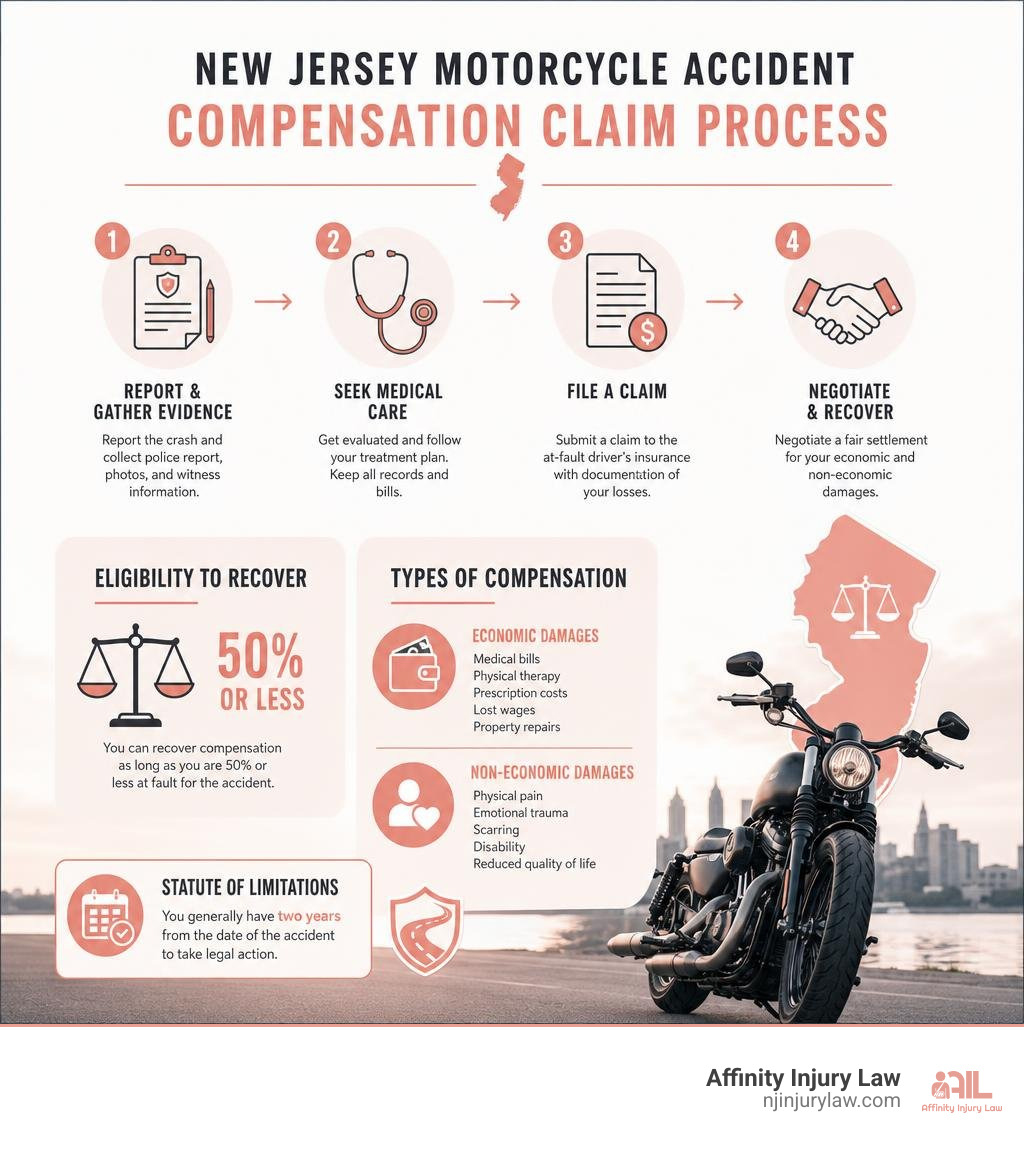
To secure motorcycle accident compensation in New Jersey, you must file a claim against the at-fault driver’s insurance. Because standard Personal Injury Protection (PIP) auto insurance excludes motorcycles in New Jersey, injured riders must pursue the negligent driver directly to cover their financial losses.
You can claim two primary types of compensation:
- Economic damages: All past and future medical bills, physical therapy, prescription costs, lost wages, and property repairs.
- Non-economic damages: Physical pain, emotional trauma, scarring, disability, and reduced quality of life.
Under New Jersey’s modified comparative negligence law, you can recover compensation as long as you are 50% or less at fault for the collision. Your final payout is simply reduced by your share of fault. You generally have two years from the date of the wreck to take legal action under the state’s statute of limitations.
I am Ioana Enescu, Esq., a founding attorney at Affinity Injury Law, and I draw upon my perspective as the daughter of two physicians to help injured riders secure the full motorcycle accident compensation in New Jersey they deserve. In this guide, I will walk you through the state’s insurance loopholes, fault rules, and the exact steps required to maximize your recovery.
Motorcycle accident compensation new jersey terms to remember:
- motorcycle accident settlement new jersey
- motorcycle accidents lawyers new jersey
- new jersey motorcycle settlement lawyer
Types of Damages in Motorcycle Accident Compensation New Jersey Claims

When pursuing compensation after a crash, the law categorizes your losses into two main buckets: economic damages and non-economic damages. Understanding how these are calculated is vital to making sure an insurance company does not shortchange your recovery.
Economic damages account for every quantifiable dollar you lose as a direct result of the crash. This starts with immediate emergency room care, surgeries, intensive care stays, diagnostic imaging, and physical rehabilitation. Knowing how legal help can recover motorcycle crash medical bills allows riders to protect their household finances from aggressive hospital billing departments. Beyond medical expenses, economic losses include the wages you lost while unable to work, diminished future earning capacity if you cannot return to your prior trade, and the cost to repair or replace your motorcycle, helmet, and protective gear.
Non-economic damages, on the other hand, compensate you for the human cost of an accident. These damages do not come with an itemized invoice, but they represent the true disruption to your life. In New Jersey, you can seek recovery for physical pain and suffering, mental anguish, permanent disfigurement or road rash scarring, loss of enjoyment of life, and loss of consortium.
| Damage Category | Description | Common Examples |
|---|---|---|
| Economic Damages | Objective, calculable monetary losses stemming from the collision. | Hospital bills, surgeries, lost income, physical therapy, future medical care, motorcycle repair/replacement. |
| Non-Economic Damages | Subjective, non-monetary losses related to personal suffering and life changes. | Physical pain, emotional distress, PTSD, permanent scarring, loss of physical function, reduced quality of life. |
How Comparative Fault Affects Motorcycle Accident Compensation New Jersey Victims Seek
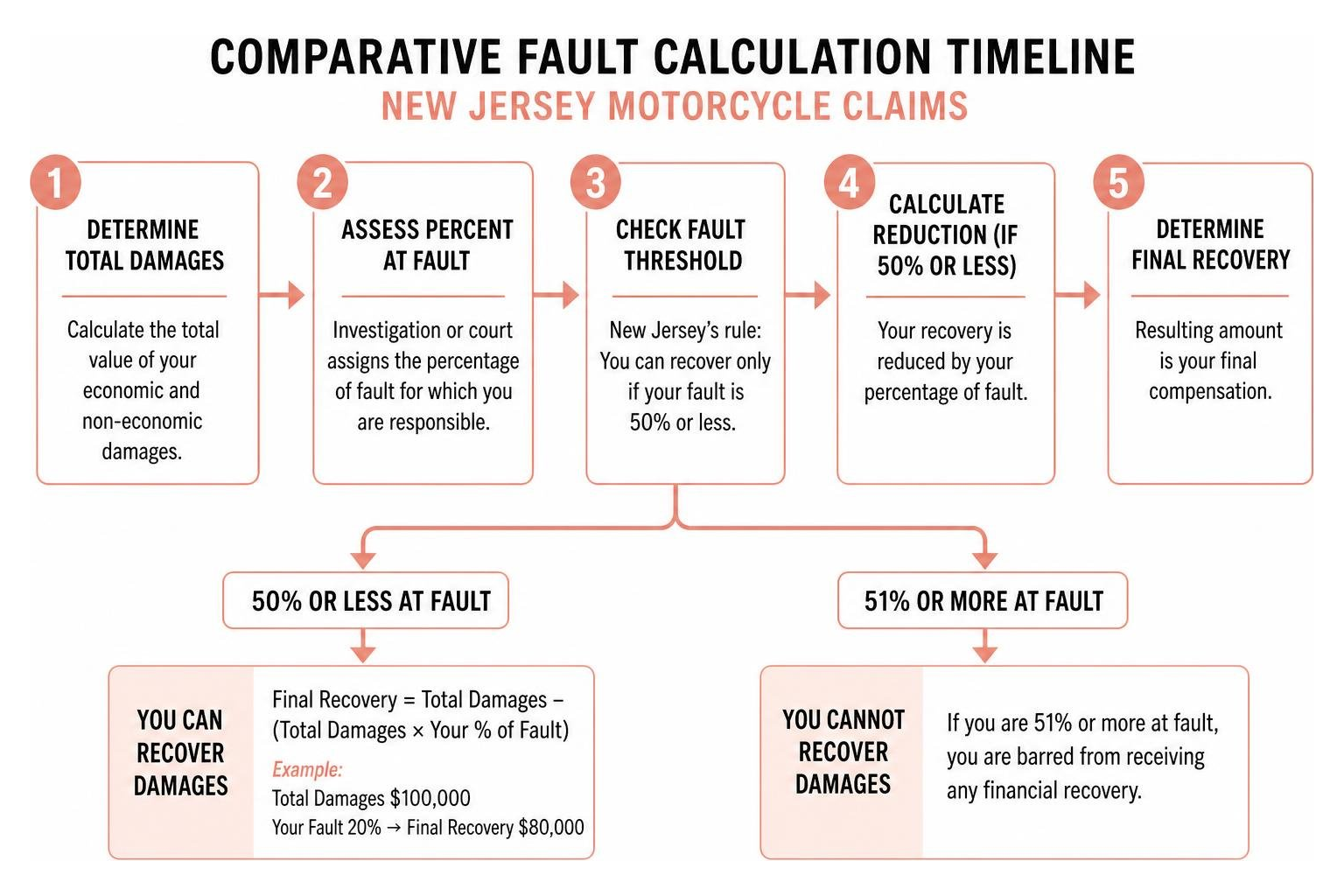
New Jersey operates under a modified comparative negligence system governed by state statute. Under this framework, you can recover damages as long as your share of responsibility is 50% or less. If a court or insurance adjuster determines that you are 51% or more at fault, you are barred from receiving any financial recovery whatsoever.
If your fault is assessed at 50% or lower, your total financial recovery is reduced in direct proportion to your percentage of fault. For example, if your total damages equal $100,000, but an investigation finds you were 20% responsible because of a minor lane position issue, your final payout is reduced by 20%, leaving you with $80,000. Understanding how riders win claims with motorcycle accident lawyers is essential because insurance carriers routinely attempt to inflate a rider’s fault above the 50% threshold to eliminate their payout entirely.
Factors That Maximize Motorcycle Accident Compensation New Jersey Claims
Motorcycle crashes frequently cause catastrophic injuries due to the lack of an enclosed passenger compartment. According to the National Highway Traffic Safety Administration, riders are roughly 28 times more likely to die in a crash per vehicle mile traveled than passenger car occupants. When riders survive, they often sustain severe traumatic brain injuries (TBIs), spinal cord damage resulting in paralysis, severe compound fractures, and internal organ lacerations.
The average settlement for minor soft-tissue injuries in New Jersey typically ranges from $15,000 to $75,000. However, when cases involve catastrophic injuries or permanent disabilities, payouts often exceed $1 million. Maximizing these claims requires identifying all available insurance coverage—including the at-fault driver’s bodily injury policy, commercial umbrella policies, and your own Underinsured Motorist (UIM) coverage. Reviewing the New Jersey motorcycle accident settlement secrets insurance companies hide helps level the playing field when demanding policy-limit payouts.
New Jersey Insurance Rules, PIP Exclusions, and Helmet Laws

New Jersey is widely recognized as a “no-fault” auto insurance state, but motorcycle riders face a unique set of rules. Under standard New Jersey law, the mandatory Personal Injury Protection (PIP) coverage that auto drivers rely on to pay their initial medical bills does not apply to motorcycles.
Because standard auto PIP excludes motorcycles, riders must rely on:
- Optional Motorcycle Medical Payments (MedPay) coverage purchased on their motorcycle policy.
- Private health insurance or Medicaid/Medicare to handle immediate treatment.
- Third-party personal injury claims filed against the negligent driver to recover medical costs and subrogation liens.
Working with experienced personal injury lawyers New Jersey ensures that complex medical liens and insurance subrogation clauses are managed efficiently so that you keep more of your settlement money.
Helmet laws also play a significant legal role. Under N.J.S.A. 39:3-76.7, all motorcycle operators and passengers must wear an approved, properly fitted safety helmet. If you were not wearing a helmet at the time of a collision, the defense will raise the “helmet defense,” arguing that your failure to wear one contributed directly to your head, neck, or facial injuries. While not wearing a helmet does not prevent you from filing a claim, it can reduce your non-economic compensation for head injuries under comparative fault rules.
Determining Fault and Driver Negligence in NJ Motorcycle Crashes
Proving liability in a motorcycle crash requires demonstrating that another driver failed to exercise reasonable care on the road. The vast majority of motorcycle accidents stem from everyday driver negligence, such as:
- Left-turn collisions: Drivers turning left at intersections across the path of an oncoming motorcycle because they misjudged its speed or failed to see it.
- Blind-spot lane changes: Motorists merging into an occupied lane without checking mirrors or blind spots properly.
- Distracted driving: Drivers texting, eating, or using in-car entertainment systems.
- Tailgating and sudden stops: Failing to keep an adequate following distance behind a motorcycle.
Establishing clear liability involves examining police crash reports, obtaining nearby traffic and security camera footage, interviewing eyewitnesses, and downloading electronic data recorder information. When dealing with standard passenger vehicles, our car accidents lawyers New Jersey investigate driver logs and cell phone records to prove distraction. When a collision involves a commercial carrier, our truck accidents lawyers New Jersey evaluate federal safety compliance and driver rest logs to hold trucking companies accountable.
Critical Steps and Deadlines to Protect Your NJ Motorcycle Claim
The steps you take immediately following a crash across Bergen County or Passaic County directly impact your legal outcome:
- Call 911 and Seek Emergency Care: Ensure local police and emergency medical teams arrive. Never refuse medical evaluation, as shock often masks severe internal trauma.
- Collect Scene Evidence: If physically able, photograph vehicle positions, skid marks, road conditions, debris, and visible injuries. Collect witness contact details.
- Obtain the Official Police Report: Ensure the responding officer files a formal accident report documenting the scene.
- Preserve Your Gear and Bike: Do not repair your motorcycle or wash your riding gear; physical evidence helps reconstruct impact angles and force.
- Contact Legal Counsel Before Talking to Insurers: Insurance adjusters frequently seek recorded statements to use against you later.
Riders can check crashing in Bergen County your Lyndhurst NJ motorcycle settlement roadmap to understand how local court jurisdictions and accident reporting operate in North Jersey communities like Hackensack, Paterson, Fort Lee, Paramus, Fair Lawn, Passaic, Clifton, and Wayne.
Under New Jersey statute N.J.S.A. 2A:14-2, the statute of limitations for filing a personal injury lawsuit is two years from the date of the collision. Missing this strict statutory deadline permanently forfeits your right to seek financial recovery in court.
Navigating Complex Settlement Negotiations with Insurers
Insurance carriers often rely on biased stereotypes, trying to paint motorcyclists as reckless daredevils who assume the risk of injury. In reality, state crash data shows that over 1,984 motorcycle crashes occur in New Jersey each year, with driver inattention being the leading factor.
To overcome these insurance settlement tactics, we build comprehensive demand packages backed by medical illustrations, future earnings calculations from economic experts, and clear liability evidence. Partnering with a skilled advocate who can get what you deserve with a top New Jersey motorcycle settlement lawyer ensures insurers take your claim seriously. If you are comparing your legal options, reading the complete guide to hiring motorcycle accident lawyers in New Jersey will help you choose the right legal team for your case.
Frequently Asked Questions About New Jersey Motorcycle Claims
Does New Jersey no-fault PIP coverage apply to motorcycle accidents?
No. Standard New Jersey no-fault Personal Injury Protection (PIP) explicitly excludes motorcycles. To cover your medical treatment, you must use optional Motorcycle Medical Payments (MedPay) coverage, your private health insurance policy, or recover costs directly from the at-fault driver’s insurance.
Can I recover compensation if I was partially at fault for the crash?
Yes. Under New Jersey’s modified comparative negligence law, you can recover compensation as long as your fault is 50% or less. Your total award will simply be reduced by your percentage of fault. If you are determined to be 51% or more at fault, you cannot recover any damages.
What is the deadline for filing a motorcycle accident lawsuit in New Jersey?
Under N.J.S.A. 2A:14-2, the statute of limitations is generally two years from the date of the accident. If your claim involves a public entity or municipality, you must also file a formal Notice of Tort Claim within 90 days of the incident.
Conclusion
A motorcycle crash can change your life in an instant, leaving you with mounting medical bills, lost income, and intense physical rehabilitation. You do not have to fight insurance companies alone while trying to heal.
At Affinity Injury Law, our team represents injured riders across New Jersey on a contingency fee basis—meaning you pay absolutely no upfront fees and nothing out of pocket unless we win your case. We also provide dedicated multilingual support so you can discuss your legal recovery comfortably in your preferred language.
Contact our motorcycle accidents lawyers New Jersey team today for a free, confidential consultation to find out how much your claim is worth.