


How Serious Is a Slip and Fall in New Jersey – And What Can You Do About It?
If you’re looking for slip & fall attorneys in NJ, here’s what you need to know right away:
Quick Answer: What to Do After a Slip and Fall in NJ
- Seek medical attention immediately – even if you feel okay
- Report the accident to the property owner or manager and get a copy of the incident report
- Document the scene – photograph the hazard before it is cleaned up or repaired
- Collect witness information – names and phone numbers of anyone who saw the fall
- Preserve your clothing and shoes – do not wash them; they are physical evidence
- Contact a slip and fall attorney before speaking to any insurance company
Most people brush off a slip and fall as an embarrassing moment. But the numbers tell a very different story.
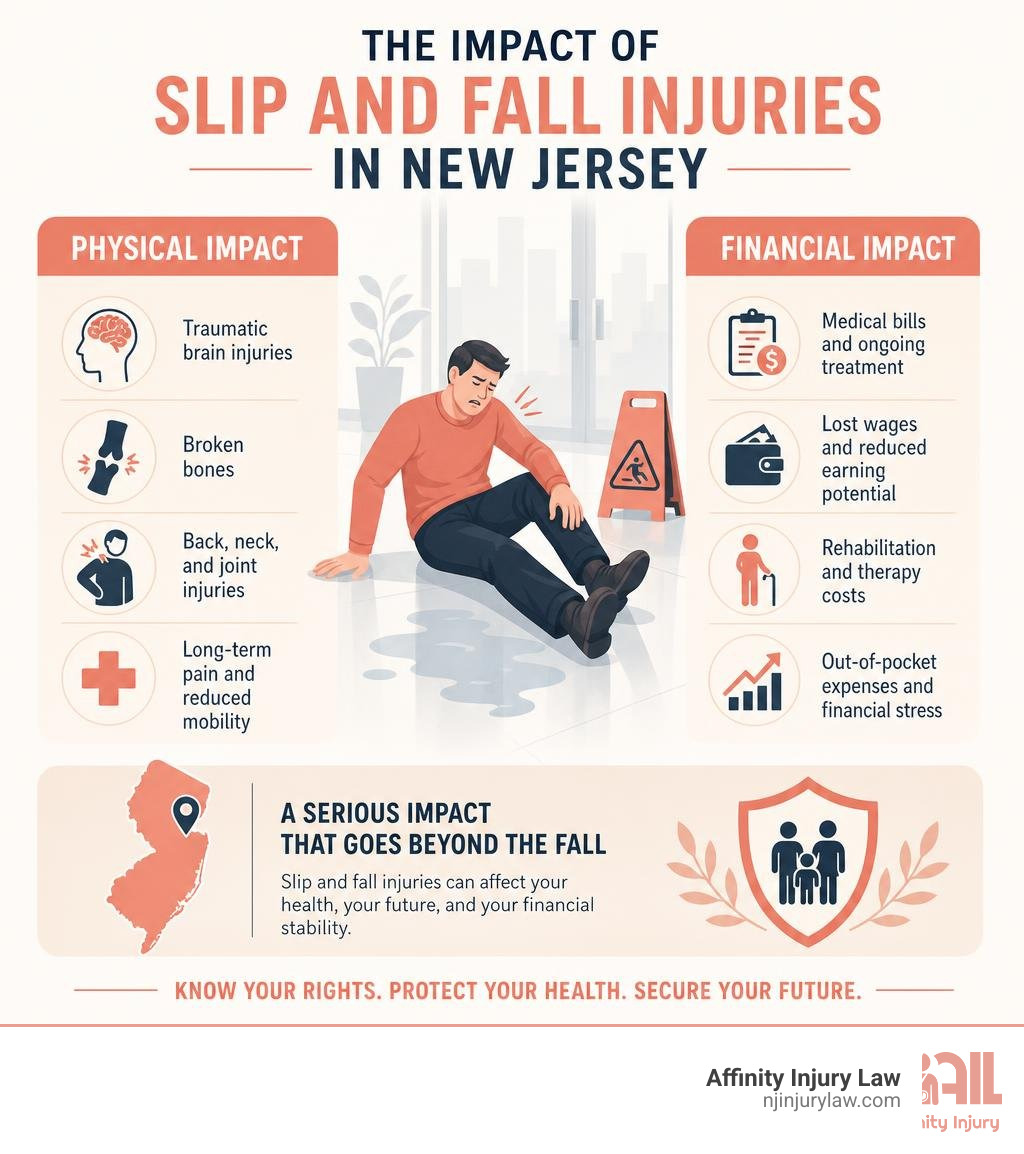
Slip and fall accidents happen more than 900 times per hour across the United States – every single day. More than 8 million people end up in the emergency room each year because of fall injuries. One in five falls results in something serious: broken bones, a head injury, or worse. For national fall injury and prevention data, the Centers for Disease Control and Prevention maintains public resources on how falls affect injury victims and families.
These are not minor incidents. Falls are the leading cause of traumatic brain injuries – surpassing even car accidents. More than 95% of all hip fractures are caused by falls. Over 800,000 people are hospitalized from fall injuries every year.
And beyond the physical pain, there is a real financial toll: medical bills, missed work, rehabilitation costs, and pressure from insurance companies to settle fast – and cheap.
That combination – physical injury, financial stress, and legal complexity – is exactly why having the right legal help matters.
I’m Ioana Enescu, Esq., a founding member of Affinity Injury Law and a New Jersey native with a background in advocating fiercely for injured clients – including those navigating complex slip & fall attorney in NJ claims across Bergen County, Passaic County, and beyond. As the daughter of two physicians and a multilingual advocate, I understand both the medical and legal sides of what you’re going through, and I’m here to walk you through everything you need to know.
New Jersey Premises Liability: Understanding Your Rights After a Fall
When you slip, trip, or step into a hazard and fall on someone else’s property, your legal case falls under a branch of civil law known as premises liability. In New Jersey, premises liability is not simply about “having an accident.” It is about whether the person or entity responsible for that property failed to keep you safe from a preventable hazard.
Under New Jersey premises liability law, property owners, business operators, and managers have a legal “duty of care” to maintain their premises in a reasonably safe condition for visitors. However, this duty is not uniform. The level of care a property owner owes you depends entirely on your legal status as a visitor at the time of your fall.
To determine this duty, New Jersey courts look to the landmark Supreme Court case Hopkins v. Fox & Lazo Realtors, 132 N.J. 426 (1993). This ruling established that a court must weigh the relationship of the parties, the nature of the risk, the opportunity and ability to exercise care, and the public interest in safety. If you want to learn more about how these duties are applied, our comprehensive guide on Premises Liability Lawyers New Jersey breaks down these foundational principles in detail.
Visitor Classifications: Invitees, Licensees, and Trespassers
To evaluate whether you have a viable claim, we must first look at why you were on the property. New Jersey law divides visitors into three distinct legal classifications, each carrying a different level of legal protection:
| Visitor Classification | Definition / Example | Property Owner’s Duty of Care |
|---|---|---|
| Invitee | A business customer (e.g., a shopper in a Lyndhurst supermarket) or a public visitor. | Highest Duty: Must actively inspect the property, repair hazards, and warn of hidden dangers they know of or should know of. |
| Licensee | A social guest (e.g., a friend visiting your home in Bergen County for a barbecue). | Moderate Duty: Must warn of known, hidden dangers, but does not have an active duty to inspect for unknown hazards. |
| Trespasser | Someone on the property without permission or legal right. | Lowest Duty: Generally, no duty of care except to refrain from causing intentional harm or setting traps. |
An important exception to the trespasser rule is the attractive nuisance doctrine. This doctrine holds property owners liable for injuries to child trespassers if the child was drawn onto the property by an unsecured, dangerous feature that naturally appeals to children—such as an unfenced swimming pool, an open trampoline, or abandoned machinery.
Actual vs. Constructive Notice and the Mode of Operation Rule
To win a slip and fall case, you must generally prove that the property owner had “notice” of the dangerous condition before your fall. Notice can be established in two ways:
- Actual Notice: The owner or employees knew about the hazard. For example, a customer reported a spilled soda in a retail aisle, or an employee spilled it themselves but left it uncleaned.
- Constructive Notice: The hazard existed for such a length of time that the owner should have discovered and remedied it through reasonable, routine inspections. For instance, if a liquid spill sat in a supermarket aisle for three hours without being mopped, the business has constructive notice.
However, New Jersey law offers a powerful tool for plaintiffs known as the mode of operation rule. If a business’s self-service model inherently creates a risk of recurring hazards, the plaintiff does not have to prove the owner had prior notice of the specific spill.
For example, in a grocery store produce section where customers bag their own loose grapes, or at a fast-food drink station where customers fill their own cups, spills are highly foreseeable. Under the mode of operation rule, the law grants an inference of negligence, shifting the burden of proof to the business to show they took extraordinary, reasonable safety measures to prevent accidents. You can read more about how this rule shifts the legal playing field in The Ultimate Guide to Premises Liability Lawyer.
Common Causes, Locations, and Serious Injuries
Slip and fall accidents in Northern New Jersey are rarely “just accidents.” They are usually the direct result of neglected maintenance. Some of the most common hazards we see in our practice include:
- Environmental and Weather Hazards: Melted snow and ice that refreezes into invisible black ice, especially during New Jersey’s winter freeze-thaw cycles.
- Interior Slippery Surfaces: Wet floors from mopping or tracked-in rain, liquid spills in grocery store aisles, or slick wax treatments on commercial tile.
- Structural Defects: Damaged flooring, loose carpets, uneven walkways, crumbling concrete stairs, and broken or missing handrails.
- Poor Lighting: Burnt-out lightbulbs in stairwells, parking lots, or hallways, making it impossible to see upcoming hazards.
These hazards are most commonly found in commercial retail stores, supermarkets, apartment complexes, and public parking lots throughout Bergen and Passaic Counties. When accessibility infrastructure fails—such as when a handicap ramp is improperly designed or maintained—the results can be devastating. For those injured in these specific scenarios, consulting a specialized Bergen County slip and fall lawyer or reviewing our guide on When Accessibility Fails How a Handicap Ramp Fall Lawyer Can Help can provide critical clarity.
The physical injuries resulting from these falls are frequently severe. Beyond painful soft tissue damage, such as torn ligaments and severe sprains, victims often suffer life-altering traumatic brain injuries (TBIs), spinal cord damage, and complex bone fractures.
Proving Negligence and Recovering Damages Under NJ Law
To secure financial recovery, you cannot simply state that you fell and got hurt. You must build a legally sound case proving that the property owner’s negligence directly caused your injuries. Partnering with dedicated Premises Liability Law Firms Holding Negligent Property Owners Accountable is often the most effective way to establish these complex legal elements.
Proving Negligence and Establishing Liability
Proving negligence in a slip and fall claim requires establishing four key legal elements:
- Duty of Care: The defendant had a legal obligation to keep the property safe for you based on your visitor classification.
- Breach of Duty: The defendant breached that duty by failing to repair, clean up, or warn you about a dangerous condition.
- Causation: The dangerous condition was the direct cause of your slip, trip, or fall.
- Damages: You suffered actual physical injuries and financial losses as a result.
Pinpointing the exact liable party can be complicated. Depending on the circumstances, liability may rest on the property owner, a business tenant renting the space, a property management company, or even a third-party snow removal contractor who failed to clear ice according to their contract.

To prove liability, we must gather and preserve time-sensitive evidence, including commercial surveillance footage, internal sweep logs, maintenance records, and weather reports. If you were injured in Passaic County, a localized Passaic County slip and fall lawyer can assist in immediately subpoenaing this critical evidence before it is erased or overwritten.
Comparative Negligence: What If You Are Partially at Fault?
It is incredibly common for property owners and insurance adjusters to try to shift the blame onto you. They may argue that you were distracted by your phone, wearing inappropriate footwear, or walking in an area clearly marked with a warning sign.
Fortunately, New Jersey follows a modified comparative negligence system (specifically, the 50% bar rule). Under this law, you can still recover financial compensation as long as your share of responsibility for the accident is 50% or less.
However, your final financial recovery will be reduced by your percentage of fault. For example, if a jury determines your total damages are $100,000, but finds you were 20% at fault because you were looking at your phone, your final award will be reduced by 20%, leaving you with $80,000. If your fault is found to be 51% or higher, you are legally barred from recovering any compensation at all.
Types of Compensation and Recoverable Damages
When we file a personal injury claim on your behalf, we pursue two primary categories of compensatory damages to cover your losses:
- Economic Damages (Objective Financial Losses): These include all medical bills, emergency room costs, surgical fees, physical therapy expenses, prescription medications, and lost wages from missed work. If your injuries prevent you from returning to your job, we also pursue compensation for your reduced future earning capacity.
- Non-Economic Damages (Subjective, Non-Monetary Losses): These cover your physical pain and suffering, emotional distress, mental anguish, loss of enjoyment of life, and permanent scarring or disfigurement. In the most tragic cases where a fall leads to fatal injuries, we help families pursue wrongful death claims to cover funeral expenses and loss of financial support.
To learn more about maximizing your financial recovery across these categories, consult our guide on Personal Injury Lawyers New Jersey.
Step-by-Step Guide: What to Do After a Slip and Fall in NJ
The actions you take in the minutes, hours, and days following a slip and fall accident will heavily influence the success of your legal claim. Insurance companies are businesses, and their adjusters are trained to find reasons to deny or minimize your claim. To protect your rights, follow this step-by-step guide.
Immediate Steps to Take at the Scene
- Seek Medical Attention Immediately: Your health is the absolute priority. Go to an urgent care or emergency room right away, even if you think your injuries are minor. Adrenaline can mask severe pain, and delaying medical care creates a gap in treatment that insurance companies will use to claim your injuries were not caused by the fall.
- Report the Incident: Alert the store manager, landlord, or property owner immediately. Ask them to fill out an official incident report. Request a physical or digital copy of this report before you leave, but do not sign any statements admitting fault or downplaying your pain.
- Document the Hazard: Take clear, close-up photographs and videos of the exact hazard that caused you to fall (e.g., the patch of ice, the puddle of liquid, the broken step). Take wider shots to show the lack of warning signs and the surrounding lighting.
- Identify Witnesses: Gather the names, addresses, and phone numbers of any bystanders who saw you fall or noticed the hazard before your accident. Their neutral testimony is invaluable.
- Preserve Your Clothing and Footwear: Place the shoes and clothes you were wearing at the time of the fall into a plastic bag. Do not wash or wear them again. They serve as critical physical evidence to prove your footwear was safe and to show any residue from the hazard.
For a deeper dive into preserving your case’s value, check out our guide on How to Document Your Slip Fall Accident for Max Comp.
Navigating Insurance Companies and Avoiding Costly Mistakes
Dealing with insurance adjusters can be a minefield. Adjusters may call you shortly after the accident, acting warm and sympathetic. Do not be fooled: this is often a tactic to get you to make recorded statements that can be twisted to blame you for the fall.
Never accept a quick, lump-sum settlement offer without consulting an attorney. These initial offers are almost always a fraction of what your case is actually worth, designed to get you to sign away your right to sue before the full extent of your medical needs is known.
Additionally, avoid posting anything about your accident, your recovery, or your daily activities on social media. Insurance defense teams actively monitor these profiles to find photos or posts they can use out of context to argue that you are not as injured as you claim. To avoid these traps, read our breakdown of the 5 Mistakes That Can Hurt Your Personal Injury Claim in New Jersey.
NJ Statute of Limitations and the Tort Claims Act
In New Jersey, you do not have unlimited time to file a lawsuit. The state imposes strict deadlines that vary depending on where your accident occurred:
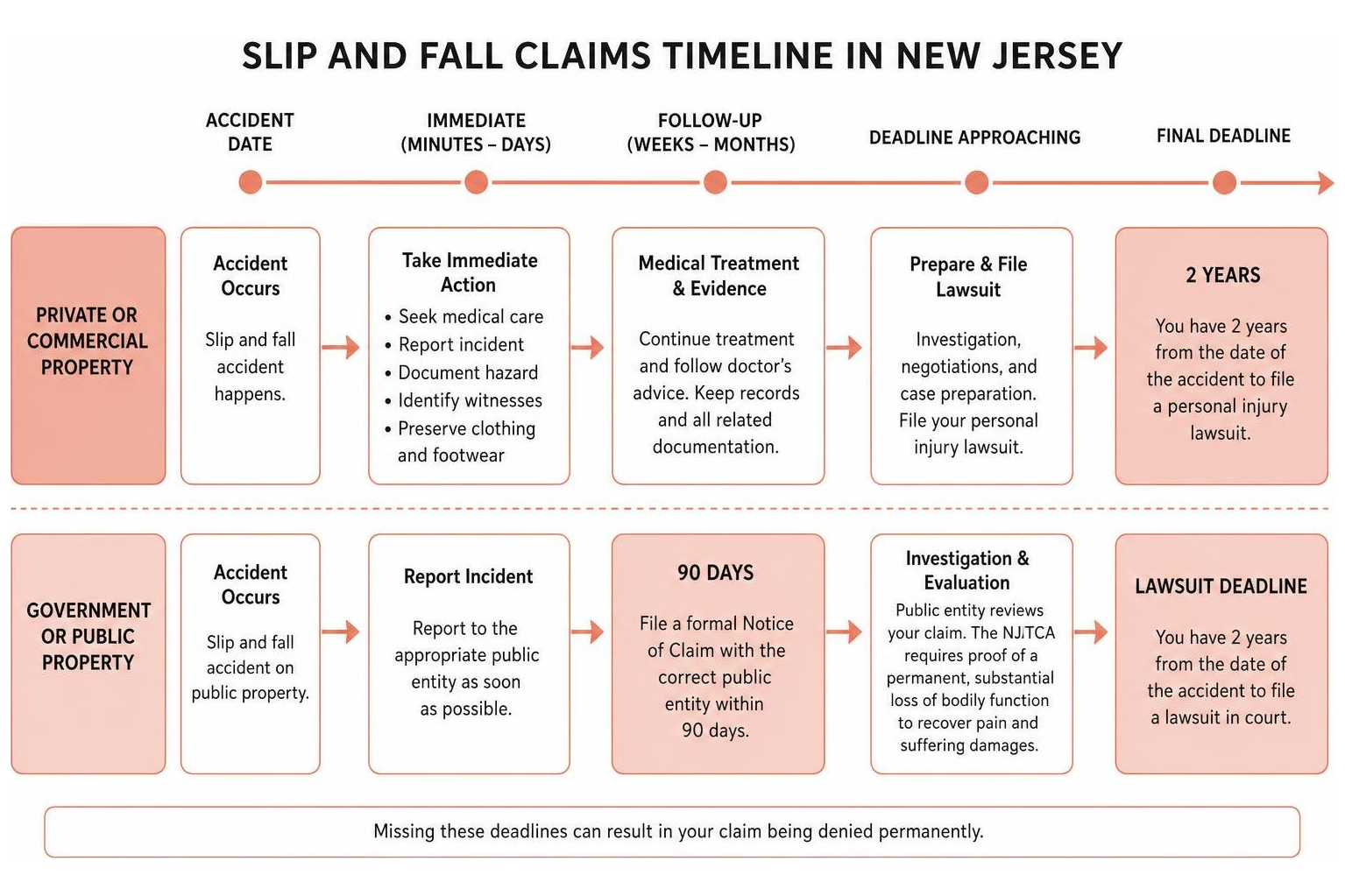
- Private or Commercial Property: Under standard New Jersey law, you have two years from the date of the slip and fall accident to file a personal injury lawsuit. If you miss this deadline, your case will be dismissed permanently.
- Government or Public Property: If you fall on public property—such as a municipal sidewalk in Lyndhurst, a county park, or a state government building—the rules change drastically under the New Jersey Tort Claims Act (NJTCA). You must file a formal Notice of Claim with the correct public entity within 90 days of the accident. Furthermore, the NJTCA imposes a high threshold, requiring proof of a permanent, substantial loss of bodily function to recover pain and suffering damages.
Whether you need a Bergen County slip and fall lawyer or a Passaic County NJ personal injury law firm to handle these tight deadlines, acting quickly is paramount.
How to Choose the Best slip & fall attorneys nj
Premises liability cases are notoriously difficult to win. Property owners will quickly clean up the hazard, and insurance companies will fight tooth and nail to avoid paying. To secure the compensation you deserve, you need experienced slip & fall attorneys in NJ who know how to navigate the local court systems.
Key Qualities to Look for in slip & fall attorneys nj
When searching for the right legal team to represent you in Bergen County, Passaic County, or Lyndhurst, look for these essential qualifications:
- Civil Trial Certification: Look for attorneys certified by the Supreme Court of New Jersey as Civil Trial Attorneys—a prestigious distinction held by only a tiny fraction of active lawyers in the state, indicating extensive courtroom and trial experience.
- A Contingency Fee Structure: You should never have to pay upfront out-of-pocket costs to get justice. A reputable firm works on a “no-fee-unless-you-win” basis, meaning they only collect a percentage of your final settlement or verdict.
- Local Geographic Expertise: An attorney familiar with local municipal codes, court clerks, and local defense firms in places like Lyndhurst, NJ, will have a distinct advantage. If you are looking for localized representation, consulting a Lyndhurst NJ personal injury lawyer or specialized slip and fall attorneys in Lyndhurst, NJ can help protect your rights.
Why You Need Specialized slip & fall attorneys nj
Building a winning premises liability case requires more than just legal knowledge. It requires resources. A specialized personal injury firm will have a network of trusted expert witnesses to deploy on your behalf.
In winter slip and fall cases, we regularly hire forensic meteorologists to analyze historical weather data to prove when ice formed and whether the property owner had sufficient time to clear it under local ordinances. We also work with drainage engineers to prove that poorly designed downspouts caused melting snow to pool and refreeze into dangerous black ice. This level of thorough preparation is why finding top-rated New Jersey slip and fall lawyers is so critical to your success.
Frequently Asked Questions About NJ Slip and Fall Claims
How much does it cost to hire a slip and fall lawyer in New Jersey?
At Affinity Injury Law, we operate on a strict contingency fee basis. This means there are absolutely no upfront, out-of-pocket costs to hire us. We cover all the expenses of investigating your claim, hiring experts, and filing court documents. We only get paid if we successfully recover a settlement or jury verdict for you. If we do not win your case, you owe us nothing.
Can I sue if I slipped on ice or snow on a residential sidewalk?
In New Jersey, the rules for snow and ice removal differ significantly between commercial and residential properties. Commercial property owners have an absolute duty to clear public sidewalks abutting their property.
However, residential homeowners are generally exempt from liability for natural accumulations of snow and ice on public sidewalks, unless their active, negligent clearing efforts made the sidewalk more dangerous than it was naturally (such as piling snow in a way that melts and refreezes into black ice). Local municipal ordinances in towns like Lyndhurst may fine homeowners for failing to shovel, but these ordinances rarely create civil liability for a slip and fall unless active negligence is proven.
What is the average settlement for a slip and fall case in NJ?
There is no “average” settlement because every case is highly unique. The value of your claim depends on several critical factors: the severity and permanency of your physical injuries, the total cost of your past and future medical treatments, the amount of wages you lost, the clarity of liability (how obvious the owner’s negligence was), and whether you shared any fault under comparative negligence laws. A minor sprain may settle for a few thousand dollars, while a traumatic brain injury or a complex fracture requiring surgery can result in a six- or seven-figure recovery.
Conclusion
A slip and fall accident can disrupt your life in an instant, leaving you with physical pain, mounting bills, and immense stress. But you do not have to navigate this complex legal journey alone.
At Affinity Injury Law (NJ Injury Law), we are committed to holding negligent property owners accountable and securing the maximum compensation you deserve. With deep roots in Bergen County, Passaic County, and Lyndhurst, NJ, we understand the local courts, the local laws, and—most importantly—the communities we serve.
Our key differentiator is our multilingual support, ensuring that language barriers never stand in the way of your access to justice. We offer compassionate, aggressive representation with no upfront fees, and we stand by our promise: no fee unless we win your case.
If you or a loved one has been injured, let us fight the insurance companies while you focus on healing. Contact Us or visit our main hub for Slip and Fall Lawyers New Jersey to schedule your free, no-obligation case evaluation today.