


When You’re Hurt on Someone Else’s Property, You Have Rights
A premises liability lawyer helps injured people hold negligent property owners accountable when unsafe conditions cause harm.
Here’s what you need to know right away:
- You may have a claim if you were hurt on someone else’s property due to a hazard the owner knew about — or should have known about
- You pay nothing upfront — most premises liability attorneys work on contingency, meaning no fees unless you win
- Time is limited — New Jersey gives you two years from the date of injury to file a claim
- You don’t have to talk to insurers alone — an attorney can handle all communication on your behalf
- Compensation can include medical bills, lost wages, pain and suffering, and more
Every day, people are injured on property that should have been safe — a wet grocery store floor, a broken apartment staircase, a poorly lit parking lot. The injuries can be serious. The medical bills pile up fast. And insurance companies don’t always make it easy to get what you’re owed.
New Jersey law requires property owners to maintain reasonably safe conditions for visitors. When they fail to do that, you have the right to seek compensation.
But these cases are rarely simple. Property owners and their insurers fight back. Evidence disappears quickly. And the legal rules around proving negligence are specific and unforgiving.
That’s why getting the right legal guidance — fast — matters so much.
I’m Ioana Enescu, Esq., a founding member of Affinity Injury Law and a New Jersey native with extensive experience representing injured clients in premises liability cases across the state. As the daughter of two physicians, I understand how serious injuries affect your health, your finances, and your family — and I’m committed to fighting for the full compensation you deserve.
What Is Premises Liability and How Does It Apply to Property Owners?
At its core, premises liability is a legal concept that holds property owners, occupiers, and managers legally responsible for injuries that occur on their property due to an unsafe or defective condition. But simply getting hurt on someone else’s land doesn’t automatically mean they have to pay you. If you trip over your own shoelaces in a perfectly maintained retail store, that is on you.

Under the legal standards of premises liability in New Jersey, property owners must exercise a reasonable standard of care to keep their property safe. However, the exact “duty of care” they owe you depends largely on why you were on the property in the first place. Traditionally, New Jersey law divides property visitors into three distinct classifications:
- Invitees: These are visitors invited onto the property for the financial benefit of the owner (like a grocery store shopper, a hotel guest, or a restaurant patron) or as members of the public for a purpose for which the land is open. Property owners owe the highest duty of care to invitees. They must actively inspect the property to discover hidden dangers, make timely repairs, and warn visitors of any hazards.
- Licensees: These are social guests who enter the property with permission for non-business purposes (like a friend coming over for a backyard barbecue). For licensees, the owner must warn of any known, hidden dangerous conditions that the guest is unlikely to discover on their own. However, the owner is generally not obligated to actively inspect the premises for unknown defects.
- Trespassers: These are individuals who enter a property without permission. Generally, property owners owe no duty to trespassers other than to refrain from willfully or wantonly creating hazards to injure them. An exception exists for children under the “attractive nuisance” doctrine, which holds owners liable if an artificial condition (like an unsecured swimming pool) attracts children who do not understand the danger.
It is worth noting that New Jersey premises liability law is dynamic. In the landmark case Hopkins v. Fox & Lazo Realtors, the New Jersey Supreme Court shifted the focus from rigid visitor classifications to a broader standard of basic fairness and public policy. While these three categories still strongly guide our courts, judges will also look at the relationship between the parties, the opportunity and ability to exercise care, and the public interest in safety when determining if a property owner was negligent.
If you have been injured, consulting our dedicated team at Premises Liability Lawyers New Jersey is the best way to determine which standards apply to your specific situation.
Common Types of Accidents and Injuries
Negligence on commercial and residential properties can manifest in dozens of ways. Over our years of practice in Passaic County, Bergen County, and across northern New Jersey, we have represented clients facing a wide array of accidents, including:
- Slip and Fall Accidents: Slipped on tracked-in rainwater, spilled liquids, or freshly waxed floors without warning signs.
- Trip and Fall Accidents: Tripped on cracked sidewalks, torn carpeting, uneven pavement, or unexpected floor transitions.
- Negligent Security: Assaults, robberies, or physical attacks occurring in parking garages, apartment complexes, or shopping centers because the owner failed to provide working locks, security guards, or proper gate control.
- Inadequate Lighting: Dimly lit stairwells, parking lots, and walkways that hide structural hazards and invite criminal activity.
- Broken Stairs and Handrails: Loose structural railings, crumbling concrete steps, or uneven wooden risers.
- Dog Bites: Attacks by unrestrained pets on private or public property.
The physical toll of these accidents is rarely minor. While some victims walk away with bruises and sprains, others suffer life-altering, catastrophic injuries. We frequently see clients dealing with traumatic brain injuries (TBIs) from hitting their heads on hard tile floors, severe spinal cord damage resulting in partial or full paralysis, shattered hips, and complex bone fractures. If you are dealing with the aftermath of a fall, working with specialized Slip and Fall Lawyers New Jersey is crucial. Our team also emphasizes how critical early medical and legal intervention is for these severe injury types.
Proving Negligence: What You Must Prove to Win Your Claim
In any personal injury lawsuit, the burden of proof rests entirely on the injured victim (the plaintiff). To secure a successful settlement or verdict in New Jersey, your premises liability lawyer must establish four key elements of negligence:

- Duty of Care: You must prove that the defendant owned, occupied, or controlled the property and owed you a legal duty of care based on your status as a visitor.
- Breach of Duty: You must demonstrate that the property owner breached that duty by failing to maintain the property in a reasonably safe condition or failing to warn you of an existing hazard.
- Causation: You must show a direct link between the owner’s breach of duty and your accident. In other words, you wouldn’t have been hurt if the hazard hadn’t been there.
- Actual Damages: You must prove that you suffered real, quantifiable losses as a result of your injuries, such as medical bills, lost wages, and pain and suffering.
Establishing liability in New Jersey requires collecting concrete evidence before it is altered or destroyed. This means obtaining surveillance footage, securing internal maintenance logs, interviewing employees, and analyzing building code compliance. If you were injured in places like Hackensack or Paramus, consulting an experienced premises liability lawyer can help you quickly gather local evidence before the property owner cleans up the scene.
Proving Constructive Knowledge Under Florida Statute § 768.0755
Property owners often defend themselves by claiming, “We had no idea that hazard existed! How could we fix something we didn’t know about?”
To defeat this defense, your lawyer must prove the owner had either actual notice (they knew about the hazard because they created it or someone reported it) or constructive notice (the hazard existed for such a length of time that they should have discovered and remedied it if they were performing reasonable inspections).
For comparison, let’s look at how other states handle this. In Florida, commercial slip-and-fall claims are strictly governed by Florida Statute § 768.0755. This statute places a heavy burden on the injured victim to prove that the business had actual or constructive knowledge of a “transitory foreign substance” (like spilled milk or a squished grape). Under Florida law, constructive knowledge must be proven by showing that:
- The dangerous condition existed for such a length of time that, in the exercise of ordinary care, the business establishment should have known of the condition; or
- The condition occurred with regularity and was therefore foreseeable.
In New Jersey, we do not have an identical single statutory hurdle, but our common law constructive notice requirements are just as rigorous. However, New Jersey plaintiffs have a powerful legal tool that Florida plaintiffs do not: the “Mode of Operation” doctrine.
Under New Jersey’s mode of operation rule, if a business’s self-service model makes it highly predictable that hazards will occur (such as customers dropping loose items in a grocery store produce aisle, or spilling drinks at a self-serve soda station), the injured victim is relieved of the burden of proving the owner had notice of the specific slip hazard. Instead, the burden shifts to the business to prove they took reasonable steps to prevent such accidents.
Whether you are dealing with a standard constructive notice claim or a mode-of-operation scenario, having an attorney who understands how to dissect maintenance logs, review sweep sheets, and analyze surveillance footage is the difference between a dismissed claim and a maximum recovery.
How Comparative Negligence and Statutes of Limitations Affect Your Case
When you file a premises liability claim, the property owner’s insurance company will almost certainly try to point the finger back at you. They will claim you weren’t looking where you were walking, you were distracted by your phone, or you ignored a warning sign.
How these arguments affect your compensation depends heavily on the comparative negligence laws of the state where your accident occurred.
| Legal Standard / Rule | New Jersey | Florida |
|---|---|---|
| Negligence Standard | Modified Comparative Negligence | Modified Comparative Negligence |
| Bar Rule | 51% Bar Rule (You can recover damages if you are 50% or less at fault. If you are 51% or more at fault, you get nothing.) | 51% Bar Rule (As of 2023, Florida changed from pure comparative to a 51% modified bar, matching NJ’s threshold.) |
| Statute of Limitations | 2 Years from the date of the accident. | 2 Years from the date of the accident (Shortened from 4 years in 2023). |
| Notice for Government Claims | Tort Claims Act Notice must be filed within 90 days. | Written notice of claim must be filed within 3 years (6 months for certain local entities). |
Under New Jersey’s modified comparative negligence standard (the 51% bar rule), you can still recover compensation even if you were partially to blame for your own fall. However, your financial recovery will be reduced by your percentage of fault. For example, if a jury determines your total damages are $100,000, but finds you were 20% at fault because you were texting while walking, your final award will be reduced to $80,000. If your share of fault is deemed to be 51% or higher, you are entirely barred from recovering any compensation.
To protect yourself from these defense tactics, avoid making the mistakes outlined in 5 Mistakes That Can Hurt Your Personal Injury Claim in New Jersey.
Statute of Limitations for Filing a Claim
As of June 2026, the strict legal deadlines for filing a lawsuit are clear and unyielding. In New Jersey, the statute of limitations for a premises liability claim is two years from the date the injury occurred. If you miss this window, the court will almost certainly dismiss your case, and you will lose your right to seek compensation forever. For general information about civil court matters in the state, the New Jersey Courts provide public resources, but injury victims should speak with an attorney about the specific deadline that applies to their case.
However, if your injury occurred on government-owned property — such as a public school, a county park, or a municipal building in Passaic County — the rules are vastly different. Under the New Jersey Tort Claims Act, you must file a formal written Notice of Claim with the correct public entity within 90 days of the accident. Failure to do so will bar you from pursuing your claim, regardless of how severely you were injured.
Furthermore, claims against public entities are subject to sovereign immunity caps and higher standards of proof. If you are navigating a claim against a public or private entity in Passaic County, working with experienced premises liability lawyers can ensure you meet all critical statutory deadlines.
Why You Need an Experienced Premises Liability Lawyer
Insurance companies are not in the business of paying out fair settlements. They are multi-billion-dollar corporations focused on protecting their bottom line. If you attempt to handle a premises liability claim on your own, you will face a team of corporate adjusters and defense lawyers whose sole job is to minimize your injuries or deny your claim entirely.
An experienced premises liability lawyer levels the playing field. When we take on your case, we immediately step in to:
- Investigate the Scene: We send investigators to take high-resolution photographs, measure dimensions, test surface traction, and preserve physical evidence before it is repaired.
- Secure Crucial Evidence: We draft formal spoliation letters demanding that property owners preserve all CCTV camera footage, internal email communications, and cleaning logs.
- Consult Expert Witnesses: We work with architectural engineers, lighting experts, and medical professionals who can testify about building code violations, visibility issues, and the exact mechanics of your injuries.
- Handle All Communications: We shield you from predatory insurance adjusters trying to trick you into giving a recorded statement that could damage your case.
By working with us at Premises Liability Lawyers New Jersey, you can focus entirely on your physical recovery while we handle the complex legal battle.
How Much Does a Premises Liability Lawyer Cost?
Many injury victims hesitate to contact an attorney because they are worried about high legal fees. At Affinity Injury Law, we believe that everyone deserves access to top-tier legal representation, regardless of their financial situation.
That is why we operate on a contingency fee structure.
Under this arrangement:
- Your initial consultation is 100% free.
- You pay absolutely zero upfront costs.
- We cover all litigation expenses (including filing fees, expert witness costs, and medical record retrieval fees).
- We only get paid if we win your case. Our fee is a pre-agreed percentage of your final settlement or jury verdict. If we do not recover money for you, you owe us nothing.
Trying to handle these claims alone often leads to the costly errors highlighted in Common Mistakes Without Accident Injury Lawyers. With our “no-fee-unless-they-win” model, there is zero financial risk in getting professional legal help.
What Damages Can a Premises Liability Lawyer Recover?
Our primary goal is to secure the maximum compensation available under New Jersey law to help you rebuild your life. The damages we can recover for you fall into three main categories:
Economic Damages (Tangible Losses):
- Medical Bills: Emergency room visits, surgeries, hospital stays, physical therapy, medications, and any estimated future medical treatments.
- Lost Wages: Income you lost while taking time off work to heal.
- Lost Earning Capacity: If your injuries prevent you from returning to your previous line of work, we calculate your lifetime lost earning potential.
Non-Economic Damages (Intangible Losses):
- Pain and Suffering: Compensation for the physical agony and discomfort caused by your injuries.
- Emotional Distress: Anxiety, depression, PTSD, or sleep disturbances resulting from the trauma of the accident.
- Loss of Enjoyment of Life: If you can no longer participate in hobbies, sports, or family activities you once loved.
Punitive Damages:
- In rare cases where a property owner’s conduct was exceptionally reckless or malicious, a court may award punitive damages to punish the wrongdoer and deter similar behavior in the future.
To understand how we build these high-value claims, read more about Premises Liability Law Firms Holding Negligent Property Owners Accountable.
Frequently Asked Questions About Premises Liability Claims
What should I do immediately after being injured on someone else’s property?
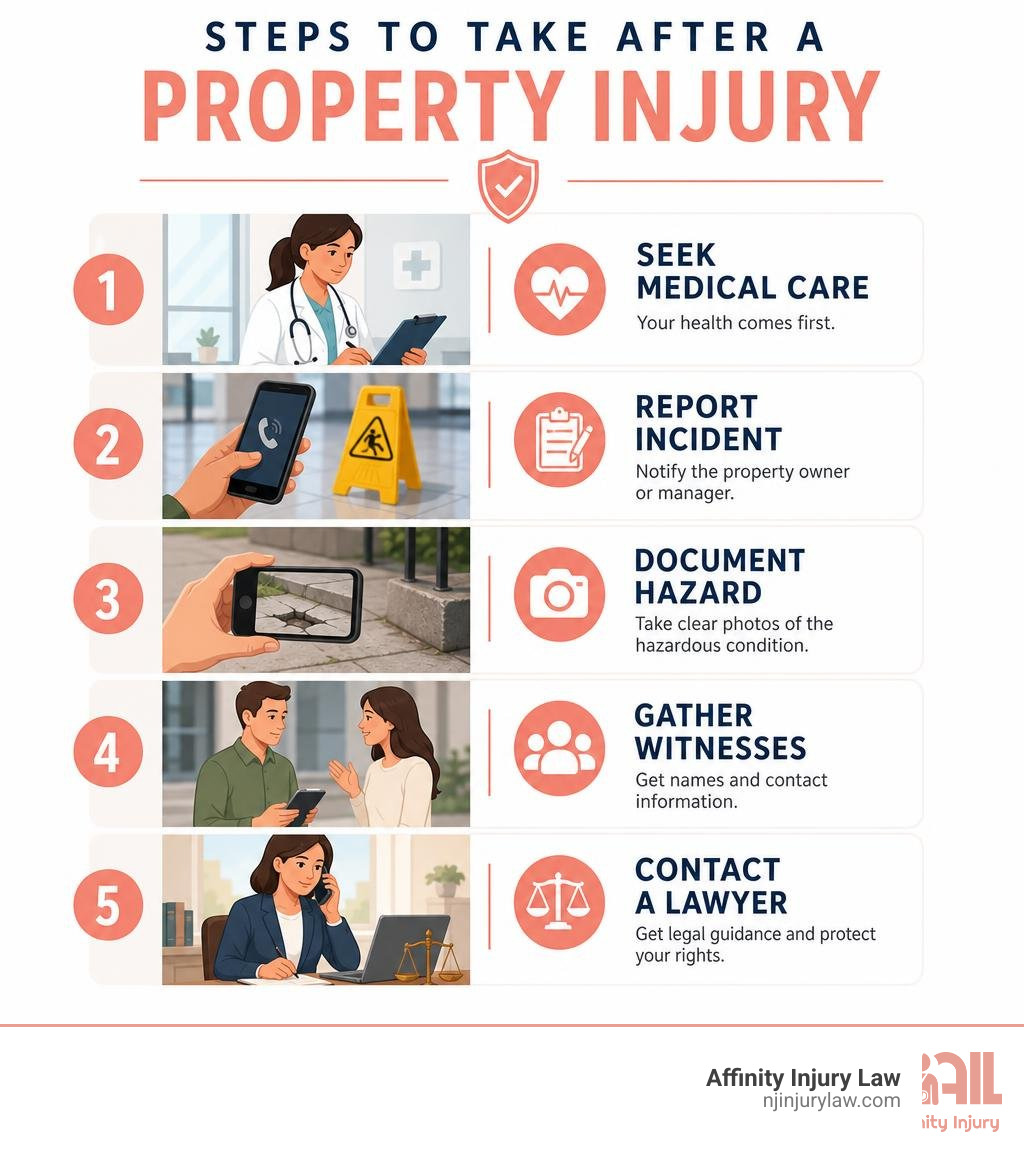
Your actions in the minutes and hours following an accident can make or break your legal claim. If you are hurt, take these steps immediately:
- Seek Medical Attention: Your health is the number one priority. Go to an emergency room or urgent care right away. This also creates an official, immediate medical record linking your injuries to the accident.
- Report the Incident: Notify the property owner, store manager, or landlord. Request that they fill out an official incident report, and make sure you get a copy.
- Photograph the Hazard: Take clear photos and videos of the dangerous condition (the spill, the ice, the broken step) from multiple angles. Conditions can change in minutes; preserve the evidence.
- Gather Witness Contact Info: Get the names and phone numbers of anyone who saw the accident or the hazard.
- Do Not Make Detailed Statements: Avoid saying “I’m fine” or admitting fault to employees or insurance adjusters.
- Contact a Lawyer: Consult an attorney before signing any documents or accepting quick cash offers.
For a detailed breakdown of how to protect your rights on-scene, check out our guide on How to Document Your Slip Fall Accident for Max Comp.
Can I sue my apartment complex for a slip and fall accident?
Yes. Landlords and property management companies have a legal obligation to maintain common areas — such as lobbies, hallways, stairwells, courtyards, and parking lots — in a reasonably safe condition. If you slipped on an icy apartment walkway, tripped over a loose stairwell carpet, or were injured because of a broken handrail, the landlord can be held liable if they knew or should have known about the hazard and failed to fix it.
What if the property owner claims the hazard was open and obvious?
The “open and obvious” doctrine is a common defense. Property owners will argue that a hazard was so visible that any reasonable person should have seen and avoided it. In New Jersey, an open and obvious hazard does not automatically shield a property owner from liability. Instead, it is factored into the comparative fault equation. A jury will weigh whether the owner still had a duty to remedy the hazard (especially if visitors had no choice but to walk near it) alongside your duty to watch your step.
Conclusion: Let Affinity Injury Law Fight for You
If you or a loved one has been injured on an unsafe property in Lyndhurst, Bergen County, Passaic County, or anywhere in New Jersey, you do not have to face the recovery process alone.
At Affinity Injury Law, we combine deep local legal expertise with a compassionate, client-first approach. Our key differentiator is our multilingual support, ensuring that language barriers never stand in the way of justice and clear communication. We operate on a strict no-fee-unless-they-win basis, meaning we absorb all the financial risk so you can focus on healing.
Let us hold negligent property owners accountable and help you secure the maximum compensation you deserve.
Contact our dedicated team of Personal Injury Lawyers New Jersey today. Visit our Premises Liability Lawyers New Jersey page to schedule your free, confidential case evaluation.