


When You Need a Wrongful Death Attorney in NJ: What to Know First
If you’re looking for a wrongful death attorney in NJ, here is what you need to know right away:
- Who can file: Only the personal representative (executor or court-appointed administrator) of the deceased’s estate can file the claim on behalf of surviving family members.
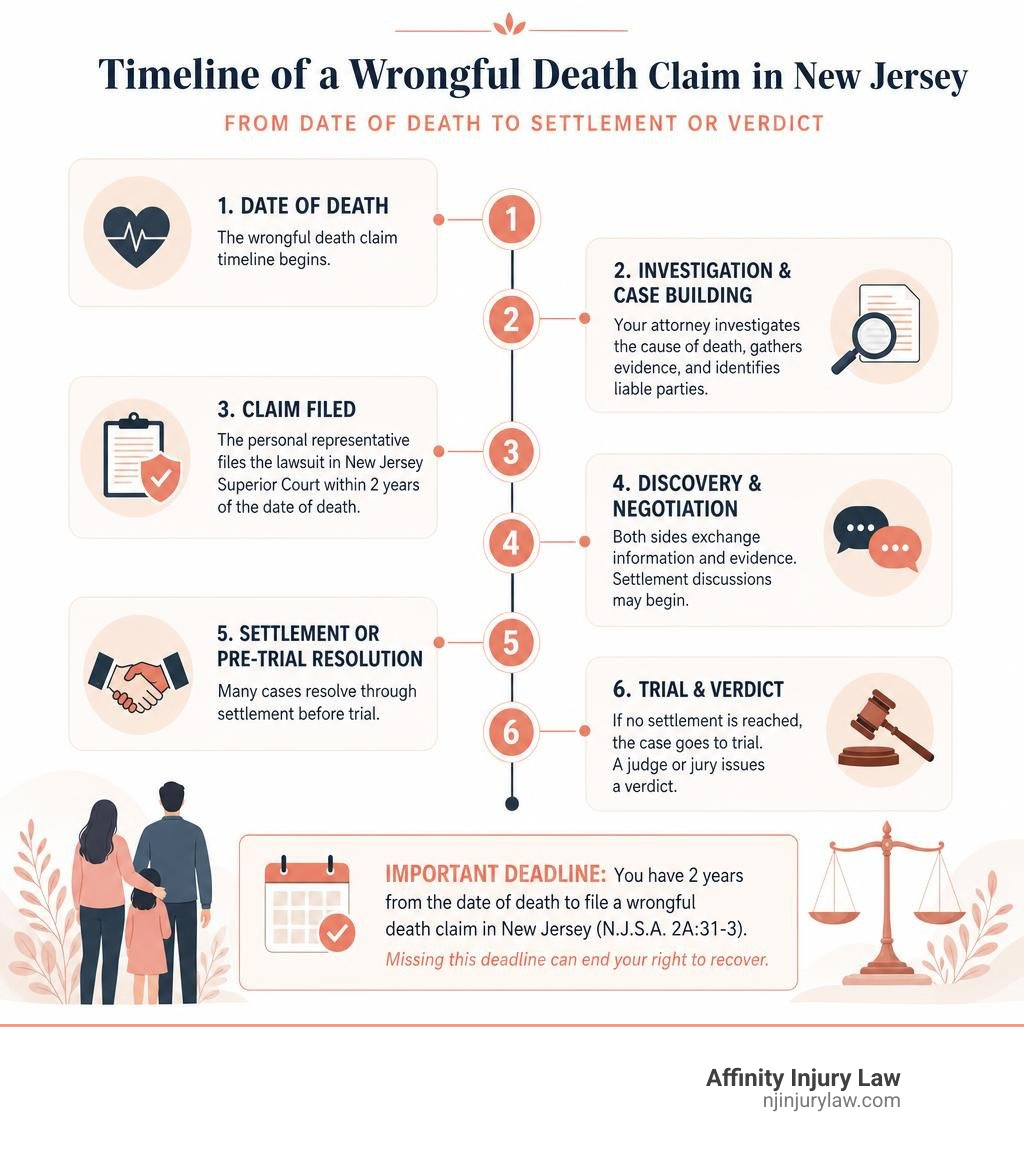
- Deadline: You have 2 years from the date of death to file under N.J.S.A. 2A:31-3. Miss this window and you lose your right to sue.
- What you can recover: Lost income, funeral costs, loss of companionship, household services, and pre-death medical bills — but not punitive damages under the Wrongful Death Act.
- Cost to hire: Most wrongful death attorneys work on a contingency fee basis — you pay nothing unless they win.
- First step: Contact a wrongful death attorney as soon as possible to preserve evidence and protect your family’s legal rights.
Losing a loved one is devastating. When that loss was caused by someone else’s negligence — a reckless driver, a careless doctor, an unsafe workplace — the grief is compounded by anger, financial pressure, and unanswered questions. Medical bills arrive. Income disappears. And somewhere in the background, an insurance company is already working to limit what your family receives.
New Jersey law gives surviving families a legal path forward. But it is time-sensitive, procedurally complex, and requires proof that meets a specific legal standard. Understanding your rights early can make all the difference.
I’m Ioana Enescu, Esq., a founding member of Affinity Injury Law and a New Jersey native with a background in advocating for clients through complex personal injury matters — including cases where families need a wrongful death attorney in NJ to fight for the compensation they deserve. As the daughter of two physicians, I bring a unique understanding of medical and legal issues that often intersect in these cases.
What is a New Jersey Wrongful Death Claim?
Under New Jersey law, specifically N.J.S.A. 2A:31-1, a wrongful death claim is a civil action brought when a person’s death is caused by the “wrongful act, neglect, or default” of another party. In simple terms, if your loved one would have been entitled to file a personal injury lawsuit had they survived the accident, their estate has the right to file a wrongful death lawsuit on behalf of their survivors.
This law serves as a vital safety net for families in Lyndhurst NJ, Bergen County, Passaic County, and throughout the state. It is designed to shift the immense financial burden of a preventable death from the grieving family to the negligent party who caused it.

These tragic claims typically arise from several common scenarios:
- Fatal Car and Truck Accidents: Reckless driving, speeding, distracted driving, or operating a commercial vehicle while fatigued on busy routes like Route 3, Route 17, or the Garden State Parkway.
- Medical Malpractice: Fatal medical errors, including misdiagnoses, surgical mistakes, birth-related fatalities, or severe medication errors in local healthcare facilities.
- Workplace and Construction Accidents: Fatal falls, falling objects (such as a heavy cement barrier striking a worker), defective machinery, or unsafe working conditions on commercial sites.
- Defective Products: Fatalities caused by design flaws, manufacturing defects, or a company’s failure to warn consumers about dangerous products or medications.
- Premises Liability: Fatal slip-and-fall accidents, drownings in unsecured pools, or inadequate security leading to fatal assaults on commercial properties.
While navigating these legal waters can feel overwhelming, understanding the basics is the first step toward securing your family’s future. For practical guidance on managing this process, you can read more about Navigating a Wrongful Death Claim in NJ Without Losing Your Mind. To review the exact wording of the state’s statutes, you can consult New Jersey’s statutory framework for accidental fatalities.
Wrongful Death vs. Survival Actions under NJ Law
One of the most critical distinctions in New Jersey personal injury law is the difference between a wrongful death action (governed by N.J.S.A. 2A:31-1) and a survival action (governed by N.J.S.A. 2A:15-3). While they are often filed together following a fatal accident, they serve entirely different purposes and compensate for different types of losses.
A wrongful death claim is designed to compensate the surviving family members for the financial losses they suffer as a result of their loved one’s passing.
A survival action, on the other hand, preserves the personal injury claim the deceased person had at the moment of the accident. It allows the estate to recover damages for the conscious pain and suffering the victim endured between the time of the injury and the time of death. For example, if a construction worker is struck by a falling load and survives for several days in a Passaic County ICU before passing away, the survival action compensates for the physical pain and mental anguish they suffered during those days.
Any compensation recovered through a survival action goes directly to the deceased’s estate. This means it is distributed according to the deceased’s will, or under New Jersey’s intestate laws if there is no will, and may be subject to the estate’s creditors. Conversely, wrongful death recoveries are distributed directly to the statutory beneficiaries based on their actual dependency and are protected from the deceased’s creditors.
| Feature | Wrongful Death Action (N.J.S.A. 2A:31-1) | Survival Action (N.J.S.A. 2A:15-3) |
|---|---|---|
| Purpose | Compensates survivors for their own financial losses. | Preserves the deceased’s personal claim for pre-death damages. |
| Key Damages | Lost financial support, funeral costs, loss of services. | Conscious pain and suffering, pre-death medical bills. |
| Recipients | Statutory beneficiaries (spouse, children, dependents). | The deceased’s estate (distributed via will or intestacy). |
| Creditor Claims | Protected from the deceased’s creditors. | Subject to the deceased’s estate debts and creditors. |
To learn more about how these dual claims are structured to maximize a family’s recovery, consult our specialized guide on Wrongful Death Lawyers New Jersey.
Recovering Damages with a Wrongful Death Attorney NJ
When pursuing justice, working with a wrongful death attorney nj is key to understanding what types of damages are actually recoverable. New Jersey law takes a strict, structured approach to compensation. The state’s Wrongful Death Act focuses primarily on pecuniary losses — meaning losses that can be measured in monetary terms.
Under N.J.S.A. 2A:31-5, the court or jury awards damages based on the financial deprivation suffered by the survivors. These recoverable damages include:
- Loss of Financial Support: The loss of the future earnings and financial contributions the deceased would have provided to their dependents over their expected working life.
- Loss of Household Services: The monetary value of services the deceased performed, such as childcare, cooking, home maintenance, and administrative tasks.
- Loss of Companionship, Guidance, and Counsel: The financial value of the parental guidance, advice, and companionship the deceased would have provided to their children and spouse.
- Funeral and Burial Expenses: The direct costs associated with laying your loved one to rest.
- Pre-Death Medical Expenses: Medical bills incurred for emergency care, surgeries, or ICU stays resulting from the fatal injury prior to death.
It is important to note that New Jersey law does not allow family members to recover damages for their own emotional grief, heartbreak, or mental suffering under the Wrongful Death Act. While this rule can feel incredibly harsh to a grieving family, a skilled attorney knows how to translate emotional loss into recognized pecuniary categories — such as the loss of parental guidance and companionship. Additionally, punitive damages are generally not permitted under the Wrongful Death Act, unless pursued under a separate tort claim for egregious or intentional misconduct (such as a fatal drunk driving accident).
To understand the full scope of what your family can claim, you can explore the types of compensation available under state law.
How a Wrongful Death Attorney NJ Calculates Pecuniary Losses
Calculating the true financial impact of a loss is a highly complex process. It is not as simple as multiplying a yearly salary by a set number of years. To build a strong claim, we work closely with expert economists, vocational experts, and life-care planners.
When calculating future earnings and financial contributions, several critical factors must be analyzed:
- Life Expectancy and Work-Life Expectancy: How long the deceased was expected to live and work based on standard actuarial tables, their health prior to the accident, and their specific occupation.
- Career Trajectory and Inflation: Future promotions, raises, and cost-of-living adjustments the deceased would have reasonably received over their career.
- The Present Value of Future Income: Translating future projected earnings into a lump-sum dollar amount in June 2026, accounting for inflation and investment potential.
- Value of Non-Market Services: Placing a concrete dollar value on the daily household contributions made by the deceased, even if they did not work outside the home or earned a modest income.
Proving Liability and Meeting the NJ Statute of Limitations
To win a wrongful death case in New Jersey, you must prove the traditional elements of negligence. This requires establishing that:
- Duty of Care: The defendant owed the deceased a legal duty of care (e.g., a driver’s duty to obey traffic laws, or a property owner’s duty to keep their premises safe).
- Breach of Duty: The defendant breached that duty through action or inaction (e.g., speeding, failing to repair a broken railing, or committing a surgical error).
- Causation: The defendant’s breach of duty was the direct and proximate cause of the accident and the resulting death.
- Damages: The surviving family members suffered measurable financial damages as a result of the death.
Time is of the essence when proving these elements. Under N.J.S.A. 2A:31-3, the standard statute of limitations for a wrongful death claim in New Jersey is two years from the date of death. If you fail to file a lawsuit within this two-year window, you will permanently lose your right to seek compensation.
Furthermore, if the negligent party is a public entity (such as a New Jersey transit vehicle, a county road department, or a public school), the rules are even stricter. Under the New Jersey Tort Claims Act, you must file a formal Notice of Claim within 90 days of the incident. Failing to meet this short deadline can bar your claim entirely before it even begins.
To avoid critical missteps early in the process, read about the 5 Mistakes That Can Hurt Your Personal Injury Claim in New Jersey and understand the Common Mistakes Without Accident Injury Lawyers.
Why You Need an Experienced Wrongful Death Attorney NJ
Insurance companies are businesses, and their main goal is to minimize payouts. In the wake of a tragedy, insurance adjusters may try to offer a quick, lowball settlement before you fully understand the long-term financial impact of your loss.
An experienced wrongful death attorney nj acts as your shield. We handle all communications with insurance carriers, conduct immediate accident investigations, secure electronic data from commercial trucks, and preserve physical evidence before it disappears.
To give you an idea of what is possible when skilled attorneys build a robust case, consider these notable New Jersey recovery benchmarks:
- $11.5 Million Global Settlement: Recovered for the families of victims who lost their lives in a catastrophic explosion at an industrial acetylene manufacturing facility.
- $1.7 Million Post-Verdict Settlement: Secured in a medical malpractice wrongful death claim for the family of a man with pre-existing multiple sclerosis.
- $1.2 Million Settlement: Obtained for the family of an unmarried construction worker who tragically drowned when a defective barge overturned.
- $875,000 Recovery: Secured from a restaurant that served alcohol to a visibly impaired patron who later died in a single-car accident.
- $850,000 Settlement: Awarded to the widow of a construction worker killed when a heavy cement barrier fell on him at a work site.
Frequently Asked Questions About NJ Wrongful Death Claims
Who can file a wrongful death lawsuit in New Jersey?
In New Jersey, individual family members cannot file a wrongful death lawsuit directly. Instead, the lawsuit must be brought by the personal representative (also known as the executor or administrator) of the deceased person’s estate.
If the deceased had a will, they likely named an executor. If they died without a will, the Surrogate’s Court in the county where they lived (such as Bergen County or Passaic County) will appoint an administrator. While the personal representative files the lawsuit, any financial recovery is held in trust and distributed to the statutory beneficiaries (the surviving spouse, children, parents, or other dependent relatives).
What if the deceased person was partially at fault for the accident?
New Jersey follows a modified comparative negligence system (the 50 percent rule). This means that as long as your loved one was not more than 50 percent responsible for the accident, your family can still recover damages. However, the total compensation award will be reduced by the percentage of fault assigned to the deceased. For example, if a jury determines the total damages are $1 million, but finds the deceased was 20 percent at fault for the crash, the final recovery will be reduced to $800,000. If the deceased’s fault is determined to be 51 percent or more, recovery is barred entirely.
Can a wrongful death claim be filed if there is a pending criminal case?
Yes. Civil wrongful death lawsuits are entirely independent of any criminal charges (such as vehicular homicide or manslaughter) that the state may bring against the negligent party. The civil claim can proceed at the same time as the criminal case, or after it concludes. Because civil cases have a lower burden of proof (“preponderance of the evidence”) compared to the strict “beyond a reasonable doubt” standard required in criminal courts, it is entirely possible to win a civil wrongful death lawsuit even if the defendant is acquitted in criminal court.
Conclusion
Losing a loved one changes your life forever. While no amount of financial compensation can ever replace the person you lost, securing your family’s financial future is a vital step toward healing and finding peace of mind.
At Affinity Injury Law, we understand the heavy emotional and financial weight you are carrying. Serving families in Lyndhurst NJ, Bergen County, Passaic County, and throughout New Jersey, we provide compassionate, dedicated representation during your darkest hours.
We operate on a no-fee-unless-they-win model, meaning you pay absolutely nothing upfront, and we only get paid if we successfully recover compensation for your family. Additionally, our firm is proud to offer multilingual support, ensuring that you can communicate comfortably and clearly with us in your preferred language.
Let us handle the legal burdens, coordinate with the experts, and stand up to the insurance companies so you can focus on your family. To discuss your legal rights in a free, confidential consultation, contact our local Personal Injury Lawyers New Jersey today.