

Start Calculating NJ Truck Accident Compensation
NJ truck accident compensation is based on your total losses, the available insurance coverage, and each party’s share of fault. Start by documenting medical care, missed income, vehicle damage, and how the injury affects daily life. Then preserve truck-specific evidence quickly, including electronic logging device data, dashcam video, black-box data, and maintenance records.
Your potential recovery may include:
- Economic damages: Medical bills, future treatment, lost wages, reduced earning ability, and property damage.
- Non-economic damages: Pain, suffering, emotional distress, and loss of enjoyment of life.
- Punitive damages in limited cases: Available only when conduct meets New Jersey’s high legal standard; these damages are generally capped at the greater of $350,000 or five times compensatory damages.
Truck claims can involve more than the driver. The motor carrier, broker, shipper, cargo loader, or a vehicle-parts manufacturer may share responsibility. Federal safety rules can also matter. For example, records may show violations of driving-hour limits, required rest breaks, maintenance duties, or drug and alcohol testing rules.
New Jersey generally gives an injured person two years from the crash date to file a personal injury lawsuit. Your compensation can be reduced by your own percentage of fault, but you may still recover if you are 50% or less responsible.
I am Ioana Enescu, Esq., a New Jersey personal injury attorney and founding member of Affinity Injury Law. My background in advocating for injured clients and helping them access appropriate care informs my work on NJ truck accident compensation claims, from early evidence preservation through settlement or litigation.
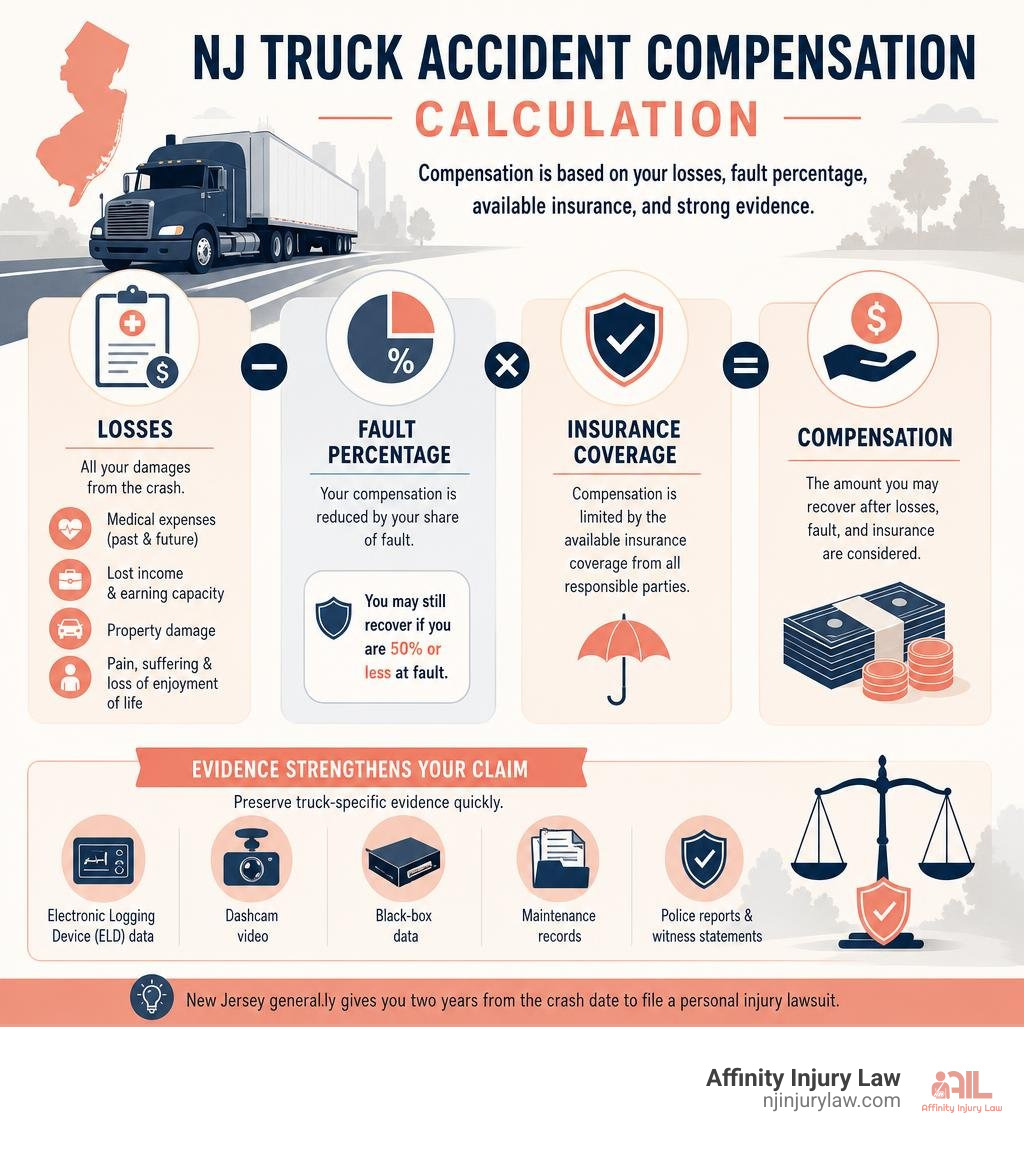
Nj truck accident compensation terms explained:
Factors That Determine Your NJ Truck Accident Compensation
When an 80,000-pound semi-truck collides with a standard passenger vehicle on the New Jersey Turnpike, Route 17, or I-80 in Bergen County, the results are rarely minor. Calculating fair compensation requires examining direct financial losses, long-term personal impacts, and complex legal liability rules under Truck Accident Laws in New Jersey (2026): Deadlines & Liability | Recording Law .
Several primary pillars dictate the ultimate value of an injury claim:
- The severity and permanence of your physical injuries
- Current and projected future medical treatment costs
- Total lost earnings and diminished earning capacity
- Available commercial insurance policy limits across all liable entities
- The clear allocation of fault under New Jersey comparative negligence statutes
Calculating Economic and Non-Economic NJ Truck Accident Compensation
Compensatory damages in New Jersey fall into two main categories: economic and non-economic. Unlike some states that restrict injury recoveries, New Jersey law does not impose statutory caps on economic or non-economic compensatory damages in personal injury claims.
Economic damages are the tangible, measurable financial losses resulting from the collision:
- Past and future medical expenses: Emergency room care, surgical procedures, ICU stays, physical therapy, prescription medications, and home modifications.
- Lost income: Wages missed while recuperating from injuries.
- Diminished earning capacity: The loss of future earning power if a permanent disability prevents you from returning to your prior profession.
- Property damage and out-of-pocket expenses: Total loss or repair costs for your vehicle, rental expenses, and medical travel costs.
Non-economic damages account for the profound human toll of a crash:
- Physical pain and chronic suffering
- Emotional distress, anxiety, and post-traumatic stress disorder (PTSD)
- Loss of enjoyment of life and inability to participate in family or recreational activities
- Scarring, physical disfigurement, and loss of consortium (companionship)
In rare cases involving actual malice or willful and wanton disregard for public safety, punitive damages may be awarded. Under New Jersey’s Punitive Damages Act, these are capped at the greater of five times compensatory damages or $350,000.
How Comparative Fault Affects NJ Truck Accident Compensation
New Jersey operates under a modified comparative negligence system governed by N.J.S.A. 2A:15-5.1. Under this standard, your ability to recover damages depends directly on your percentage of fault:
- The 51% Bar Rule: You can recover damages as long as your fault is 50% or less. If you are found 51% or more at fault, you are barred from recovering any financial compensation.
- Proportional Reduction: If you share partial responsibility (50% or less), your total financial award is reduced in direct proportion to your share of liability.
For example, if your total proven damages equal $1,000,000, but a jury determines you were 20% responsible for the collision (perhaps due to a late lane change), your final payout will be reduced by 20%, resulting in a net recovery of $800,000.
Insurance Rules and Liability in New Jersey Truck Collisions

Commercial truck accident claims differ significantly from standard passenger car claims. The insurance mechanisms, policy limits, and legal standards operate under distinct state and federal frameworks.
| Feature | Standard NJ Car Accident Claim | NJ Commercial Truck Accident Claim |
|---|---|---|
| Typical Minimum Insurance | $35,000 / $70,000 bodily injury | $750,000 to $5,000,000+ (Federal FMCSA) |
| Verbal Threshold Application | Applies if chosen under personal auto policy | Generally exempt under Favell v. Hernandez |
| Potentially Liable Parties | Individual driver, vehicle owner | Driver, carrier, broker, shipper, loader, manufacturer |
| Primary Regulatory Body | NJ Motor Vehicle Commission (MVC) | Federal Motor Carrier Safety Admin (FMCSA) & NJ MVC |
| Critical Evidence | Police report, scene photos | ELD logs, ECM black box data, telematics, maintenance files |
The Verbal Threshold and Commercial Vehicle Exemption
New Jersey auto insurance policies typically feature a choice between the “No Limitation on Lawsuit” threshold and the “Limitation on Lawsuit” (verbal) threshold. The verbal threshold restricts your ability to sue for non-economic damages (pain and suffering) unless your injury meets specific statutory categories, such as a permanent injury, displaced fracture, or significant disfigurement.
However, commercial truck crashes feature a vital legal exception. Under N.J.S.A. 39:6A-2 and the landmark New Jersey case Favell v. Hernandez, commercial freight trucks are generally not classified as “automobiles” for no-fault verbal threshold purposes. This means that even if your personal auto policy includes the limitation-on-lawsuit threshold, that limitation usually does not restrict your right to seek full pain and suffering damages against a negligent commercial motor carrier.
Federal Minimum Coverage and Multiple Liable Parties
Federal law mandates substantial liability protection for commercial freight carriers. Under 49 CFR 387.9, interstate motor carriers operating commercial motor vehicles over 10,001 pounds must carry minimum liability coverage:
- $750,000 for non-hazardous general freight transported in interstate commerce
- $1,000,000 for oil, certain hazardous materials, and large equipment transport
- $5,000,000 for portable tank transports of hazardous substances and hazardous materials
Establishing liability in a commercial collision often extends beyond the driver. Multiple entities within the commercial supply chain can share legal responsibility:
- The Motor Carrier / Trucking Company: Liable for vicarious liability, negligent hiring, inadequate driver training, and pressuring drivers to exceed federal hours-of-service limits.
- Freight Brokers and Logistics Companies: Liable for negligent selection of unqualified or unsafe carriers.
- Cargo Shippers and Third-Party Loaders: Liable for imbalanced cargo, improper tie-downs, or overloading that causes rollovers or jackknifes.
- Maintenance Contractors and Parts Manufacturers: Liable for mechanical failures, brake defects, tire blowouts, or steering malfunctions.
Federal Regulations and Evidence That Maximize Claim Value
Commercial trucking operations are strictly regulated by the Federal Motor Carrier Safety Administration (FMCSA). Violations of these federal safety regulations provide crucial proof of negligence in personal injury litigation.
Critical FMCSA Safety Violations
Key safety regulations that impact liability determinations include:
- Hours of Service (49 CFR Part 395): Property-carrying drivers are restricted to an 11-hour driving limit after 10 consecutive hours off duty, a maximum 14-hour duty window, mandatory 30-minute breaks after 8 hours of cumulative driving, and a 60/70-hour weekly cap.
- Driver Qualification Files (49 CFR Part 391): Carriers must verify commercial driver’s license (CDL) validity, medical examiner certificates, background driving histories, and annual safety reviews.
- Inspection and Maintenance (49 CFR Part 396): Motor carriers must systematically inspect, repair, and maintain all commercial motor vehicles under their control.
- Drug and Alcohol Testing (49 CFR Part 382): Mandatory pre-employment, random, post-accident, and reasonable-suspicion testing protocols.
Preserving Essential Electronic Evidence and Black Box Data
Commercial trucks generate extensive electronic data that can confirm vehicle speed, braking patterns, steering inputs, and driver hours before an impact. However, Electronic Control Module (ECM) data, Electronic Logging Devices (ELDs), and telematics systems can be automatically overwritten within 30 days.
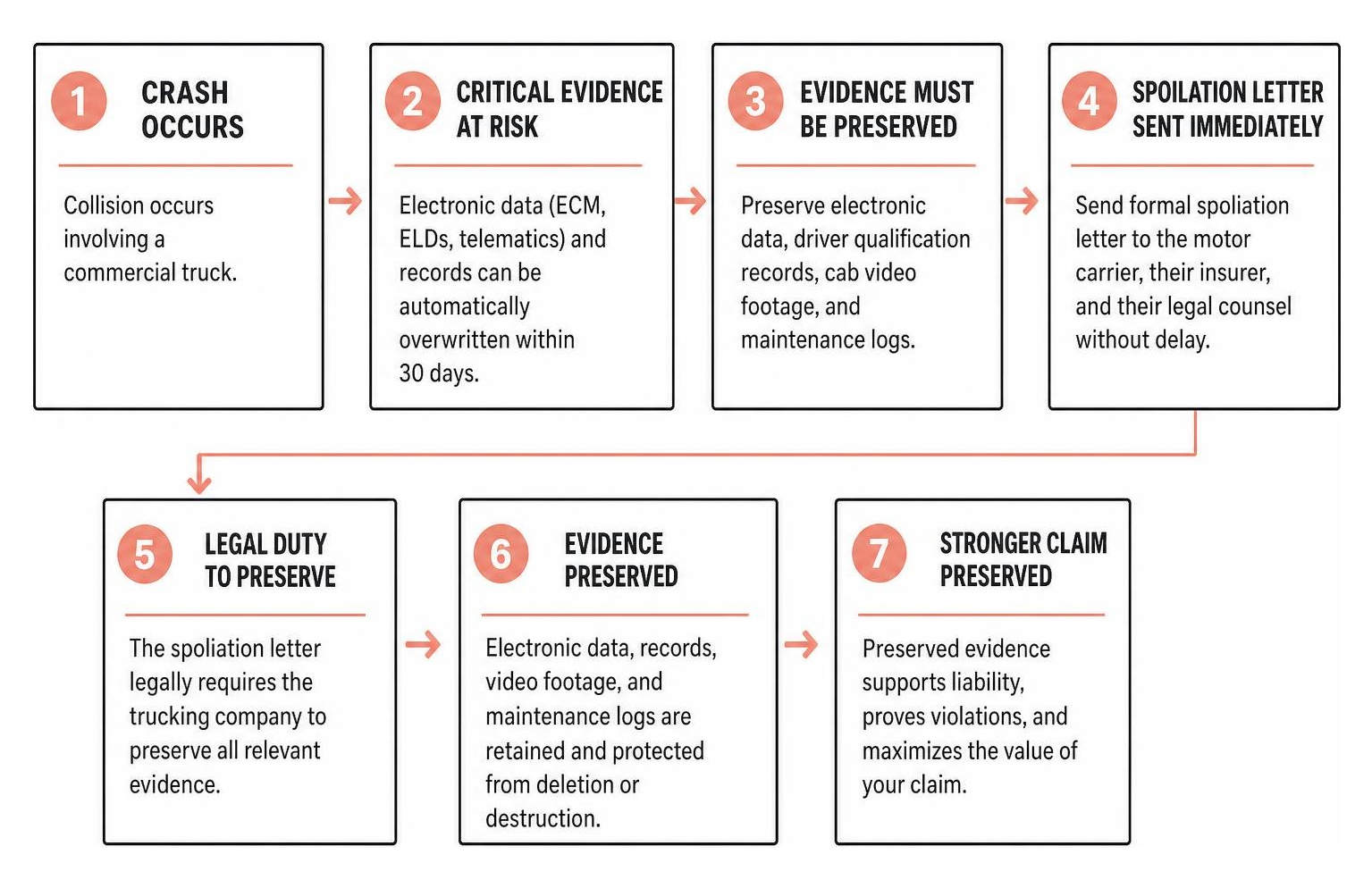
To protect this critical information, an immediate formal spoliation letter must be sent to the motor carrier, their insurer, and their legal counsel. This formal notice legally requires the trucking company to preserve all electronic data, driver qualification records, cab video footage, and physical maintenance logs.
Deadlines and Steps to Protect Your Truck Accident Claim
Protecting your legal rights after a semi-truck crash requires adherence to strict procedural deadlines and prompt action:
- Statute of Limitations: Under N.J.S.A. 2A:14-2, you have two years from the date of the accident to file a personal injury lawsuit. Wrongful death claims must also be filed within two years of the date of death under N.J.S.A. 2A:31-3. Claims involving public entities (such as state or municipal vehicles) require a formal Tort Claims Notice within 90 days.
- Obtain the Police Crash Report: Secure the official New Jersey State Police or local municipal police accident report documenting initial citations and driver information.
- Open a PIP Claim: Notify your personal auto insurance provider to establish your Personal Injury Protection (PIP) claim for prompt medical billing coverage.
- Document Medical Treatment: Attend all follow-up appointments, physical therapy sessions, and diagnostic evaluations to build a clear medical paper trail.
- Avoid Giving Recorded Statements: Do not provide recorded statements to commercial carrier claims adjusters before consulting experienced legal counsel.
Frequently Asked Questions About NJ Truck Accidents
What is the deadline to file a truck accident lawsuit in New Jersey?
In New Jersey, the standard statute of limitations for personal injury claims is two years from the date of the collision (N.J.S.A. 2A:14-2). For fatal crashes, a wrongful death action must be filed within two years from the date of death (N.J.S.A. 2A:31-3). Rare exceptions may apply to minors or incapacitated individuals, but timely filing is critical to preserve your right to compensation.
Does New Jersey’s verbal threshold apply to commercial truck accidents?
Generally, no. Under N.J.S.A. 39:6A-2 and New Jersey case law (Favell v. Hernandez), commercial freight trucks are not classified as standard personal “automobiles.” As a result, the verbal threshold (limitation on lawsuit) typically does not bar injured victims from seeking full compensation for non-economic damages, including pain and suffering.
What is the minimum insurance a trucking company must carry?
Under FMCSA regulation 49 CFR 387.9, interstate commercial carriers operating vehicles over 10,001 pounds must carry at least $750,000 in liability coverage for general, non-hazardous freight. Carriers transporting oil or certain hazardous materials must maintain $1,000,000 in coverage, while transporters of specific high-hazard materials and bulk hazardous substances must carry at least $5,000,000.
Conclusion
Securing full and fair recovery after a major commercial vehicle crash requires in-depth knowledge of federal safety mandates, corporate liability, and New Jersey tort laws.
At Affinity Injury Law, our team serves clients throughout New Jersey, including Lyndhurst, Hackensack, Paterson, Fort Lee, Paramus, Fair Lawn, Passaic, Clifton, Wayne, Bergen County, and Passaic County. We provide dedicated, multilingual legal support on a contingency fee basis—meaning you pay no attorney fees unless we successfully recover compensation for you.
If you or a family member was injured in a collision, contact our truck accidents lawyers in New Jersey today to request a free, no-obligation case evaluation.