

Protect Your Settlement After a Rear-End Collision
After being hit from behind, protect your claim by getting medical care, saving crash evidence, and avoiding a fast insurance settlement before you know the full extent of your injuries. A rear end collision attorney can investigate fault, document your losses, handle insurer communications, and pursue fair compensation for medical bills, missed income, and pain caused by the crash.
Rear-end crashes often seem simple, but insurers may argue that a sudden stop, old injury, treatment gap, or minor vehicle damage reduces what they owe. Pain from whiplash, back injuries, or concussions can also appear or worsen after the scene has cleared. According to the National Highway Traffic Safety Administration, rear-end collisions are among the most common types of motor vehicle crashes, frequently resulting in preventable injuries.
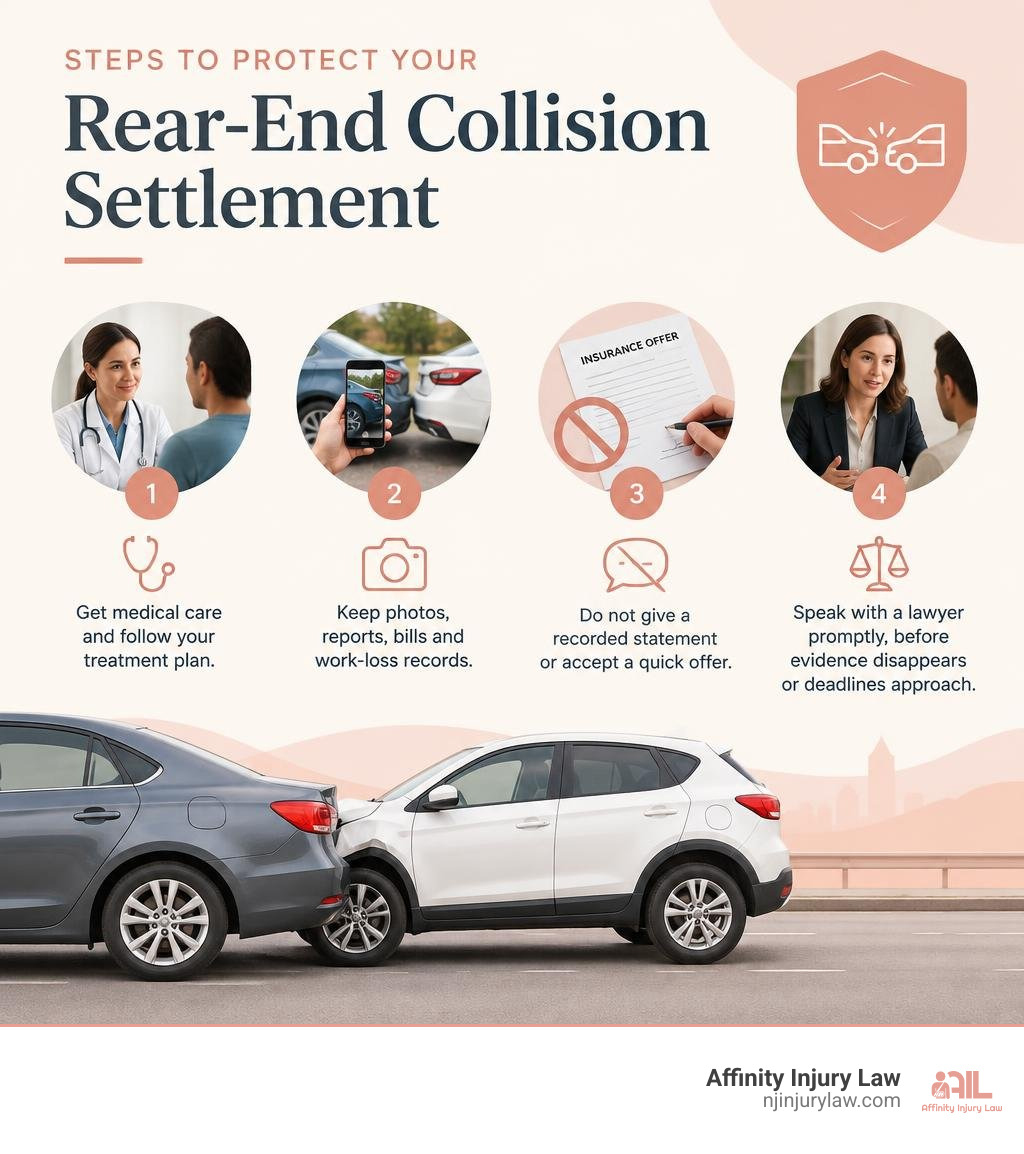
In New Jersey, the driver behind is often responsible for following too closely or failing to pay attention. Still, fault can be disputed, especially in multi-car crashes. The steps you take early can make a real difference:
- Get checked by a medical professional and follow the treatment plan.
- Keep photos, the police report, witness details, bills, and work-loss records.
- Do not give a recorded statement or accept a quick offer without understanding its impact.
- Speak with a lawyer promptly, before evidence disappears or deadlines approach.
I am Ioana Enescu, Esq., a founding member of Affinity Injury Law and a New Jersey attorney who advocates for injured people seeking the medical care and legal support they need. As a multilingual rear end collision attorney, I help clients understand their options while managing the pressure that can follow an unexpected crash.
Simple rear end collision attorney glossary:
Why You Need a Rear End Collision Attorney to Prove Fault and Liability

When another vehicle slams into your back bumper, it feels obvious who caused the crash. The laws of physics point directly behind you. However, insurance carriers rarely concede liability without a fight. Motorists have a legal duty to maintain a safe following distance and adjust their speed to changing traffic conditions. When a motorist ignores this duty due to texting, tailgating, or plain daydreaming, they commit actionable negligence.
Proving that negligence under state law requires demonstrating four core elements: duty of care, breach of duty, direct causation, and measurable damages. Even when a traffic officer issues a ticket to the trailing driver for following too closely, that ticket alone does not automatically guarantee a full insurance payout.
Insurance companies employ seasoned claim adjusters who attempt to shift blame back onto you. They may claim you braked too abruptly, failed to maintain working brake lights, or cut into their lane without warning. Learning what a personal injury lawyer can do for your case is often the best move you can make to protect your financial recovery from these aggressive counter-arguments.
Establishing Negligence and Overcoming Comparative Fault Defenses
Under comparative negligence rules, an injured driver can still recover damages as long as their share of responsibility does not exceed that of the other parties. However, your total financial award is reduced by your percentage of fault. If an insurer manages to assign you 20% of the blame for a sudden stop, your eventual $100,000 compensation package immediately shrinks to $80,000.
In multi-vehicle chain reactions—common on busy commuter corridors in Clifton, Paterson, and Paramus—fault becomes even more tangled. A middle vehicle might be pushed into your car by a third speeding vehicle, prompting every driver’s insurer to point fingers in a circle. We break through these finger-pointing defenses by reconstructing the impact sequence, proving which vehicle initiated the chain, and demonstrating that you were an innocent victim stopped safely in traffic.
How a Rear End Collision Attorney Gathers Crucial Crash Evidence
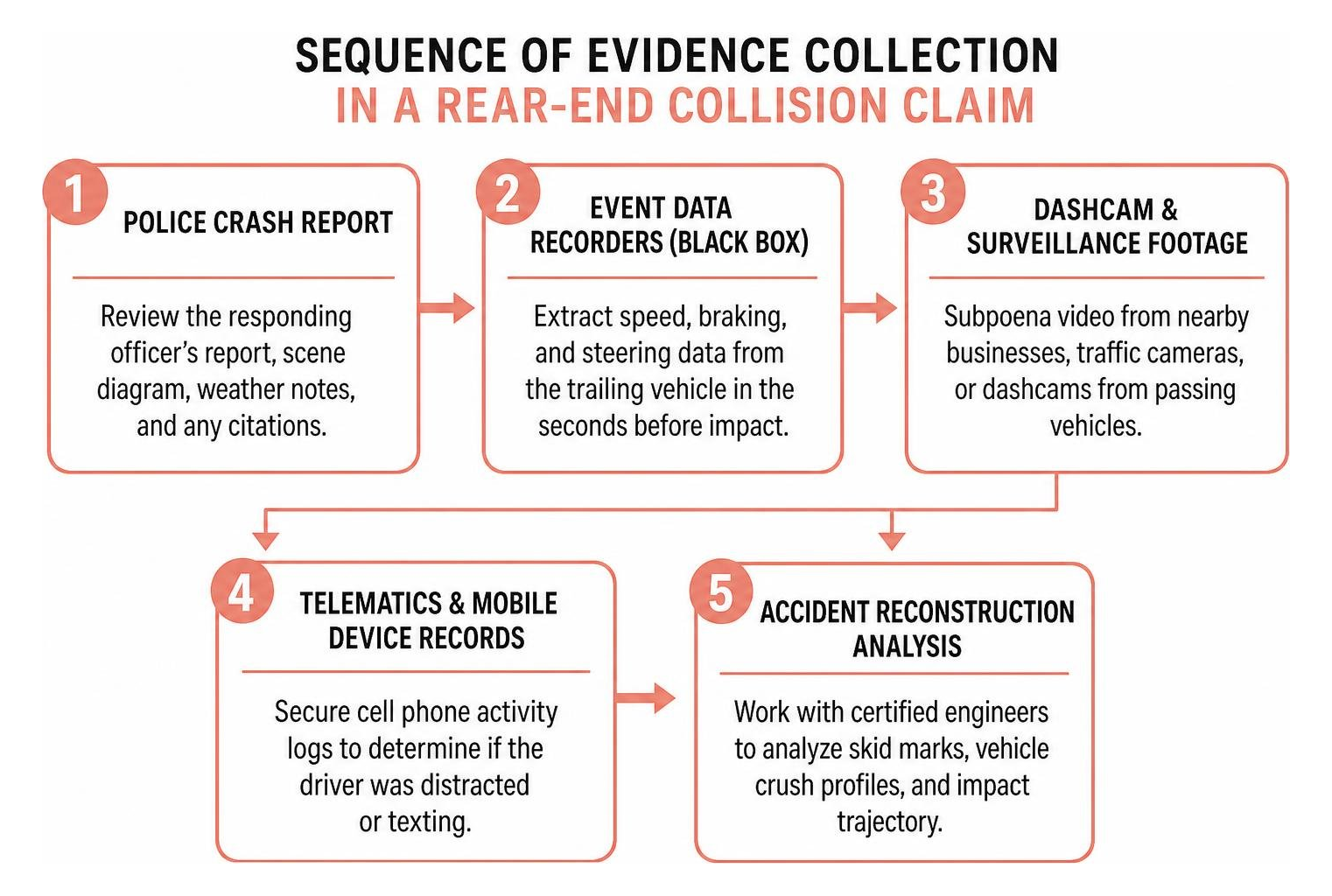
A successful claim relies on hard evidence rather than assumptions. Once retained, we begin preserving time-sensitive documentation before it can be overwritten or lost. Understanding how to handle crashing into reality after a collision means taking a systematic approach to evidence gathering:
- Official Police Crash Reports: Reviewing the responding officer’s scene diagram, weather notes, and any citations issued.
- Electronic Event Data Recorders (Black Boxes): Extracting crucial speed, braking, and steering inputs from the trailing vehicle in the seconds immediately preceding impact.
- Dashcam and Surveillance Footage: Subpoenaing video from nearby commercial businesses, municipal traffic cameras, or dashcams installed on passing vehicles.
- Telematics and Mobile Device Records: Securing cell phone activity logs to prove the other motorist was distracted or texting when the collision occurred.
- Accident Reconstruction Analysis: Working with certified engineers to analyze skid marks, vehicle crush profiles, and impact trajectory.
Immediate Actions to Take After Getting Hit from Behind

The moments following a crash are disorienting. Adrenaline spikes, your heart races, and your neck might feel stiff while your vehicle sits stranded in traffic. Taking deliberate, calm steps at the crash scene directly influences the success of your future injury claim. Knowing why hiring an NJ auto accident attorney changes your claim helps you realize that your defense begins long before anyone enters a courtroom.
- Ensure Safety and Call 911: Move to a safe location if possible and request emergency services immediately. Ensure a formal police report is filed, even for seemingly moderate collisions.
- Seek Immediate Medical Attention: Allow paramedics to evaluate you at the scene, or visit an urgent care or emergency room in Hackensack, Fair Lawn, or Passaic right away.
- Capture Comprehensive Visual Evidence: Take wide-angle photos of the entire crash scene, close-ups of vehicle crush damage, skid marks, road debris, and visibility conditions.
- Collect Unbiased Witness Information: Get full names, phone numbers, and brief statements from neutral bystanders before they leave the area.
- Report the Crash to Your Insurer Carefully: Notify your carrier that an incident occurred, but avoid giving detailed opinions on fault or signing open-ended medical authorizations.
Documenting Scene Evidence and Medical Symptoms
Physical injuries from rear-end crashes are notoriously deceptive. The sudden hyper-extension and hyper-flexion of the spine commonly cause soft-tissue tears, disc herniations, and cervical strain that might not trigger severe pain for 24 to 72 hours. When adrenaline wears off, deep muscle spasms, radiating nerve pain, and severe headaches frequently set in.
Maintain a dedicated medical journal detailing your daily pain levels, physical limitations, and missed personal milestones. Attend every scheduled physical therapy, chiropractic, or orthopedic appointment without gaps. If your doctor orders an MRI or CT scan, complete it promptly. Consistent medical records create an unbroken chain of causation showing that your injuries directly resulted from the crash, shutting down defense arguments that your pain was caused by aging or prior activities.
Navigating Insurance Adjuster Tactics and Lowball Settlement Traps
Insurance adjusters are skilled professionals whose primary job is minimizing claim payouts for their employers. Within days of your accident, an adjuster may contact you offering a quick settlement check of a few thousand dollars in exchange for a full legal release. Accepting this early offer closes your claim forever—even if you discover next week that you require a $50,000 spinal fusion surgery.
Adjusters may also demand a recorded statement, asking leading questions designed to make you say you are “doing fine” or that the crash was unavoidable. Politely decline these requests until you have professional legal representation. Having your attorney manage all communication shields you from manipulative interview tactics and prevents innocent remarks from being used against you.
Calculating the Full Value of Your Rear-End Crash Damages
To recover fair compensation, you must account for every current and future cost associated with your crash. An attorney helps you identify all applicable damages so you do not leave money on the table. You can maximize your car accident settlement by categorizing your losses into economic and non-economic damages.
| Damage Category | Description | Typical Examples |
|---|---|---|
| Economic Damages | Direct, measurable financial losses with verifiable receipts and documentation. | – Emergency room & hospital bills – Diagnostic imaging (MRIs, X-rays) – Physical therapy & chiropractic care – Past & future lost wages – Loss of earning capacity – Prescription medications |
| Non-Economic Damages | Subjective, non-monetary losses representing personal physical and mental hardship. | – Physical pain and suffering – Emotional distress & anxiety – Loss of life enjoyment – Chronic sleep disruption – Permanent disability or scarring – Loss of consortium |
Economic Damages: Medical Bills and Lost Wages
Economic damages form the baseline of your financial recovery. Calculating these costs requires gathering every hospital invoice, ambulance fee, pharmacy receipt, and specialist copay. If your injuries prevent you from performing your normal job duties in Wayne, Lyndhurst, or Fort Lee, we calculate your lost wages using recent paystubs, tax filings, and employer verification letters.
For catastrophic injuries involving permanent impairment, economic calculations must project future financial shortfalls. We consult with vocational experts and life-care planners to estimate future medical procedures, ongoing rehabilitation, and the loss of lifetime earning capacity if you cannot return to your prior career.
Non-Economic Damages and the Low-Impact Injury Defense
Insurance carriers love to deploy the “minor property damage equals minor bodily injury” defense. If your rear bumper only shows minor scratches or cracked plastic, adjusters will argue that the impact force was insufficient to cause serious spinal or neurological trauma.
We dismantle this defense using biomechanical evidence. Modern vehicle bumpers are engineered with energy-absorbing plastic that masks significant physical forces. Even in low-speed collisions, the violent kinetic energy transfers directly into the occupants’ bodies, whipping the neck and spine. Under the “eggshell plaintiff” legal rule, a defendant must take the victim as they find them. If you had a dormant or pre-existing back condition that was aggravated or made symptomatic by the crash, the at-fault driver remains legally responsible for that worsening pain.
Legal Timelines and Fee Structures When Filing a Claim
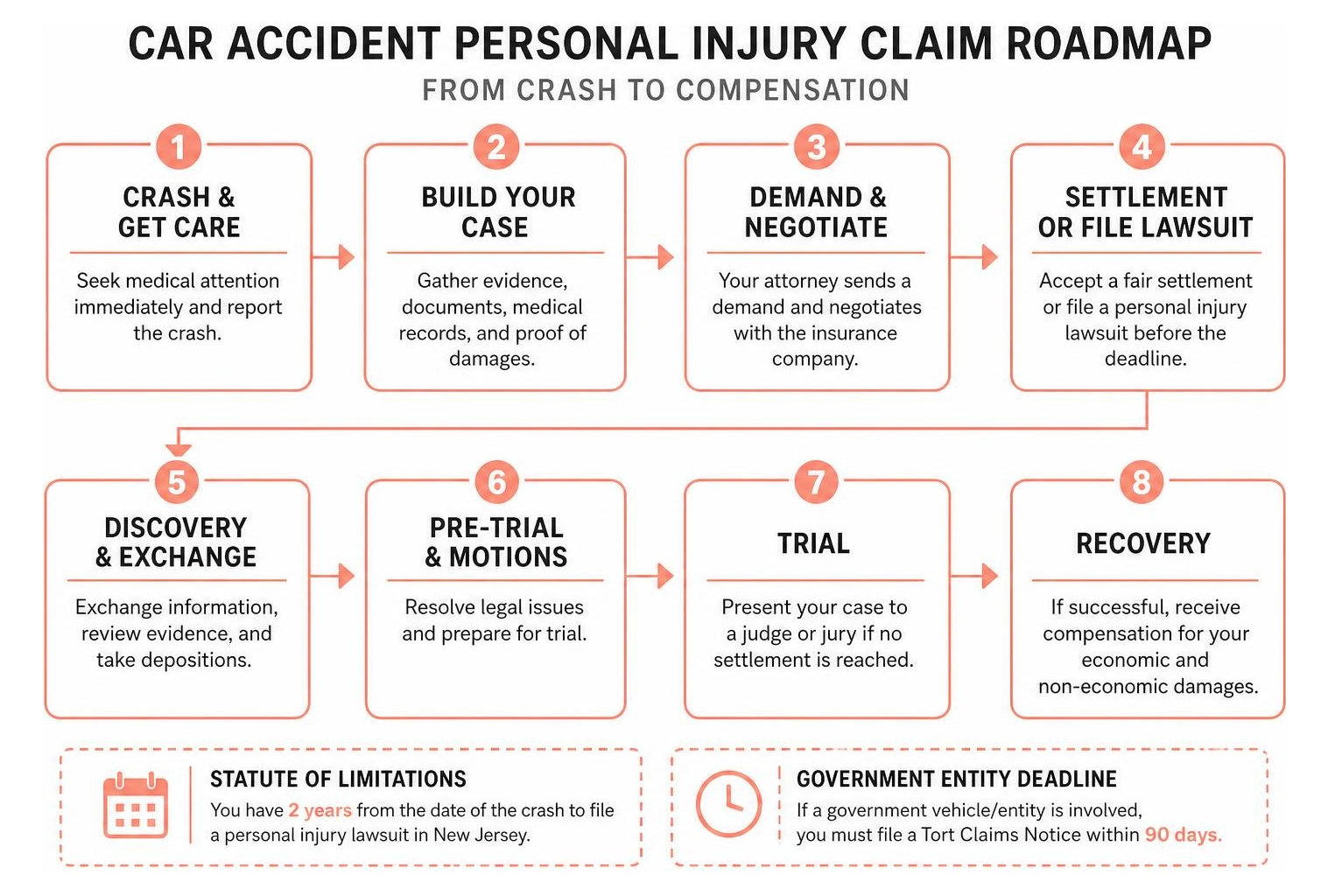
Pursuing a personal injury claim follows a structured legal process designed to hold negligent parties accountable. Understanding the applicable statutory timelines and payment models ensures you make informed decisions about your case.
Adhering to the Two-Year Statute of Limitations
Under New Jersey law, the statute of limitations for filing a personal injury lawsuit is strictly two years from the date of the collision. Failing to file a formal complaint with the appropriate civil court before this statutory window closes permanently extinguishes your right to pursue compensation, regardless of how severe your injuries are.
Certain circumstances involve even tighter deadlines. If the vehicle that rear-ended you was owned by a government municipality, public transit agency, or state entity, you must submit a formal Tort Claims Notice within 90 days of the incident. Promptly engaging legal counsel guarantees that all statutory notices, discovery deadlines, and court pleadings are filed accurately and on time.
Working with a Rear End Collision Attorney on a Contingency Basis
Navigating legal challenges while recovering from painful injuries is stressful enough without worrying about hourly legal bills. That is why our firm operates strictly on a contingency-fee model. There are zero upfront costs or out-of-pocket expenses for our legal services.
We advance all necessary litigation costs, such as filing fees, expert witness retainers, and accident reconstruction expenses. We only receive payment as an agreed-upon percentage of the final settlement or court verdict we secure on your behalf. If we do not win compensation for your case, you do not owe us an attorney fee. Additionally, we actively negotiate with your healthcare providers and health insurers to reduce outstanding medical liens, maximizing the actual net payout that goes directly into your bank account. Discover how contingency fee accident lawyer representation protects your finances while giving you access to dedicated legal advocacy.
Frequently Asked Questions About Rear-End Collisions
Is the trailing driver always found 100% at fault in a rear-end crash?
While there is a strong legal presumption that the trailing driver is at fault for failing to maintain a safe stopping distance, that presumption can be rebutted. Exceptions occur when the lead vehicle suddenly reverses, makes an unsafe lane change directly into the trailing car’s braking path, or operates at night without functioning taillights. Multi-car pileups also distribute liability across several drivers based on their relative percentages of fault.
What should I do if my neck pain appeared days after the collision?
Delayed pain is extremely common after a rear-end collision due to delayed inflammation and adrenaline masking soft-tissue trauma. You should seek a comprehensive medical evaluation immediately. Inform the examining physician that you were involved in a recent auto accident so they can run appropriate diagnostic imaging. Be honest about your symptoms, keep a daily journal of your physical limitations, and avoid giving recorded statements to insurance adjusters until you consult a lawyer.
How do insurance companies undervalue low-speed rear-end claims?
Insurers rely on computer algorithms and adjusters who assume that minimal visible property damage equates to zero bodily harm. They frequently argue that soft-tissue strains are temporary or that your pain stems from pre-existing degenerative conditions. An experienced attorney overcomes these claims by providing objective diagnostic evidence, such as MRI scans showing disc herniations or tears, paired with expert medical testimony detailing the biomechanical forces involved in the crash.
Conclusion: Secure Experienced Legal Representation Today
Getting hit from behind can upend your health, your career, and your financial peace of mind in a fraction of a second. You should not have to navigate insurance lowball tactics and complex legal filings while you are trying to heal.
At Affinity Injury Law, we combine relentless legal advocacy with compassionate client support. With multilingual representation available in Spanish, Romanian, and English, we ensure that language is never a barrier to demanding justice. Our no-win, no-fee guarantee means we are fully invested in your recovery from day one. Contact us today for a free, confidential case evaluation and get the trusted Bergen County personal injury legal assistance you deserve.