


When to Hire a Premise Liability Law Firm After a Property Injury
If you were hurt on someone else’s property in New Jersey, a premise liability law firm can help you pursue compensation for your medical bills, lost wages, and pain — at no upfront cost.
Here’s what to know right away:
- You have 2 years from the date of your injury to file a claim in New Jersey
- Property owners are legally responsible for keeping their premises safe for visitors
- You may still recover compensation even if you were partially at fault
- Most premises liability lawyers work on contingency — you pay nothing unless you win
- Evidence disappears fast — contacting a lawyer early protects your case
Getting hurt on someone else’s property can turn your life upside down overnight. Medical bills stack up. You miss work. And the property owner’s insurance company is already working to minimize what they owe you.
That pressure is real — and it’s exactly what premises liability law is designed to address.
Property owners have a legal duty to keep their premises reasonably safe. When they fail to fix a hazard, warn visitors, or maintain their building, and someone gets hurt as a result, the law holds them accountable.
But these cases are rarely simple. Property owners and their insurers fight hard to avoid paying. They’ll argue the hazard was obvious, that they didn’t know about it, or that you share the blame. Without experienced legal help, many injured people settle for far less than they deserve — or nothing at all.
I’m Ioana Enescu, Esq., a founding member of Affinity Injury Law and a lifelong New Jersey resident who has guided clients through the full range of premises liability claims, from slip and falls to negligent security cases. I created this guide to help you understand exactly what a premise liability law firm can do to protect your rights and maximize your recovery.
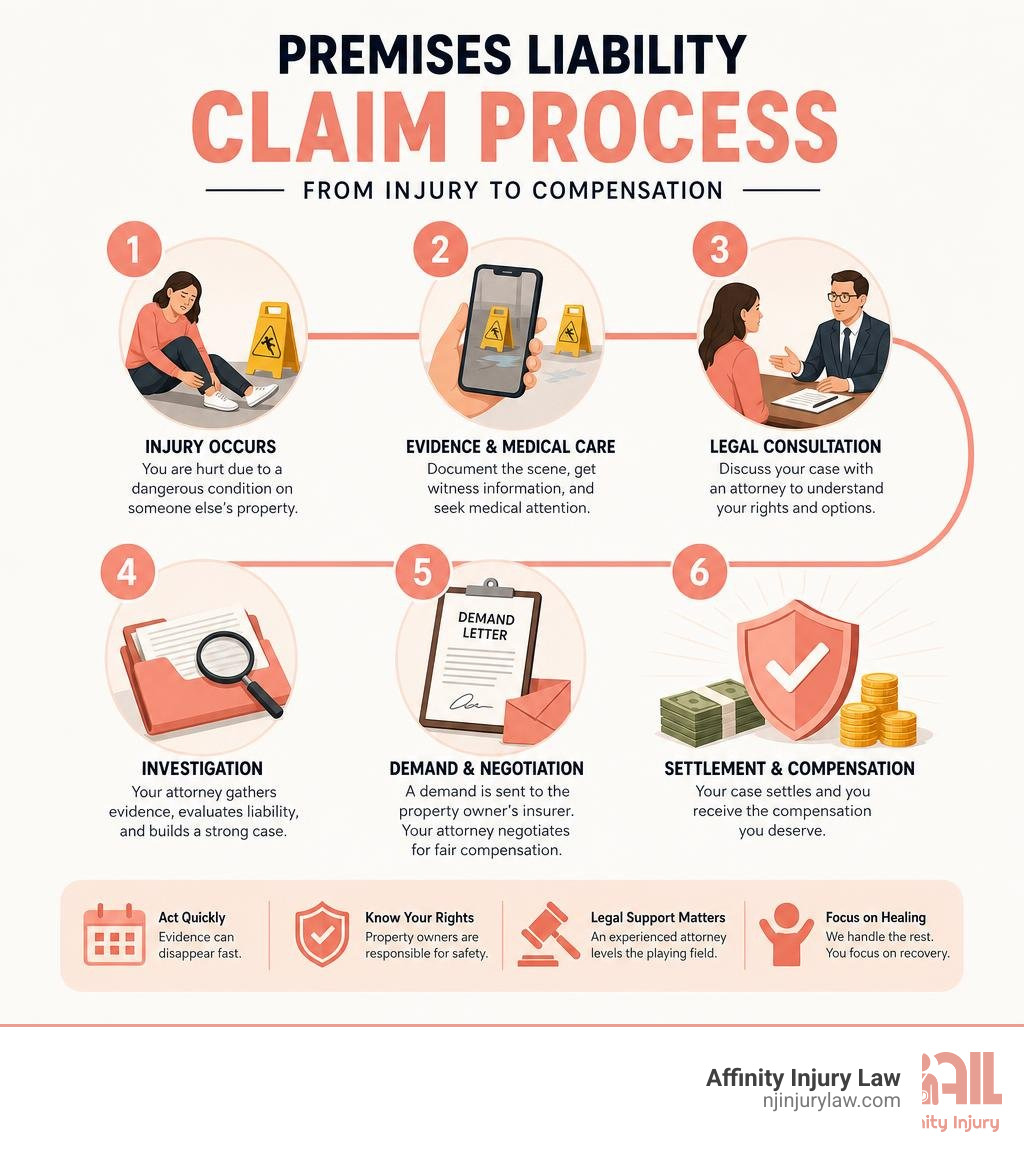
Understanding Premises Liability Law and Common Property Accidents
Premises liability is a specific area of personal injury law focused on property owner negligence. In New Jersey, if you are injured on commercial, residential, or public property because the owner or manager failed to maintain a safe environment, you have the right to seek compensation.
However, simply getting hurt on someone else’s property does not guarantee a successful claim. You must prove that a specific dangerous condition caused your injury and that the property owner should have addressed it.
As experienced Personal Injury Lawyers New Jersey, we handle a wide variety of premises liability cases. Some of the most common property accidents we see in Lyndhurst, Bergen County, and Passaic County include:
- Slip and Fall Accidents: These are the most common premises liability claims. They often stem from wet floors, spilled liquids, icy sidewalks, worn carpets, or highly polished surfaces. If you have been injured in a fall, working with specialized Slip and Fall Lawyers New Jersey is essential to proving the property owner had notice of the hazard.
- Dog Bites and Animal Attacks: Property owners and homeowners are responsible for controlling their pets. New Jersey enforces strict liability for dog attacks, meaning owners are generally held responsible if their dog bites someone on public or private property. If you have suffered an animal attack, consulting dedicated Dog Bite Lawyers New Jersey can help you secure compensation for medical care and reconstructive surgery.
- Negligent Security: Commercial properties like apartment complexes, parking garages, and shopping malls in Bergen County have a duty to provide reasonable security. If a lack of security cameras, poor lighting, or broken locks leads to a physical assault or robbery, the property owner may be held liable.
- Structural and Construction Defects: Broken staircases, loose handrails, collapsing decks, and falling ceiling tiles represent severe hazards. In some cases, building code violations are the direct cause of catastrophic injuries.
- Toxic Exposure: Exposure to lead paint, mold, asbestos, or hazardous chemicals due to a landlord’s failure to remediate unsafe conditions can lead to chronic illness and long-term medical complications.
How Visitor Classifications Dictate a Property Owner’s Duty of Care
Under New Jersey common law, the standard of care a property owner owes you depends heavily on why you were on the property. Visitors are traditionally divided into three distinct classifications: invitees, licensees, and trespassers.
However, the New Jersey Supreme Court shifted from rigid visitor categories to a fairness-based duty analysis in the landmark case Hopkins v. Fox & Lazo Realtors. Today, New Jersey courts look at the relationship between the parties, the nature of the risk, and the public interest in safety to determine what a property owner should have done.
To help you understand the baseline standards, here is how visitor classifications traditionally compare:
| Visitor Classification | Definition | Owner’s Duty of Care | Examples |
|---|---|---|---|
| Invitee | Someone invited onto the property for commercial or business reasons. | Highest Duty: Owners must inspect the property, repair hazards, and warn of hidden dangers. | Grocery store shoppers, hotel guests, restaurant patrons. |
| Licensee | Someone entering the property for social or personal reasons with permission. | Moderate Duty: Owners must warn of known dangers but do not have to perform inspections. | Social houseguests, visiting family members, delivery drivers. |
| Trespasser | Someone entering the property without permission or legal right. | Lowest Duty: Owners generally owe no duty of care, except they cannot set intentional traps. | Intruders, uninvited wanderers. |
For commercial properties, the law is strict. Owners must actively inspect their buildings and parking lots to find hidden hazards. For residential properties, the owner’s responsibility is generally limited to warning you about hazards they already know exist.
If you want to read more about how these classifications apply in our state, check out our dedicated page on Premises Liability Lawyers New Jersey.
Key Elements to Prove in a Case with a Premise Liability Law Firm
To win a premises liability lawsuit, your legal team must establish four core elements of negligence.

- Duty of Care: We must prove the property owner owed you a legal duty of care based on your visitor status and the relationship between you.
- Breach of Duty: We must show the property owner breached that duty by failing to keep the premises safe or failing to warn you of a hazard.
- Causation: We must prove that the property owner’s breach was the direct cause of your slip, trip, fall, or injury.
- Actual Damages: You must have suffered real, documented losses (such as medical bills, lost wages, or physical pain) as a result.
A major hurdle in these cases is proving notice. We must show that the property owner either had actual notice (they knew the hazard existed because they saw it or someone reported it) or constructive notice (the hazard existed for so long that they should have discovered and fixed it through reasonable care).
Because evidence like security footage, cleaning logs, and witness statements can easily be deleted or forgotten, immediate action is critical. You can learn the exact steps to protect your claim by reading our guide on How to Document Your Slip Fall Accident for Max Comp.
Common Defenses and Legal Hurdles in Property Injury Claims
Property owners and their insurance companies do not simply hand over checks. They employ aggressive legal defenses to reduce or completely deny your payout. Some of the most common defenses we defeat include:
- The “Open and Obvious” Defense: The defense will argue that the hazard (such as a large pothole or a brightly colored wet floor sign) was so obvious that you should have seen and avoided it yourself.
- Lack of Notice: Insurers frequently claim they had no way of knowing about the spill or broken steps because it happened right before your accident.
- Comparative Negligence: New Jersey operates under a modified comparative negligence system. If the defense can prove you were distracted (e.g., looking at your phone) or wearing inappropriate footwear, they can shift some of the blame to you. If your share of fault is determined to be 51% or higher, you are legally barred from recovering any compensation.
Understanding how defense firms build these arguments can help us stay one step ahead. To make sure you do not accidentally damage your own claim, be sure to read about the 5 Mistakes That Can Hurt Your Personal Injury Claim in New Jersey.
Recoverable Damages and New Jersey Statutes of Limitations
If your claim is successful, you can recover both economic and non-economic damages to help you put your life back together.

- Medical Bills: Covers emergency room visits, surgeries, prescription medications, and ongoing physical therapy.
- Lost Wages: Compensates you for the income you lost while recovering, as well as any reduction in your future earning capacity if your injuries are permanent.
- Pain and Suffering: Addresses the physical pain, emotional distress, and loss of enjoyment of life caused by the accident.
- Punitive Damages: In rare cases where the property owner’s behavior was exceptionally malicious or reckless, punitive damages may be awarded to punish the wrongdoer.
In New Jersey, you generally have two years from the date of the accident to file a personal injury lawsuit under the state’s statute of limitations. However, if your injury occurred on municipal or government property (such as a public sidewalk in Passaic County or a school in Bergen County), you must file a formal Notice of Claim within 90 days under the New Jersey Tort Claims Act. Missing this deadline will permanently bar you from seeking compensation.
Navigating Complex Claims with Professional Legal Representation
Premises liability cases are highly complex. They require an in-depth understanding of local building codes, engineering standards, and insurance policies. Going up against a commercial insurance carrier alone is a recipe for an unfair settlement.
Professional legal representation levels the playing field. An experienced law firm will handle the heavy lifting, allowing you to focus entirely on your physical recovery.
How a Premise Liability Law Firm Maximizes Your Compensation
When you hire a specialized firm, we take immediate control of your case to build the strongest possible claim:
- Securing Crucial Evidence: We send immediate spoliation letters to preserve security camera footage, internal incident reports, and maintenance logs before they are destroyed.
- Hiring Industry Experts: We work with accident reconstructionists, structural engineers, and medical professionals to prove how the hazard formed and the true extent of your injuries.
- Managing Insurance Communications: We handle all phone calls and negotiations with the insurance adjusters so you do not accidentally make statements that hurt your case.
- Preparing for Trial: We prepare every case as if it is going to court, showing the insurance company that we are ready to fight for your rights in front of a jury if they refuse to offer a fair settlement.
To learn more about the risks of handling a claim on your own, read our guide on Common Mistakes Without Accident Injury Lawyers.
Selecting the Right Premise Liability Law Firm for Your Case
Choosing the right legal team can make or break your recovery. When evaluating local law firms in Passaic County or Bergen County, look for the following qualities:
- A “No-Fee-Unless-You-Win” Contingency Structure: You should never have to pay out-of-pocket legal fees to seek justice.
- Local Court Experience: A firm familiar with the local courts in Lyndhurst and surrounding New Jersey counties will know how local judges and defense attorneys operate.
- Clear and Compassionate Communication: You deserve a legal team that answers your questions, explains complex laws in plain English, and keeps you updated on your case.
Frequently Asked Questions About Premises Liability
What should I do immediately after getting injured on someone else’s property?
First, seek immediate medical attention—this creates an official medical record of your injuries. Next, report the incident to the property owner or manager and ask for a written copy of the report. Take detailed photos of the hazard (such as the ice, spill, or broken step) and the surrounding area. Finally, gather contact information from any eyewitnesses and contact a premises liability attorney before speaking to the insurance company.
Can I still recover compensation if I was partially at fault for my slip and fall?
Yes. Under New Jersey’s modified comparative negligence law, you can still recover compensation as long as your share of the fault is 50% or less. Your final payout will simply be reduced by your percentage of fault. For example, if you are awarded $100,000 but are found to be 20% at fault, you will receive $80,000.
How much does it cost to hire a lawyer for a property injury claim?
At our firm, it costs nothing upfront. We operate on a contingency fee basis, which means our legal fees are paid as a percentage of the settlement or jury verdict we win for you. If we do not win your case, you do not owe us a single dime.
Conclusion
If you or a loved one has been injured due to a property owner’s negligence in New Jersey, you do not have to navigate the complex legal system alone. At Affinity Injury Law (NJ Injury Law), we are committed to holding negligent property owners accountable and securing the maximum compensation you deserve.
With convenient locations serving Lyndhurst, Bergen County, and Passaic County, we provide personalized, compassionate legal advocacy. Our key differentiator is our robust multilingual support, ensuring that language barriers never stand in the way of your right to justice. We operate on a strict “no-fee-unless-we-win” policy, so you can pursue your claim with complete peace of mind.
Contact us today to schedule your free, confidential legal consultation. Let us help you take the first step toward recovery by visiting our Premises Liability Lawyers New Jersey page.