


What to Know About a New Jersey Truck Claim
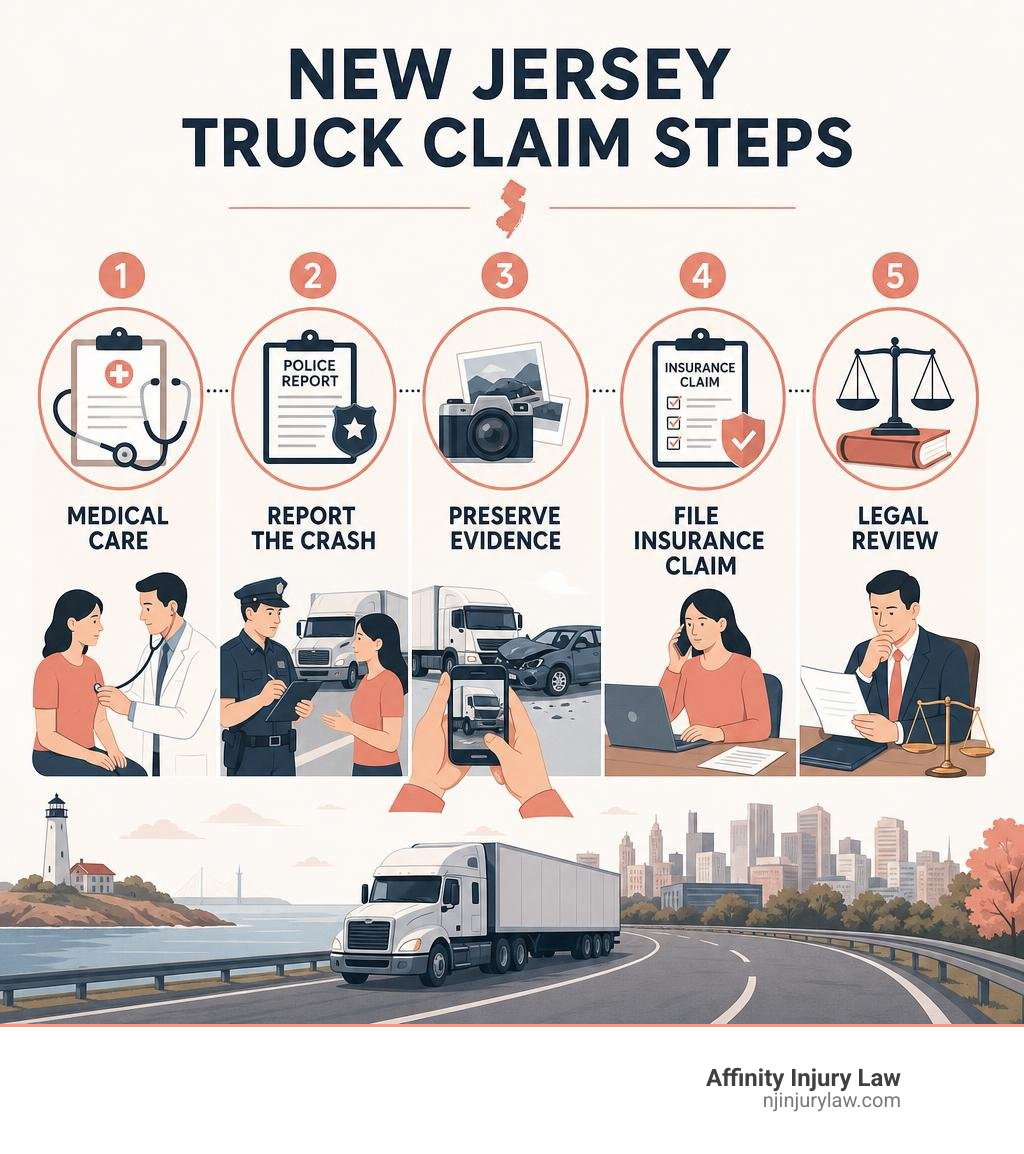
A new jersey truck claim can involve medical bills, lost income, vehicle damage, and several insurance companies. The quick answer: protect your health, report the crash, preserve evidence, and understand whether you are dealing with your own insurer, the truck driver’s insurer, or a government entity.
- Your own insurer: May pay certain benefits quickly under your policy, including PIP medical coverage and, if purchased, collision or comprehensive vehicle coverage.
- The trucking company or its insurer: May be responsible when the truck driver, carrier, or another party caused the crash.
- Government vehicle or road claim: A claim involving the State of New Jersey can have a strict 90-day notice deadline.
- Evidence matters: Photos, the police report, witness details, medical records, repair estimates, and proof of missed work can all affect the outcome.
- Do not confuse PIP with vehicle repairs: New Jersey PIP generally covers medical expenses, not damage to your car.
Truck crashes are often more complicated than ordinary car accidents. A commercial carrier may have its own insurer, safety records, electronic driving data, maintenance documents, and legal team. Early insurance calls may feel routine, but what you say and what you sign can matter.
I am Ioana Enescu, Esq., a New Jersey attorney and founding member of Affinity Injury Law. My background in advocating for injured people and helping them pursue needed medical care informs this guide to a new jersey truck claim and the decisions that follow.
First-Party vs. Third-Party New Jersey Truck Claim Options

When your vehicle is struck by a massive 18-wheeler or commercial delivery truck on Route 17, Interstate 80, or the New Jersey Turnpike, figuring out who pays for the physical destruction is one of your first hurdles. In New Jersey, you generally have two distinct pathways for recovering motor vehicle property damage: a first-party claim filed through your own auto insurance policy or a third-party claim pursued directly against the commercial truck driver, freight motor carrier, or fleet owner.
Understanding what makes truck crash claims different from car wrecks starts with recognizing how insurance coverages function under state law. Motor vehicle drivers in New Jersey often confuse Personal Injury Protection (PIP) with vehicle physical damage coverage. PIP is strictly a no-fault benefit designed to cover medical treatments, hospital bills, and essential services for injured individuals regardless of who caused the collision; PIP never pays a single dollar toward repairing your car, SUV, or pickup truck.
When you seek recovery for physical property damage, you must look to collision or comprehensive physical damage coverage, or seek recovery directly from the at-fault trucking company’s insurance policy. Navigating these avenues requires a firm understanding of filing an auto damage claim with your own insurer versus pursuing third-party commercial liability.
Understanding First-Party Auto Insurance Claims
Filing a first-party claim means turning to your own auto insurance company to fix your vehicle under your optional collision or comprehensive coverage. This is frequently the fastest way to get back behind the wheel after a crash because you do not have to wait for a commercial trucking carrier’s insurance adjuster to complete a complex fault investigation.
Under New Jersey Department of Banking and Insurance regulations, strict timelines govern how your insurance company handles your first-party claim:
- 10 Working Days Mandatory Contact: Your insurance company must contact you within 10 working days after receiving notification of your loss.
- 7 Working Days Inspection Timeline: If the insurer intends to physically inspect your damaged vehicle, it must do so within 7 working days of receiving notice.
- 30-Day Settlement Window: Insurers have 30 calendar days to settle a first-party vehicle damage claim from the moment notice is provided, assuming you cooperate and provide necessary documentation.
- Storage Fee Protections: Insurers must provide at least 3 working days’ written notice before stopping payments for vehicle storage fees at an auto body shop or salvage yard.
When you use your own collision coverage, you are responsible for paying your policy’s out-of-pocket deductible upfront. Your insurer then calculates the vehicle’s repair costs or determines if it is a constructive total loss (typically when repairs approach or exceed 80% of the vehicle’s Actual Cash Value). If declared a total loss, the carrier calculates value using approved valuation databases, local dealer quotes within a 25-mile radius, or standard industry guidebooks (such as NADA or Red Book).
Once your insurer pays your repair or total loss settlement, it will initiate a process called subrogation against the negligent truck driver’s insurance company to recover the money it spent—plus your paid deductible.
Navigating Third-Party Commercial Trucking Liability
A third-party claim involves seeking financial compensation directly from the commercial trucking company, its liability insurance policy, or a self-insured motor carrier. Unlike your own insurer, a third-party commercial carrier owes you no immediate contractual duty and will evaluate driver negligence, comparative fault, and corporate liability before offering a payout.
Commercial truck crashes frequently involve multiple potential tortfeasors, including:
- The truck driver (for distracted driving, speeding, or hours-of-service violations).
- The motor carrier or trucking firm (for negligent hiring, improper training, or pressure to skip mandatory rest breaks).
- Cargo loading contractors (for unbalanced or improperly secured freight).
- Maintenance vendors (for failed mechanical inspections or brake failures).
Because commercial liability policies carry substantial coverage limits, trucking companies and their third-party administrators aggressively defend against every new jersey truck claim. They may attempt to assign partial fault to you under New Jersey’s modified comparative negligence statute, which reduces your financial recovery by your percentage of fault (and completely bars recovery if you are found more than 50% at fault).
Working with experienced NJ semi truck accident lawyers who keep trucking companies honest helps ensure that vital electronic logging device (ELD) data, dashcam footage, and black box event data recorders are preserved before commercial carriers destroy them.
Subrogation, PIP Reimbursement, and Mandatory Arbitration

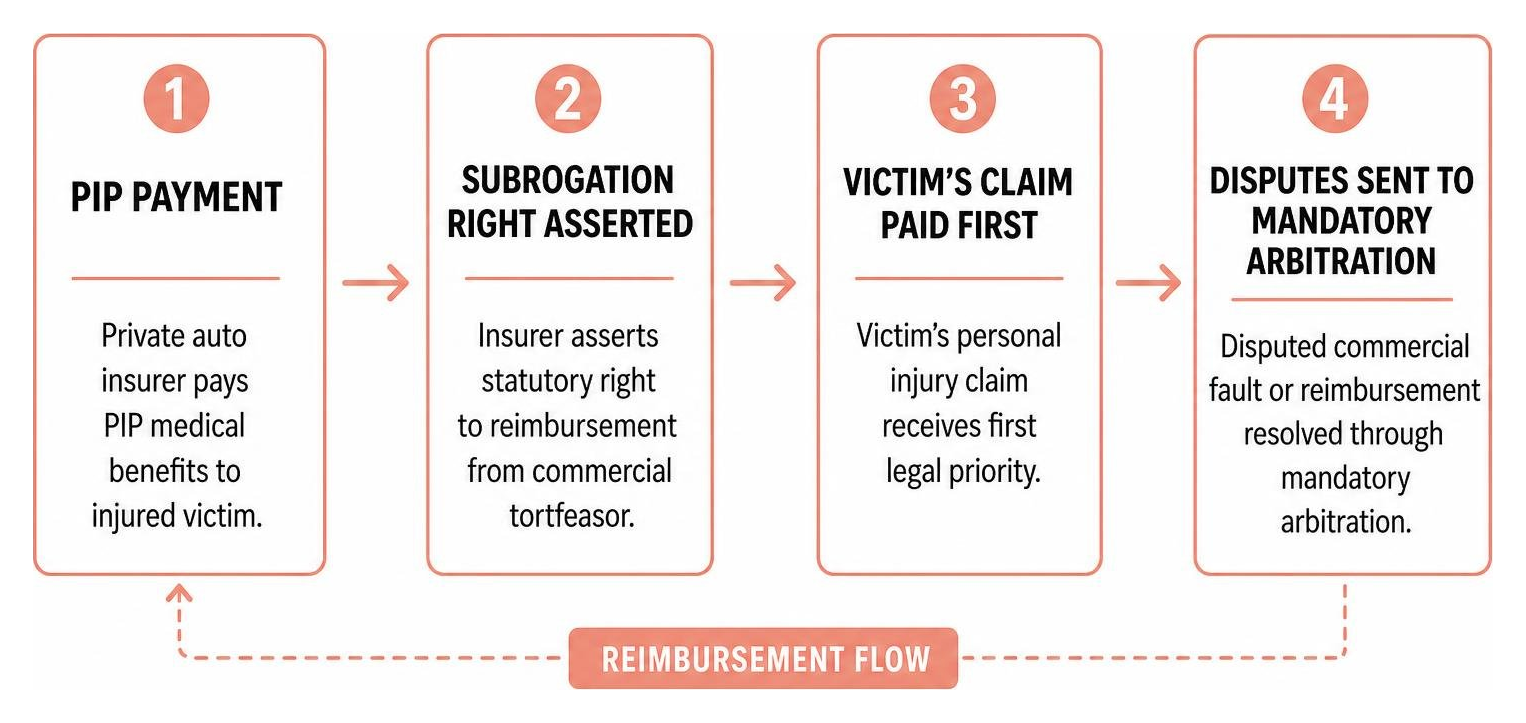
Commercial truck collisions create complex legal interactions between auto insurance policies, statutory healthcare reimbursement provisions, and corporate fleet liability. Under New Jersey’s No-Fault system, your private auto insurance policy pays your Personal Injury Protection (PIP) medical benefits up to your selected policy limit, even if an 80,000-pound tractor-trailer blew through a red light and smashed into your vehicle.
However, New Jersey law grants private auto insurers a powerful legal mechanism to seek full reimbursement for those medical payouts from commercial trucking entities.
PIP Reimbursement Rights Against Commercial Fleets
Under N.J.S.A. 39:6A-9.1, an insurance carrier that has paid Personal Injury Protection (PIP) benefits to an injured party has a direct statutory right to recover those benefits from any tortfeasor who was not required to maintain PIP coverage under New Jersey law.
This distinction is crucial: commercial motor vehicles, heavy freight haulers, and semi-trucks are specifically excluded from the definition of an “automobile” under N.J.S.A. 39:6A-4 and are therefore exempt from maintaining mandatory PIP coverage. Consequently, when a commercial truck driver causes an accident, the injured passenger’s PIP carrier can pursue the self-insured trucking company or commercial liability insurer to reimburse every dollar paid for medical treatments.
Key requirements under N.J.S.A. 39:6A-9.1 include:
- Two-Year Statute of Limitations: The PIP insurer must formally assert its statutory reimbursement demand within two years of the initial claim filing.
- Secondary Priority Rule: An insurer’s PIP reimbursement recovery is strictly secondary to the injured victim’s financial recovery. The commercial carrier’s insurance policy limits must first fully compensate the injured person for their personal injury damages before any money can be funneled to reimburse the PIP insurer.
Resolving Driver Fault Disputes via Arbitration
When an auto insurance company files a PIP reimbursement claim against a commercial fleet owner or trucking insurer, the commercial entity frequently disputes whether its truck driver was actually negligent or at fault for the crash. For years, legal battles persisted over whether state trial courts or private arbitrators had the legal jurisdiction to determine commercial truck driver negligence.
This question was settled authoritatively by the Superior Court of New Jersey, Appellate Division, in the landmark case Liberty Mutual Insurance Co. v. Penske Truck Leasing / CEVA Freight. In that case, a tractor-trailer blocked lanes on Route 9 while backing into a dealership at 4:45 a.m., resulting in a severe crash.
When Liberty Mutual paid PIP benefits and sought reimbursement, the trucking defense team argued that a trial court judge had to hold a full jury trial to establish driver negligence before any PIP reimbursement could be ordered.
The Appellate Division ruled that under N.J.S.A. 39:6A-9.1(b), all factual disputes concerning driver fault, tortfeasor status, and reimbursement amounts must be resolved through mandatory inter-company arbitration, rather than trial court litigation. The court emphasized that the New Jersey No-Fault Act was specifically created by the Legislature to eliminate costly court litigation and streamline inter-carrier disputes through efficient binding arbitration.
State Property Damage and Government Vehicle Claims
When a new jersey truck claim involves a government-owned vehicle—such as a New Jersey Department of Transportation (NJDOT) dump truck, a municipal garbage truck, or a state highway maintenance vehicle—special statutory procedures apply. You cannot simply file a routine insurance claim or lawsuit as you would with a private commercial carrier.
Navigating government liability requires strict adherence to the New Jersey Tort Claims Act (N.J.S.A. 59:1-1 et seq.) and procedures administered through the Department of the Treasury’s State of NJ – NJ Treasury – Division of Risk Management.
State Agency Claim Categories and Subrogation Rules
From the internal state government perspective, the Division of Risk Management classifies state-related property and asset damage into three distinct claim categories:
- Comprehensive Claims for State Vehicles: Covers internal state agency requests for non-collision physical damage to state fleet assets (such as storm damage, flood, or vandalism). These claims carry a standardized $250.00 deductible per vehicle.
- Claims for Damage to State Property: Used when state-owned property (such as bridges, guardrails, or state facilities) suffers structural damage. State agencies face a $100,000.00 threshold deductible before state central risk management funds are issued, unless a third party is responsible.
- Subrogation Claims Against Third Parties: Filed when a third-party commercial vehicle or driver causes physical damage to state assets or vehicles.
If a commercial truck crashes into a state highway barrier or damages a state-owned vehicle, the state department agency must initiate a subrogation claim. All state agency claims must be filed digitally through the State Department Agency Claim Filing System (SDACFS) portal.
Under state risk guidelines, state departments must submit a digital RM1 State Vehicle Accident & Incident Form within five (5) days from the date of loss. Furthermore, if a state vehicle is damaged in a non-collision incident (such as a hurricane or flood) caused partially by a third party, state agencies are legally permitted to file both a comprehensive claim to repair the fleet vehicle immediately and a subrogation claim to pursue full financial recovery from the responsible commercial trucking firm.
Filing a New Jersey Truck Claim Against a Government Entity Under Title 59
If you are a private citizen whose vehicle was hit by a state-owned truck or state entity, your legal recovery process is governed by strict statutory mandates under Title 59. Failing to follow these rules will permanently bar your right to financial recovery.
If you suspect government negligence, consulting skilled Personal Injury Lawyers New Jersey or experienced Car Accidents Lawyers New Jersey as soon as possible is critical to preserving your legal rights.
- Mandatory 90-Day Filing Deadline: You must complete and submit a formal Notice of Tort Claim within 90 days of the date of the incident. If you miss this strict 90-day window, New Jersey law mandates that you forfeit your right to recover damages forever.
- Use Your Own Insurance First (N.J.S.A. 59:9-2e Offset): Under New Jersey Tort Claims rules, private citizens are legally required to file a physical damage claim with their own auto insurance company first if collision coverage is available. State law explicitly mandates that any insurance benefits you receive (or are entitled to receive) from your private policy must be subtracted from any settlement or payout made by the State of New Jersey.
- Filing Requirements for Uninsured Drivers: If you do not carry collision coverage on your vehicle, you must submit the official Property Damage Claim-Short Form directly to the Department of the Treasury, Division of Risk Management, Tort Claims Unit in Trenton, NJ, accompanied by two independent repair estimates, your policy declaration sheet, and proof of non-coverage.
- Deductible Recovery Only: If your private insurer pays for your repairs, you may file a Title 59 Tort Claim against the State solely to recover your out-of-pocket insurance deductible.
Small Claims Court Procedures and Required Evidence
When a new jersey truck claim involves minor property damage or disputed repair costs, filing a lawsuit in New Jersey Small Claims Court provides an accessible, efficient path to justice without long court delays. However, navigating the court system requires strict adherence to jurisdictional caps, procedural rules, and evidence standards.
| Feature | Small Claims Court | Special Civil Part |
|---|---|---|
| Maximum Statutory Cap | $5,000.00 Maximum | $20,000.00 Maximum |
| Excess Damage Waiver | Required (Waives amount over $5,000) | None (Up to $20k cap) |
| Standard Court Filing Fee | $45.00 (1 Defendant) | $75.00+ (Varies by demand) |
| Evidence Requirements | Live Testimony Mandatory | Live Testimony & Formal Discovery |
| Primary Use Case | Minor vehicle repairs / Deductibles | Moderate vehicle damage / Small injuries |
Small Claims Court Filing Process and Documentation
The Small Claims Section of the New Jersey Superior Court, Special Civil Part, has a strict statutory monetary cap of $5,000 for motor vehicle property damage cases.
If your vehicle repair bill or out-of-pocket loss is $6,500 and you choose to file in Small Claims Court to resolve the matter quickly, New Jersey law dictates that you permanently forfeit and waive your legal right to recover any amount exceeding $5,000. If you do not wish to give up the excess $1,500, you must file your lawsuit in the regular Special Civil Part (which handles claims up to $20,000) or the Law Division.
To file a motor vehicle small claim pro se, you must complete the official instructions provided under How to Sue for Up To $5,000 in Small Claims Court – Motor Vehicle Case:
- Complete Form A (Small Claims Complaint): Detail the date, precise crash location, involved drivers, vehicle owners, and exact itemized money damages claimed.
- Complete Form B (Small Claims Summons): Identify the proper county venue—which must be the New Jersey county where at least one defendant resides or where the commercial trucking business maintains a registered office or conducts business.
- Redact Confidential Information: You must remove or redact all sensitive personal identifiers (including social security numbers, driver’s license numbers, license plate numbers, and insurance policy account numbers) from all publicly filed court documents.
- Pay Court Filing Fees: The standard filing fee is $45.00 for one defendant ($35 court filing fee plus $10 court officer service fee), with an additional $15.00 fee for each extra defendant.
- Strict Evidence Rules (Live Testimony Mandatory): In New Jersey Small Claims Court, written witness statements—even if notarized or given under oath—are completely inadmissible. You must bring live, in-person witnesses to testify at trial.
For larger cases involving complex liability or significant financial losses, reviewing The Ultimate Guide To Hiring A Contingency Fee Accident Lawyer can help you understand how legal representation works without paying upfront attorney fees.
Key Evidence Needed to Support a New Jersey Truck Claim
Whether negotiating with a commercial truck insurance adjuster, filing a state tort claim, or presenting your case before a Small Claims judge in Bergen County or Passaic County, compiling complete, concrete evidence is vital.
To maximize your monetary recovery for a new jersey truck claim, compile the following documentation:
- Official New Jersey Police Crash Report: Required under state law for any motor vehicle collision involving property damage exceeding $500. Ensure police report details accurate officer observations, traffic summonses issued, and commercial carrier USDOT/MC identification numbers.
- Itemized Repair Estimates: Provide at least two official, itemized collision repair estimates from state-licensed auto body shops, or a finalized repair invoice showing detailed parts and labor breakdowns.
- Proof of Paid Deductible: Submit a receipt, cancelled check, or bank statement proving you paid your collision deductible to the repair facility.
- Insurance Declaration Page: Submit your auto insurance policy declaration page showing coverage limits, comprehensive/collision deductibles, and named insureds.
- High-Resolution Scene & Damage Photographs: Clear, timestamped photos showing vehicle damage, truck impact points, skid marks, road conditions, traffic signals, and weather conditions at the crash site.
- Proof of Total Loss Valuation (If Applicable): If your vehicle was declared a total loss, gather local comparable vehicle listings within a 25-mile radius within 30 days to challenge lowball valuation offers from insurance adjusters.
Frequently Asked Questions About New Jersey Truck Claims
How long do I have to file a claim after a truck collision in New Jersey?
The filing deadline depends on who you are making the claim against and the type of damage:
- Government Entity (State/County/Municipal): You must file a formal Notice of Tort Claim within 90 days of the incident under N.J.S.A. 59:8-8, or your claim will be forever barred.
- Personal Injury Claims Against Private Trucking Firms: New Jersey’s statute of limitations for personal injury lawsuits is two (2) years from the date of the crash.
- First-Party Insurance Claims: Your insurance policy requires immediate or prompt notification following a loss. In addition, New Jersey law requires insurers to settle physical damage claims within 30 calendar days of receiving loss notice.
Can I recover PIP medical payments from a self-insured trucking company?
Yes. Under N.J.S.A. 39:6A-9.1, an auto insurer that pays Personal Injury Protection (PIP) medical benefits to an injured driver has a statutory right to seek full reimbursement from a self-insured commercial trucking company or commercial liability carrier. Because commercial trucks are exempt from mandatory PIP coverage under N.J.S.A. 39:6A-4, they are classified as statutory tortfeasors subject to inter-carrier reimbursement claims. However, the injured person’s personal injury recovery always takes legal priority over an insurer’s reimbursement demand.
What happens if my motor vehicle property damage exceeds $5,000?
If your motor vehicle property damage exceeds $5,000, filing in New Jersey Small Claims Court requires you to sign a legal waiver surrendering any right to recover damages above $5,000. If your damages are higher—such as $12,000 in repair bills—you should file your lawsuit in the Special Civil Part (which handles claims up to $20,000) or the Law Division (for unlimited monetary demands) to ensure you recover the full value of your vehicle loss.
Conclusion
Navigating a new jersey truck claim requires quick action, meticulous record-keeping, and a clear understanding of state insurance laws. Whether dealing with mandatory 90-day government tort claim notices, understanding first-party collision timelines, or confronting multi-million dollar commercial freight carriers, knowing your legal rights protects both your personal health and financial security.
At Affinity Injury Law, our legal team provides no-fee-unless-you-win legal representation for accident victims across New Jersey—including Lyndhurst, Hackensack, Paterson, Fort Lee, Paramus, Fair Lawn, Passaic, Clifton, Wayne, Bergen County, and Passaic County. With multilingual support and a dedicated focus on holding negligent commercial carriers accountable, we help injured individuals and families navigate every phase of the insurance and legal process.
If you or a loved one was involved in a commercial truck collision, explore our specialized legal support for Truck Accidents Lawyers New Jersey or Contact Us today for a free, confidential consultation.