


The Reality of a Motorcycle Accident Settlement in New Jersey
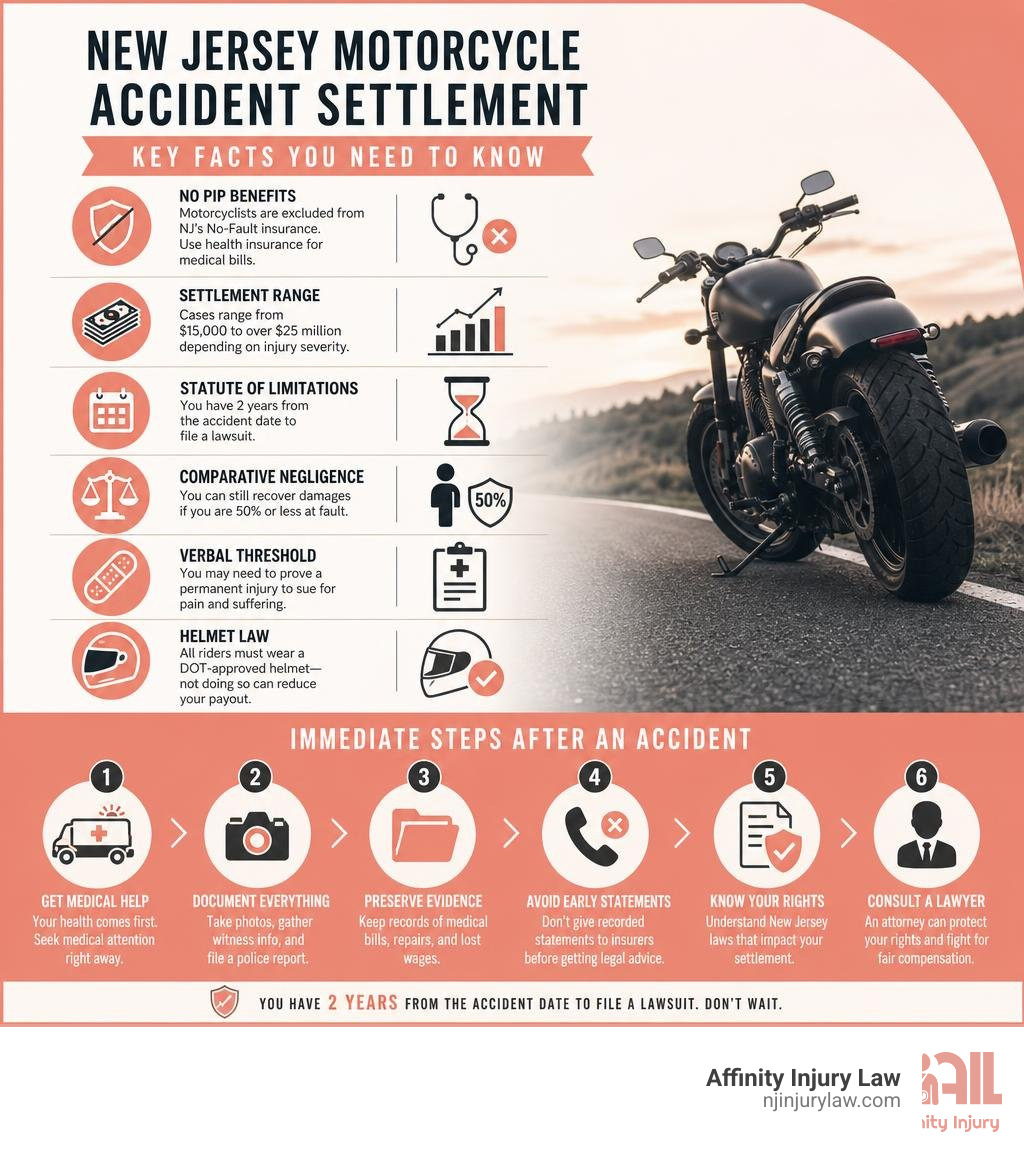
If you’re hurt and looking for a quick answer about a motorcycle accident settlement in New Jersey, here’s what you need to know right away:
| Key Factor | What It Means for You |
|---|---|
| No PIP benefits | Motorcyclists are excluded from NJ’s No-Fault insurance — you must use health insurance for medical bills |
| Settlement range | Cases range from $15,000 to over $25 million depending on injury severity |
| Statute of limitations | You have 2 years from the accident date to file a lawsuit |
| Comparative negligence | You can still recover damages if you are 50% or less at fault |
| Verbal threshold | You may need to prove a permanent injury to sue for pain and suffering |
| Helmet law | All riders must wear a DOT-approved helmet — not doing so can reduce your payout |
Every year, roughly 2,200 motorcycle riders are involved in collisions in New Jersey, and about 69 of them don’t survive. Nationally, motorcyclists are more than 28 times more likely to die in a crash than passenger car occupants. When a crash happens, the physical damage is often severe — but the financial and legal battle that follows can be just as brutal.
Insurance companies know that injured riders are desperate. They know you have medical bills piling up, you may be missing work, and you probably don’t know the legal traps built into New Jersey’s system — like the fact that you have no access to No-Fault PIP benefits that car accident victims take for granted. They use that to their advantage.
This guide pulls back the curtain on what insurers don’t want you to know about how motorcycle accident settlements in New Jersey actually work — and how to protect yourself.
I’m Ioana Enescu, Esq., a founding member of Affinity Injury Law and a lifelong New Jersey resident, and I have helped injured riders navigate the unique legal challenges of a motorcycle accident settlement in New Jersey, from proving liability to fighting insurance companies that undervalue serious injuries. Let’s walk through everything you need to know.
Motorcycle accident settlement new jersey word list:
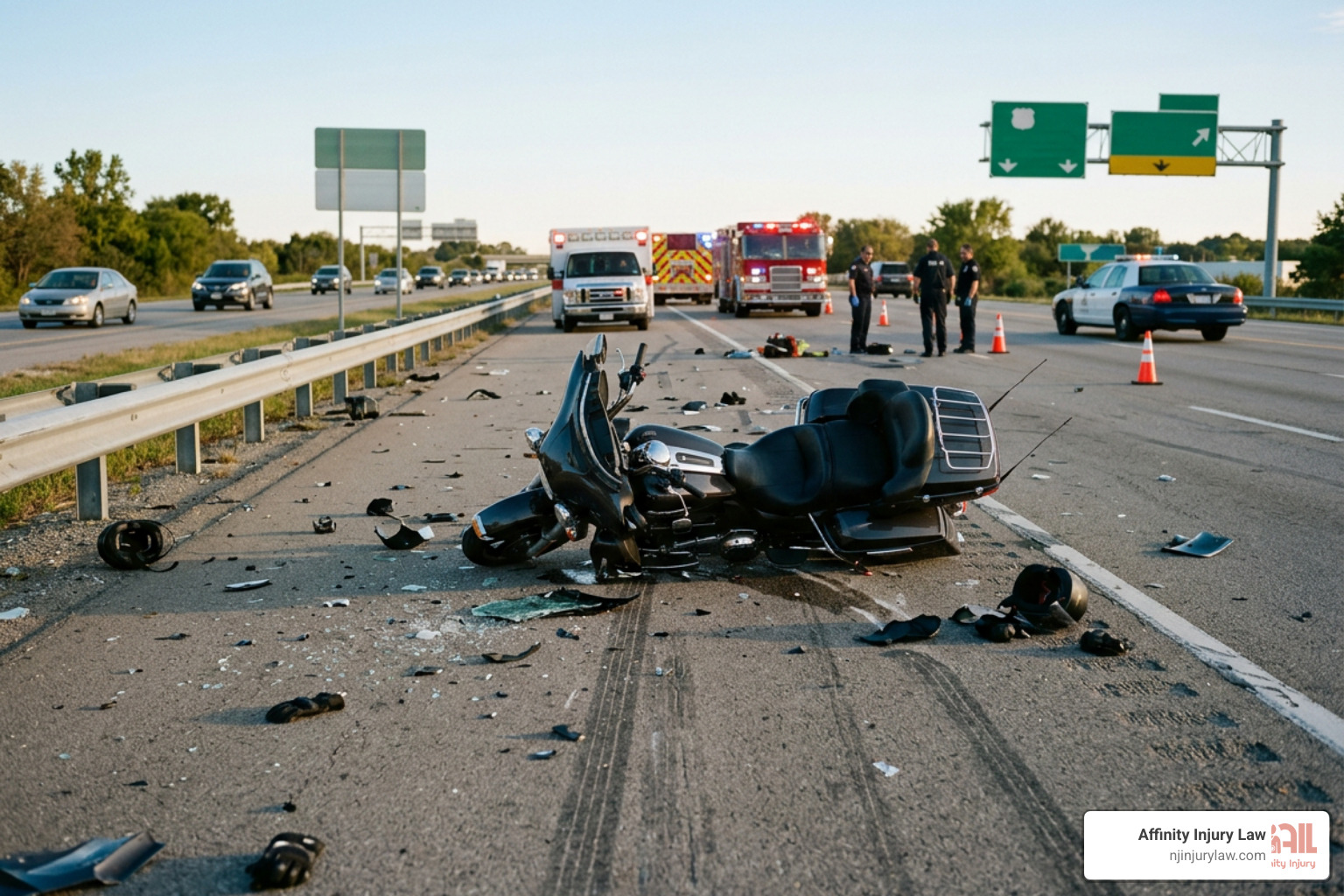
When you are thrown from a motorcycle, your life can change in a split second. But when you seek a motorcycle accident settlement in New Jersey, you quickly realize that the insurance system is not designed to be your friend.
Insurance adjusters often rely on societal biases against motorcycle riders. They paint motorcyclists as reckless daredevils who assume all risks the moment they kick up their kickstands. This bias is a calculated tactic. By shifting the blame onto you, the insurance company hopes to offer a quick, lowball settlement that represents a tiny fraction of what your case is actually worth.
There is no magical “average” settlement calculator for New Jersey motorcycle accidents. Every crash is unique, and settlement amounts vary wildly based on the facts. A minor crash resulting in temporary muscle strains might settle in the $15,000 to $30,000 range. However, serious orthopedic injuries requiring surgical intervention regularly command mid-six-figure settlements.
For instance, a motorcyclist who suffered knee and shoulder injuries requiring surgery after striking road debris settled their case for $342,500. For catastrophic, life-altering injuries like traumatic brain damage, settlements can reach into the millions. In one landmark case, a young rider catastrophically injured by a turning bus secured a $25.75 million settlement to cover a lifetime of specialized medical care.
To make sure you do not fall victim to insurance company tactics, it is crucial to work with a new jersey motorcycle settlement lawyer who understands how to combat these biases and accurately value your claim.
Factors That Determine Your Motorcycle Accident Settlement New Jersey Value
The final value of your motorcycle accident settlement in New Jersey is shaped by several critical components:
- The Severity of Your Injuries: Fractures, spinal cord damage, and brain injuries naturally command higher payouts because they require intensive medical intervention. For example, a severe femoral fracture requiring multiple surgeries and a bone graft settled for $1.7 million in a Morris County lawsuit, as reported by Motorcyclist Injured in Crash Paid $1.7 Million in Morris County Suit | Law.com .
- Past and Future Medical Bills: Because motorcycle injuries are often long-term and highly costly, your settlement must cover both immediate emergency room bills and projected future care, such as physical therapy, hardware removal, or joint replacements. You can learn more about managing these expenses in our guide on How Legal Help Can Recover Motorcycle Crash Medical Bills.
- Lost Wages and Future Earning Capacity: If your physical injuries prevent you from returning to a labor-intensive job—such as working as an auto mechanic or a construction worker—the loss of your future livelihood must be factored into the settlement.
- Pain and Suffering: This compensates you for physical pain, emotional distress, scarring, and loss of life enjoyment.
The Critical Insurance Gap: No-Fault PIP Exclusion for Motorcyclists
Perhaps the most shocking secret of New Jersey insurance law is the No-Fault PIP Exclusion.
In New Jersey, if you are injured in a standard passenger car accident, your own auto insurance policy covers your medical bills through Personal Injury Protection (PIP), regardless of who caused the crash. However, motorcycle riders and passengers are completely excluded from PIP benefits.
This means that if you are hurt on a motorcycle, you cannot rely on auto insurance PIP to pay your medical bills. Instead, you must rely on your private health insurance, union welfare funds, or Medicare.
This creates a complicated web of medical liens. When your private health insurance company pays for your accident-related medical care, they will often assert a subrogation lien against your personal injury settlement. This means they expect to be paid back out of your final settlement.
Navigating these liens requires skilled legal negotiation. A dedicated attorney can work to reduce these liens so that more of the settlement money stays in your pocket. To understand how to protect your rights under this challenging system, see How Riders Win Claims With Motorcycle Accident Lawyers.
Crucial New Jersey Motorcycle Laws That Impact Your Claim
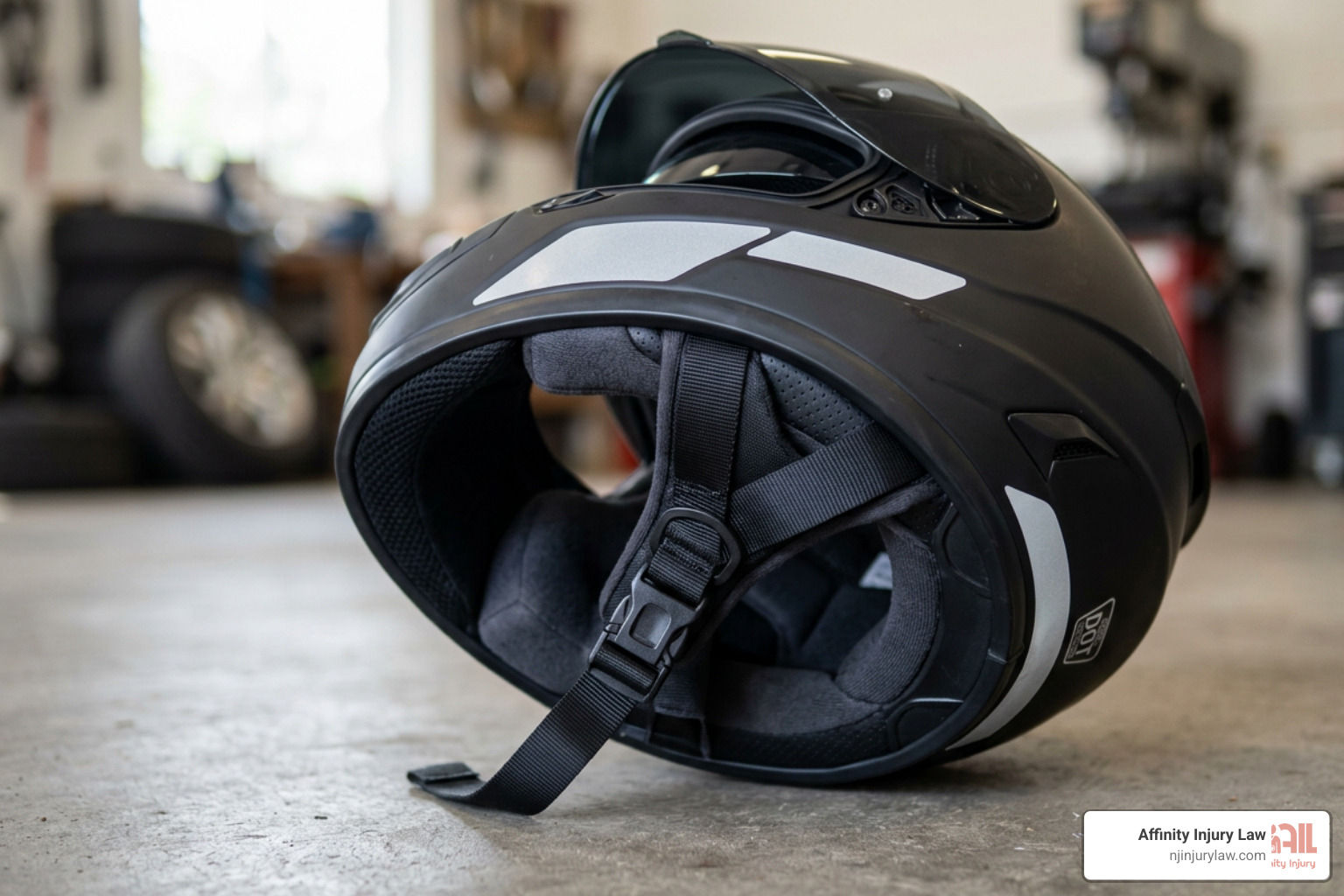
Your actions before and during the ride can directly impact your legal standing and your ultimate settlement. New Jersey has strict statutory requirements for motorcycle riders, and violating these laws can give the insurance company the ammunition they need to slash your payout.
How Helmet and Passenger Laws Affect Liability
Under New Jersey Statute N.J.S.A. 39:3-76.7, all motorcycle operators and passengers must wear a securely fitted, U.S. Department of Transportation (DOT) approved helmet. The helmet must have a neck or chin strap and feature reflectors on both sides.
If you are injured in a crash while wearing a non-DOT-approved helmet—or no helmet at all—the defense will aggressively argue comparative negligence. They will claim that your failure to wear proper safety gear directly caused or worsened your head, neck, or brain injuries. While not wearing a helmet does not completely disqualify you from seeking compensation, it can dramatically reduce your non-economic damages.
Passenger laws are also strictly enforced. To legally carry a passenger in New Jersey:
- The motorcycle must be designed to carry more than one person.
- The passenger must have a designated seat and their own functional footrests.
- The passenger must wear a DOT-approved helmet.
Violating these passenger rules can complicate your claim, as the defense may argue that the motorcycle was overloaded or unstable, contributing to the crash. To avoid these traps, read about the 5 Mistakes That Can Hurt Your Personal Injury Claim in New Jersey.
Proving Fault in Complex Crash Scenarios
Proving liability in a motorcycle accident is rarely straightforward, especially when the other driver claims they “never saw you.” Common complex scenarios include:
- Left-Turn Collisions: A passenger vehicle turns left directly into the path of an oncoming motorcycle. Drivers often misjudge the speed and distance of a smaller motorcycle.
- Blind Spot and Lane Change Collisions: Drivers frequently change lanes without checking their blind spots, forcing a motorcyclist off the road.
- Lane Splitting: Riding between lanes of traffic is illegal in New Jersey. If you were lane-splitting at the time of the crash, the insurance company will use this to place the majority of the fault on you.
To defeat these defense arguments, we regularly work with accident reconstruction experts. These specialists analyze skid marks, vehicle damage, and road measurements to prove the other driver’s negligence. If your crash involved a commercial vehicle, we also apply strict standards from the Commercial Driver License (CDL) Manual to hold professional drivers accountable. Learn more about how we handle commercial vehicle crashes through our Truck Accidents Lawyers New Jersey page.
How Comparative Negligence and the Verbal Threshold Affect Your Payout
Understanding how New Jersey’s unique legal rules apply to your case is the key to maximizing your financial recovery.
| Legal Concept | How It Works in New Jersey | Impact on Your Motorcycle Claim |
|---|---|---|
| Comparative Negligence (51% Rule) | Your compensation is reduced by your percentage of fault. If you are 51% or more at fault, you get nothing. | If a jury awards you $100,000 but finds you 20% at fault, your payout is reduced to $80,000. |
| Verbal Threshold (Limitation on Lawsuit) | Restricts your right to sue for pain and suffering unless you prove a “permanent injury.” | Good news: Under N.J.S.A. 39:6A-2, motorcycles are not “automobiles,” so the verbal threshold usually does not apply to your motorcycle claim! |
To navigate these complex rules, it is vital to consult with experienced Personal Injury Lawyers New Jersey.
Maximizing Your Motorcycle Accident Settlement New Jersey Claim
Because motorcycles are not considered “automobiles” under New Jersey’s No-Fault law, motorcycle riders are generally exempt from the verbal threshold (limitation on lawsuit) option. This is a massive advantage! It means you do not have to prove a permanent injury to sue the at-fault driver for pain and suffering.
However, insurance defense lawyers will still try to minimize your claim by arguing that your soft-tissue injuries, bulging discs, or joint pain are minor or pre-existing. To maximize your settlement, you must present undeniable medical evidence. This includes:
- Immediate emergency room or urgent care records.
- Diagnostic imaging, such as MRIs or CT scans.
- Consistent treatment records from specialists, physical therapists, or orthopedic surgeons.
If you have suffered severe physical trauma, our specialized team at Bodily Injury Lawyers New Jersey and Spinal Cord Injuries Lawyers New Jersey is prepared to build a comprehensive medical portfolio to support your claim.
Out-of-Court Settlement vs. Going to Trial
The vast majority of personal injury cases in New Jersey are settled out of court. However, deciding whether to accept a settlement or take your case to trial requires careful analysis.
- Out-of-Court Settlement: This is faster, less stressful, and carries no courtroom risks. However, once you sign a release, you permanently waive your right to seek additional compensation if your medical condition worsens.
- Jury Trial: If the insurance company refuses to offer a fair settlement, going to trial may be necessary to secure full compensation. However, trials involve significant litigation costs, including court fees and expensive expert witness testimony (such as accident reconstructionists and medical experts).
To learn how we handle these litigation costs and protect your financial interests, check out The Ultimate Guide to Hiring a Contingency Fee Accident Lawyer.
Frequently Asked Questions About New Jersey Motorcycle Claims
What is the statute of limitations for a motorcycle accident lawsuit in New Jersey?
In New Jersey, under N.J.S.A. 2A:14-2, you have exactly two years from the date of the motorcycle accident to file a personal injury lawsuit. If you miss this deadline, your right to seek compensation is permanently lost.
There are very few exceptions to this rule, which is why delaying legal action is a critical mistake. To learn more about avoiding costly procedural errors, see our guide on Common Mistakes Without Accident Injury Lawyers.
Can I still recover damages if I was partially at fault for the crash?
Yes! Under New Jersey’s comparative negligence law, you can recover damages as long as your percentage of fault is 50% or less.
However, your financial recovery will be reduced proportionally by your percentage of fault. For example, if a jury determines your total damages are $100,000, but finds you 30% responsible because you were traveling slightly over the speed limit, you will receive $70,000. If you are found 51% or more at fault, you are barred from recovering any compensation.
If you were injured in Bergen County, you can find a localized legal strategy in our Crashing in Bergen County Your Lyndhurst NJ Motorcycle Settlement Roadmap.
How does the lack of PIP benefits affect my medical bills?
Because you do not have PIP coverage, your primary health insurance is responsible for paying your medical bills after a motorcycle crash.
You will be responsible for your standard health insurance deductibles, co-pays, and out-of-pocket maximums. Furthermore, if your health insurance plan is governed by federal law (like an ERISA plan) or Medicare, they may place a subrogation lien on your final personal injury settlement to claw back the money they spent on your care.
We can help negotiate these liens down to ensure you keep the maximum amount of your settlement. For a detailed breakdown of how this process works, read How Legal Help Can Recover Motorcycle Crash Medical Bills.
Conclusion
Securing a fair motorcycle accident settlement in New Jersey requires overcoming aggressive insurance tactics, navigating the complex lack of No-Fault PIP coverage, and presenting rock-solid evidence of liability. You do not have to fight this battle alone.
At NJ Injury Law (Affinity Injury Law), we specialize in representing injured riders in Lyndhurst, Bergen County, Passaic County, and throughout New Jersey. We operate on a strict contingency fee basis—meaning you pay nothing unless we win your case. Our diverse, multilingual team is ready to stand by your side and break down communication barriers during your recovery.
If you or a loved one has been injured on a motorcycle, contact our dedicated Motorcycle Accidents Lawyers New Jersey today or visit our Contact Us page to schedule your free, confidential consultation. Let us fight for the justice and compensation you deserve.