

Finding a New Jersey Dog Bite Lawyer: What to Know First
A New Jersey dog bite lawyer can help you document your injuries, deal with the insurer, and seek payment for medical bills, missed work, and pain and suffering. When you speak with a lawyer, ask about their experience with dog bite claims, how they handle insurance negotiations, and what you would owe in fees.
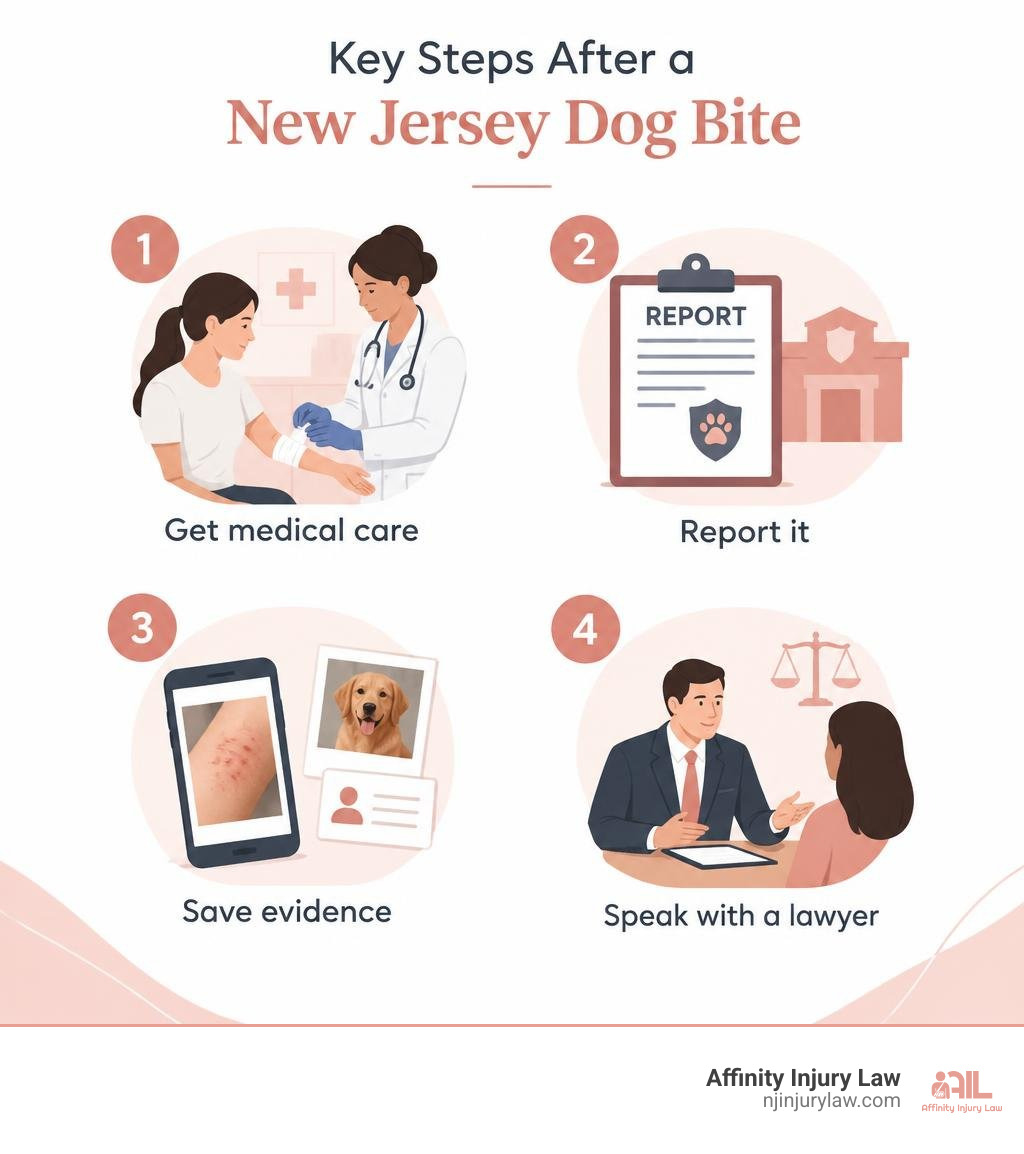
New Jersey law generally holds a dog owner responsible for a bite that happens in a public place or while you are lawfully on private property, even if the dog has never bitten anyone before. Get medical care, report the bite, and save photos and witness details as soon as you can.
I’m Ioana Enescu, Esq., a New Jersey native and founding member of Affinity Injury Law. My work advocating for injured clients and their medical care informs this guide for people searching for “dog bite lawyers new jersey,” starting with the steps below.
Dog bite lawyers new jersey further reading:
Understanding New Jersey Dog Bite Law: Strict Liability Explained
When an animal attack turns a routine walk or a visit to a neighbor into an emergency, understanding the law helps remove the guesswork from your recovery. In New Jersey, animal attacks are governed under the legal doctrine known as strict liability, codified under N.J.S.A. 4:19-16. This statute provides strong legal protection for victims injured by dog bites across the state.
Under N.J.S.A. 4:19-16, a dog owner is held legally liable for the damages suffered by any person bitten by the dog, provided two straightforward conditions are met:
- The victim was in a public place (such as a sidewalk, park, or public building), or
- The victim was lawfully on private property, which includes the property of the dog owner (such as an invited social guest, contractor, or postal carrier).
Because liability is strict, the victim does not have to prove that the dog owner acted carelessly, failed to maintain a proper leash, or knew that the animal had aggressive tendencies. This legal protection is essential given broader trends; major outlets like The New York Times frequently report on the rising healthcare and financial costs associated with serious animal attacks nationwide.
New Jersey consistently ranks among the states with the highest dog bite claim costs. With over 1,200 claims filed annually across the state, the average cost per claim hovers around $50,000—well above the national average of approximately $44,000. In recent years, New Jersey ranked 8th nationwide for total insurance payouts for animal attacks, exceeding $60 million in claim settlements.
| Legal Element | New Jersey Strict Liability (N.J.S.A. 4:19-16) | Common Law Negligence |
|---|---|---|
| Prior Aggression Proof | Not required | Required (must show prior viciousness or knowledge) |
| Owner Carelessness | Not required to prove lack of care | Must prove failure to exercise reasonable care |
| Location Requirement | Public space or lawful presence on private property | Any location where duty of care is established |
| Applies To | Direct bite wounds | Non-bite injuries (scratches, knock-downs, secondary falls) |
Why Prior Vicious Propensity Is Irrelevant Under State Law
In many jurisdictions, laws still follow the outdated “one-bite rule,” which essentially excuses an owner from liability for a first attack if the dog had never shown aggression before. New Jersey does not follow this rule.
Under our state’s strict liability statute, past behavior and owner awareness of aggressive tendencies are irrelevant in bite cases. It does not matter if the animal was previously considered the gentlest pet on the block or had never growled at a stranger. The owner is held accountable the very first time their dog bites someone who is lawfully present.
Courts do not require you to track down past veterinary records, seek out neighbors to prove past barking or lunging, or establish a pattern of vicious propensity when seeking damages for an actual bite. The statute centers entirely on the fact that an attack occurred and caused bodily harm.
Common Defenses Used Against Dog Bite Victims
While New Jersey’s strict liability statute heavily favors bite victims, insurance carriers representing dog owners still raise defenses to minimize or deny payouts. When filing a dog bite claim with an NJ lawyer, you should anticipate the two primary statutory defenses:
- Trespassing: Strict liability only applies if you were lawfully on the property. If an individual enters private property without express or implied permission and without a legal duty (such as delivering mail or reading meters), the owner may argue the victim was trespassing.
- Provocation: If an owner can demonstrate that the injured person deliberately tormented, struck, or provoked the dog into attacking, the court may reduce or eliminate the owner’s liability under New Jersey’s comparative negligence principles.
Additionally, under New Jersey’s modified comparative fault rules, if an injured party’s own negligent actions contributed to the incident (for instance, ignoring clear warning signs or separating fighting dogs with bare hands), compensation may be reduced proportionately. However, as long as your share of fault is 50% or less, you can still recover damages.
Critical Steps to Take Immediately After an Attack

The moments directly following an animal attack can be overwhelming, but taking prompt action protects both your physical recovery and your legal rights. Knowing what steps to take helps ensure that crucial evidence is preserved before it disappears.
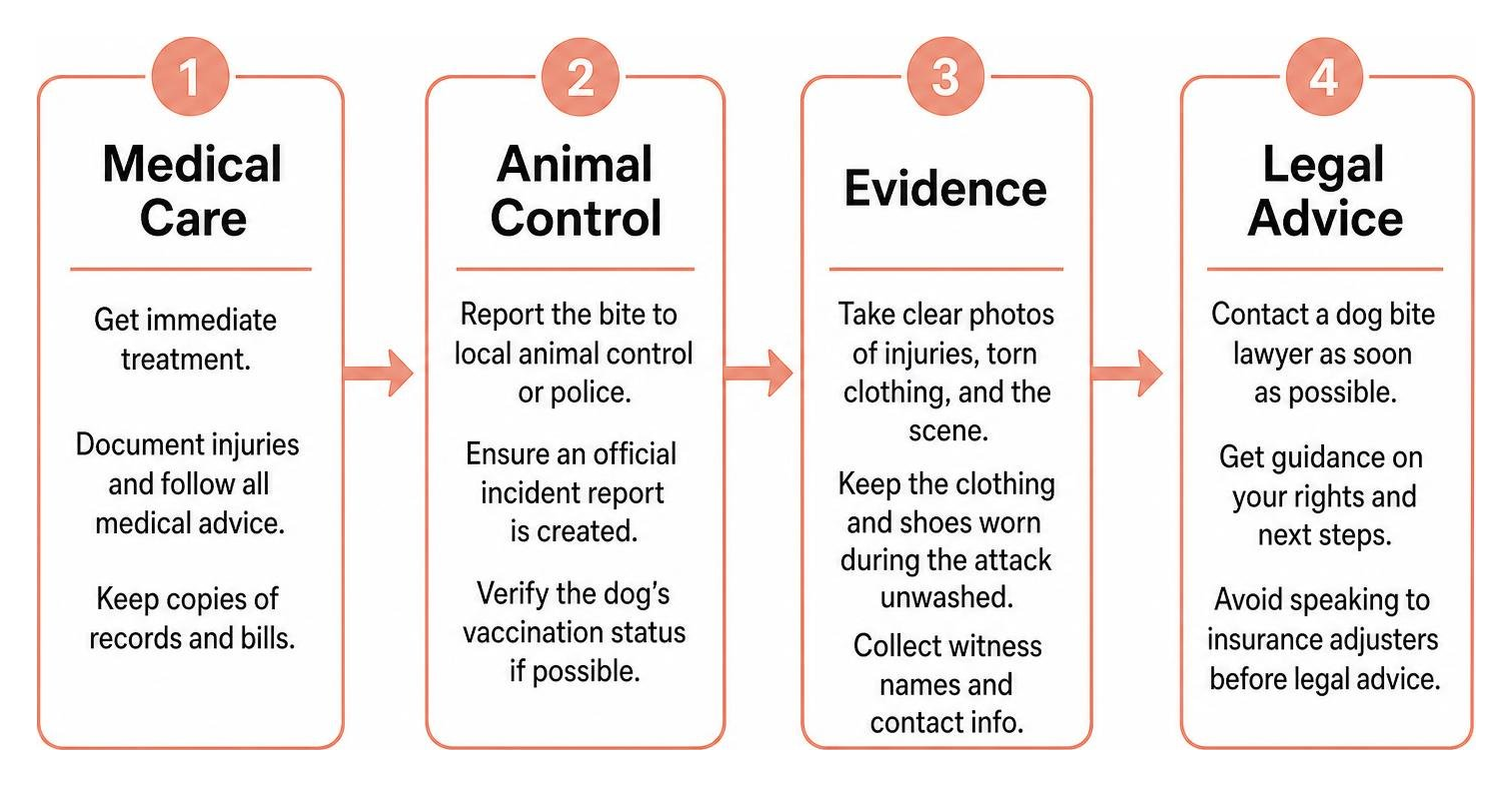
- Seek Immediate Medical Attention: Animal bites carry severe risks of bacterial infection, tissue loss, and nerve damage. Visit an emergency department or urgent care facility right away to clean wounds, receive tetanus or rabies shots, and document your injuries in formal medical records.
- Identify the Dog and Owner: Obtain the pet owner’s full name, address, phone number, and homeowners or renters insurance details. Verify the animal’s rabies vaccination status whenever possible.
- Report the Attack to Local Authorities: Notify municipal animal control or the local police department in the town where the attack took place (whether in Lyndhurst, Clifton, Hackensack, or elsewhere in Bergen or Passaic County). An official incident report creates an independent, formal record of the bite.
- Preserve Physical Evidence: Keep the clothing and footwear worn during the attack in an unwashed condition. Take high-resolution photographs of all bite wounds, bruises, torn items, and the exact location where the incident occurred.
- Gather Eyewitness Information: Collect names, phone numbers, and written recollections from anyone who witnessed the attack or observed the dog roaming unrestrained prior to the incident.
Statute of Limitations for Filing in New Jersey
In New Jersey, personal injury claims resulting from dog bites are governed by a strict statute of limitations under N.J.S.A. 2A:14-2. In most situations, an injured adult has two years from the exact date of the attack to file a formal civil lawsuit against the responsible parties.
Failing to file your lawsuit before this two-year deadline permanently bars you from seeking financial recovery in court, regardless of how severe your injuries or financial losses might be.
An important exception applies to minor children: children aged 5 to 9 account for nearly 30% of all reported dog bites in New Jersey. When a minor is bitten, the two-year statute of limitations clock is typically paused (“tolled”) until the child reaches their 18th birthday. This gives them until their 20th birthday to file suit. Even with this extension, gathering evidence, securing witness accounts, and pursuing insurance claims early provides the strongest foundation for full compensation.
Compensation and Damages Available to Dog Bite Victims

A severe animal attack can result in significant financial, physical, and emotional disruption. In New Jersey, victims can pursue compensatory damages designed to restore their financial standing and account for subjective suffering.
Damages in dog bite cases are divided into two main categories:
- Economic Damages: Measurable financial losses directly tied to the injury. These include ambulance transport, emergency room fees, surgery costs, physical therapy, prescription medications, future reconstructive procedures, lost wages from missed work, and diminished earning capacity if you cannot return to your prior role.
- Non-Economic Damages: Intangible losses reflecting the human cost of the injury. This covers physical pain and suffering, loss of enjoyment of life, permanent impairment, and severe cosmetic disfigurement. If you or a loved one suffered lacerations resulting in permanent marks, consulting a Lyndhurst dog bite attorney for severe scars can help ensure these life-altering aesthetic injuries are properly valued.
Emotional Trauma and Long-Term Rehabilitation
The psychological impact of an animal attack often outlasts the initial physical wounds. Victims—particularly young children—frequently experience symptoms of Post-Traumatic Stress Disorder (PTSD), severe cynophobia (fear of dogs), night terrors, anxiety, and social withdrawal.
Comprehensive legal claims account for ongoing mental healthcare costs, such as cognitive behavioral therapy, alongside medical rehabilitation. When deep tissue damage or facial lacerations occur, recovery often requires multiple stages of plastic and reconstructive surgery over several years. Calculating a fair claim value requires accounting for both current medical bills and the projected cost of long-term psychological and surgical care.
When and How Dog Bite Lawyers New Jersey Help Your Case
Most dog bite claims do not involve suing an individual’s personal savings directly; instead, payouts are typically covered by homeowners, renters, or commercial liability insurance policies. However, insurance carriers routinely deploy adjusters to minimize claim values, dispute injury severity, or shift blame onto the victim.
Navigating these claims requires understanding both local legal practice and insurance company tactics. When evaluating legal support, learning how to choose a dog bite claim attorney in Passaic County ensures you partner with experienced advocates who understand regional procedures and can accurately assess your claim’s value.
Approximately 70% of dog bite cases in New Jersey resolve through negotiated settlements before ever reaching trial. Experienced legal representation levels the playing field during negotiations, ensuring insurers take your claim seriously and present fair settlement offers.
How Dog Bite Lawyers New Jersey Prove Liability and Negligence
Although direct bites fall under strict liability, proving the full scope of damages and establishing accountability for non-bite injuries (such as when an unleashed dog charges and knocks someone over, causing a broken hip) requires thorough investigative work.
We establish comprehensive liability by:
- Subpoenaing municipal animal control logs, past police complaints, and local licensing records.
- Proving violations of municipal leash laws and restraint ordinances across local townships like Paramus, Fair Lawn, Paterson, and Wayne.
- Working with medical experts and plastic surgeons to document the permanent nature of scar tissue and functional impairments.
- Reconstructing the incident using surveillance footage, doorbell cameras, and witness testimony to defeat claims of trespassing or provocation.
Working with Dog Bite Lawyers New Jersey Across County Courts
Every county court system throughout Northern New Jersey manages personal injury dockets with unique local rules and case management conferences. Whether you are filing a dog bite claim with a Bergen County attorney or pursuing litigation through the Passaic County Superior Court, having local familiarity with court procedures, mandatory non-binding arbitration, and settlement conferences helps move your case forward efficiently.
We handle civil litigation throughout Bergen, Passaic, and surrounding New Jersey counties, ensuring all court filings, discovery responses, and expert reports comply with state court guidelines.
Frequently Asked Questions About New Jersey Dog Bite Claims
Does New Jersey follow the one-bite rule for dog attacks?
No. New Jersey does not follow the “one-bite rule.” Under N.J.S.A. 4:19-16, dog owners are strictly liable for bite injuries regardless of whether the dog has ever shown prior signs of viciousness or bitten anyone in the past.
How long do I have to file a dog bite lawsuit in New Jersey?
In most cases, adults have two years from the date of the dog bite to file a personal injury lawsuit under New Jersey’s statute of limitations. For injured minor children, this two-year deadline is paused until their 18th birthday, giving them until age 20 to file.
What if I was bitten while legally visiting private property?
If you were on private property as an invited social guest, service provider, postal worker, or delivery driver, you are considered lawfully present under New Jersey law. The strict liability statute protects you, and the property owner’s homeowners or renters insurance policy typically covers your resulting medical expenses and related damages.
Conclusion
Recovering from an animal attack is physically demanding and emotionally draining. You should not have to carry the financial burden of emergency room bills, missed work, and ongoing medical procedures on your own.
At Affinity Injury Law (NJ Injury Law), our team is dedicated to helping injured victims navigate the legal system with clarity and care. We provide personalized legal representation with multilingual support, ensuring that language is never a barrier to asserting your legal rights. We operate on a contingency fee basis—meaning you pay no legal fees unless we successfully recover compensation for your case.
If you or a family member was injured in an attack across Lyndhurst, Hackensack, Paterson, Passaic, Clifton, or anywhere else in New Jersey, contact our dedicated dog bite lawyers new jersey today to discuss your rights and take the first step toward recovery.