


When a Loved One Dies Because of Someone Else’s Negligence
A wrongful death claim in NJ gives surviving family members the legal right to seek financial compensation when a loved one is killed due to someone else’s negligence or wrongful act.
Here is what you need to know right away:
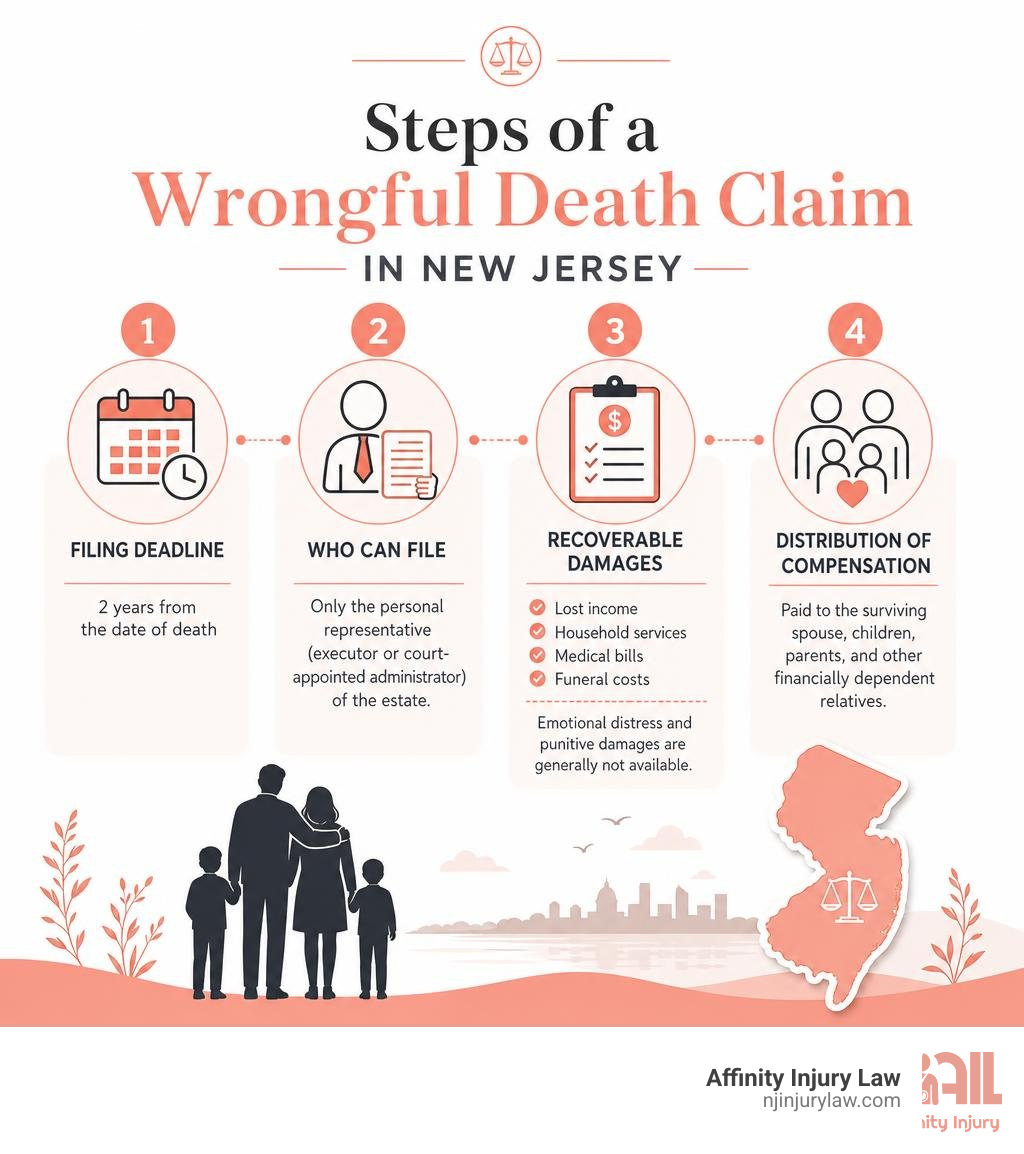
- Who can file: Only the personal representative (executor or court-appointed administrator) of the deceased’s estate can file the lawsuit.
- Who can recover: The surviving spouse, children, parents, and other financially dependent relatives.
- Deadline: You have 2 years from the date of death to file, or you lose the right to recover.
- What you can recover: Financial losses such as lost income, household services, medical bills, and funeral costs. Emotional distress and punitive damages are generally not available.
- Two types of claims: A wrongful death claim (for survivors’ losses) and a survival action (for the deceased’s pre-death pain and suffering) can often be filed together.
Losing someone unexpectedly is devastating. When that loss could have been prevented, the grief is often mixed with anger, confusion, and urgent financial pressure. Medical bills pile up. Income disappears. And insurance companies move fast to protect their interests — not yours.
New Jersey’s wrongful death laws are complex. The rules about who can file, what you can recover, and how the money gets distributed are strict and easy to get wrong without legal guidance.
This guide walks you through every step, in plain language.
My name is Ioana Enescu, Esq., founding member of Affinity Injury Law, and I have dedicated my practice to fighting for New Jersey families navigating a wrongful death claim in NJ after suffering an unexpected and devastating loss. As the daughter of two physicians, I bring a unique understanding of medical and injury cases to every client I represent.
Understanding the Legal Process of a Wrongful Death Claim in NJ
When a fatal accident occurs because of a person’s or entity’s reckless, careless, or intentional behavior, New Jersey law steps in to offer civil liability solutions. A wrongful death claim is essentially a civil lawsuit designed to provide financial recourse for the survivors left behind.
The fundamental rule of a wrongful death action in New Jersey is simple: the lawsuit can only be pursued if the deceased person would have had the legal right to file a personal injury claim had they survived the incident. If their own injuries would have warranted a lawsuit, their death warrants a wrongful death claim.
However, time is your absolute enemy in these cases. Under New Jersey statute N.J.S.A. 2A:31-3, there is a strict two-year statute of limitations for filing a wrongful death lawsuit. This means the legal action must be officially filed in court within two years of the exact date of your loved one’s death. If you miss this deadline, your right to seek justice and financial recovery is permanently barred.
While there are rare exceptions—such as cases involving criminal homicide convictions where the perpetrator is prosecuted—you should never assume your case qualifies for an extension. Waiting too long is one of the most devastating 5 Mistakes That Can Hurt Your Personal Injury Claim in New Jersey. Understanding the nuances of the New Jersey Wrongful Death Law early on is the best way to safeguard your family’s future.
Proving Negligence in a Wrongful Death Claim in NJ
To successfully recover damages in a wrongful death claim, we must establish that the defendant’s negligence directly caused your loved one’s death. In legal terms, this requires proving four key elements:
- Duty of Care: The defendant owed the deceased a legal duty to act reasonably (for example, a driver’s duty to obey traffic laws, or a doctor’s duty to provide standard medical care).
- Breach of Duty: The defendant failed to uphold that duty (e.g., running a red light or misdiagnosing a treatable condition).
- Causation: The defendant’s breach directly caused the fatal accident or injury.
- Damages: The death resulted in real, quantifiable financial losses for the surviving beneficiaries.
Proving causation is often the most heavily contested part of a lawsuit. It requires a thorough, immediate investigation, preserving physical evidence, interviewing witnesses, and working with top-tier experts like accident reconstructionists or medical professionals. Whether we are dealing with fatal collisions analyzed by our Car Accidents Lawyers New Jersey or complex medical errors reviewed by our Medical Malpractice Lawyers New Jersey, establishing a clear, undeniable chain of causation is the cornerstone of a successful claim.
Common Accidents Leading to a Wrongful Death Claim in NJ
Tragic losses can happen anywhere, but certain scenarios frequently lead to wrongful death actions in New Jersey. Some of the most common include:
- Fatal Motor Vehicle Crashes: Distracted driving, speeding, and driving under the influence remain leading causes of fatal accidents on New Jersey roadways. These cases often require swift action to secure dashcam footage and black box data, areas where our Truck Accidents Lawyers New Jersey focus their investigative efforts.
- Workplace and Construction Site Accidents: Falls from scaffolding, defective machinery, and structural collapses claim lives far too often. Our Construction Accident Lawyers New Jersey frequently help families hold negligent third-party contractors and equipment manufacturers accountable.
- Defective Products: From failing auto parts to unsafe medical devices, manufacturers who put profits over safety can be held strictly liable for fatal defects.
- Premises Liability: Property owners who fail to maintain safe conditions—such as neglecting secure fencing around a pool or failing to install adequate security—can face claims if their neglect leads to a fatal drowning or assault.
Who Has Legal Standing and How is Compensation Distributed?
A common point of confusion for grieving families is who actually has the right to file the lawsuit. In New Jersey, you cannot simply walk into a courthouse and file a wrongful death claim because you are the spouse, child, or parent of the deceased. The law requires a specific legal structure to bring the case forward.

Under New Jersey Wrongful Death Laws, only the personal representative of the deceased’s estate has the legal standing to file a wrongful death lawsuit.
The Role of the Personal Representative
The personal representative acts as the official voice of the estate. If your loved one left behind a valid will, they likely named an executor to manage their affairs. If there is no will, or if the named executor cannot serve, the New Jersey Surrogate’s Court in the county where your loved one resided (such as Bergen County or Passaic County) will appoint an administrator or an administrator ad prosequendum (a representative specifically appointed to pursue a wrongful death lawsuit).
The personal representative’s duties include:
- Initiating the legal process and hiring qualified legal counsel.
- Serving as the named plaintiff in the lawsuit.
- Managing the collection of evidence, medical records, and financial documents.
- Reviewing settlement offers in consultation with the heirs and legal team.
It is important to note that while the personal representative files the lawsuit, they do not automatically keep the compensation. They act as a trustee, holding any recovered funds for the exclusive benefit of the eligible survivors.
Eligible Beneficiaries and Distribution Hierarchy
Once a settlement or jury verdict is reached, the compensation is distributed to the eligible beneficiaries. New Jersey does not distribute these funds equally; instead, it follows a strict hierarchy based on actual financial dependency on the deceased at the time of death.
The primary beneficiaries who have first priority under the law include:
- The surviving spouse and biological or adopted children: They are presumed to be dependent and receive priority distribution.
- Surviving parents: If there is no spouse or child, the parents are next in line to recover.
- Siblings, nieces, and nephews: They may recover only if they can prove they were actually financially dependent on the deceased and there are no surviving spouses, children, or parents.
To qualify for a share of the recovery, beneficiaries must demonstrate their level of dependency. New Jersey courts evaluate factors such as age, health, financial status, and the amount of support the deceased regularly provided to each relative to determine a fair allocation of the funds.
Wrongful Death Claims vs. Survival Actions in New Jersey
When a negligent act leads to a fatality, New Jersey law actually allows for two separate and distinct legal claims: a Wrongful Death Claim and a Survival Action (governed by the Survivor Act under N.J.S.A. 2A:15-3).
Understanding the differences between these two claims is vital, as they compensate for different losses, distribute funds to different recipients, and carry distinct tax and creditor implications.
| Feature | Wrongful Death Claim (N.J.S.A. 2A:31-1) | Survival Action (N.J.S.A. 2A:15-3) |
|---|---|---|
| What it Compensates | The financial losses suffered by the survivors as a result of the death. | The personal injury losses suffered by the decedent before they died. |
| Key Damages | Lost future income, loss of household services, funeral and burial costs, loss of guidance. | Pre-death conscious pain and suffering, medical bills incurred before death, lost wages up to the date of death. |
| Who Receives the Funds | Paid directly to the dependent beneficiaries (bypassing the estate’s creditors). | Paid to the deceased’s estate (subject to estate taxes, wills, and creditor claims). |
| Filing Authority | Personal representative (on behalf of the heirs). | Personal representative (on behalf of the estate). |
Historically, filing both claims was a procedural headache. Before a major legislative update, representatives had to secure separate court-authorized “letters” to pursue both actions, and a minor technical error could result in losing the right to sue.
Fortunately, Assembly Bill 6133 simplified this process. The law now permits an executor, administrator, or administrator ad prosequendum to file both survival and wrongful death claims under a single authorization, eliminating unnecessary red tape for grieving families.

If your loved one did not pass away instantly—for example, if they survived for hours, days, or weeks in a hospital following a medical error or car accident—a survival action is critical. It allows us to seek compensation for the conscious pain, fear, and suffering they endured during those final moments, ensuring the negligent party is held fully accountable for the entirety of the harm they caused.
Recoverable Damages: What Can Families Actually Recover?
Calculating the value of a human life is an impossible task. No amount of money can replace a parent, spouse, or child. However, the civil justice system’s only tool for righting a wrong is financial compensation.
In New Jersey, the damages you can recover are governed by strict statutory rules and standardized jury instructions, specifically outlined in the New Jersey Judiciary’s 8.43 Wrongful Death model charges.
Why Emotional Distress and Punitive Damages Are Generally Excluded
One of the most surprising and frustrating aspects of New Jersey’s Wrongful Death Act for grieving families is that it strictly limits recovery to “pecuniary” (financial) losses.
This means that under the Wrongful Death Act, you cannot recover damages for:
- Your grief, sorrow, and mental anguish.
- The loss of the emotional satisfaction you received from your loved one’s companionship.
- Punitive damages (damages meant to punish the defendant), which are generally banned in standard wrongful death claims unless there is a separate survival action involving incredibly reckless or intentional conduct, such as a fatal drunk driving crash.
Note: If a close family member personally witnessed the fatal accident, they may be able to file a separate civil claim for Negligent Infliction of Emotional Distress (NIED). However, within the wrongful death claim itself, the focus remains strictly economic.
How Pecuniary Damages Are Calculated and Distributed
Because New Jersey law limits recovery to financial injury, we must build a meticulous economic case. Pecuniary damages are not just about the deceased’s salary; they cover a wide range of economic contributions:
- Loss of Financial Support: The net income (after taxes and personal maintenance expenses) the deceased would have contributed to support their dependents over their projected working life.
- Loss of Services: The tangible value of household chores, childcare, cooking, home maintenance, and administrative tasks. We calculate this by determining what it would cost to hire a professional (e.g., a housekeeper, landscaper, or nanny) to perform these services.
- Loss of Guidance, Care, and Nurturing: For surviving children, the loss of a parent’s moral guidance, training, and educational assistance has a high, legally recognized economic value.
- Funeral and Medical Expenses: The cost of medical treatment prior to death and reasonable funeral and burial expenses.
To prove these losses, we regularly collaborate with forensic economists and life expectancy experts. These professionals analyze the deceased’s age, health, career trajectory, and historical earnings to calculate the “present value” of their future contributions, adjusted for inflation and interest rates. This ensures the settlement or verdict we secure will provide for your family’s long-term financial stability.
Frequently Asked Questions About New Jersey Wrongful Death Laws
Can stepchildren or unmarried partners recover damages in NJ?
Under New Jersey’s strict statutory definitions, stepchildren cannot recover wrongful death damages unless they were legally adopted by the deceased before the fatal incident. Similarly, unmarried partners—regardless of how long they lived together or how financially dependent they were—generally do not have standing to recover damages unless they were legally recognized domestic partners or civil union partners under New Jersey law.
What happens if the deceased did not leave a will?
If your loved one died “intestate” (without a will), the local Surrogate’s Court will appoint a general administrator—usually the surviving spouse or next of kin—to manage the estate and handle the lawsuit. Any recovery from a wrongful death claim will be distributed to the legal heirs according to New Jersey’s intestate succession laws, which prioritize spouses, children, and parents.
Does a life insurance payout affect a wrongful death lawsuit?
No. Under New Jersey’s collateral source rule, any independent financial benefits you receive as a result of your loved one’s death—such as life insurance policies, private pensions, or Social Security survivor benefits—cannot be used by the defense to reduce the amount of damages they owe you in a wrongful death lawsuit.
Conclusion
Losing a loved one is a profoundly painful experience, and trying to handle a complex legal battle while grieving can feel completely overwhelming. Insurance adjusters know you are vulnerable, and they often use this time to push for quick, lowball settlements before the full scope of your financial losses is understood.
At Affinity Injury Law, we believe you shouldn’t have to carry this burden alone. We serve families across New Jersey, including Lyndhurst NJ, Bergen County NJ, and Passaic County NJ. Our compassionate legal team is committed to handling every detail of your wrongful death claim in NJ—from navigating surrogate court appointments to building a powerful economic case—so you can focus on healing with your family.
We operate on a strict contingency fee basis, meaning there are absolutely no upfront costs, and you pay us nothing unless we win your case. Additionally, we offer robust multilingual support to ensure you can communicate comfortably and clearly with us in your preferred language throughout the process.
Do not let administrative hurdles or insurance tactics jeopardize your family’s future security. Avoid the Common Mistakes Without Accident Injury Lawyers and protect your rights.
If you are ready to explore your options, contact our experienced Wrongful Death Lawyers New Jersey today. Let our dedicated Personal Injury Lawyers New Jersey stand in your corner, fight for the justice your loved one deserves, and help you find a path forward.