


What a Lyndhurst Injury Attorney Usually Costs
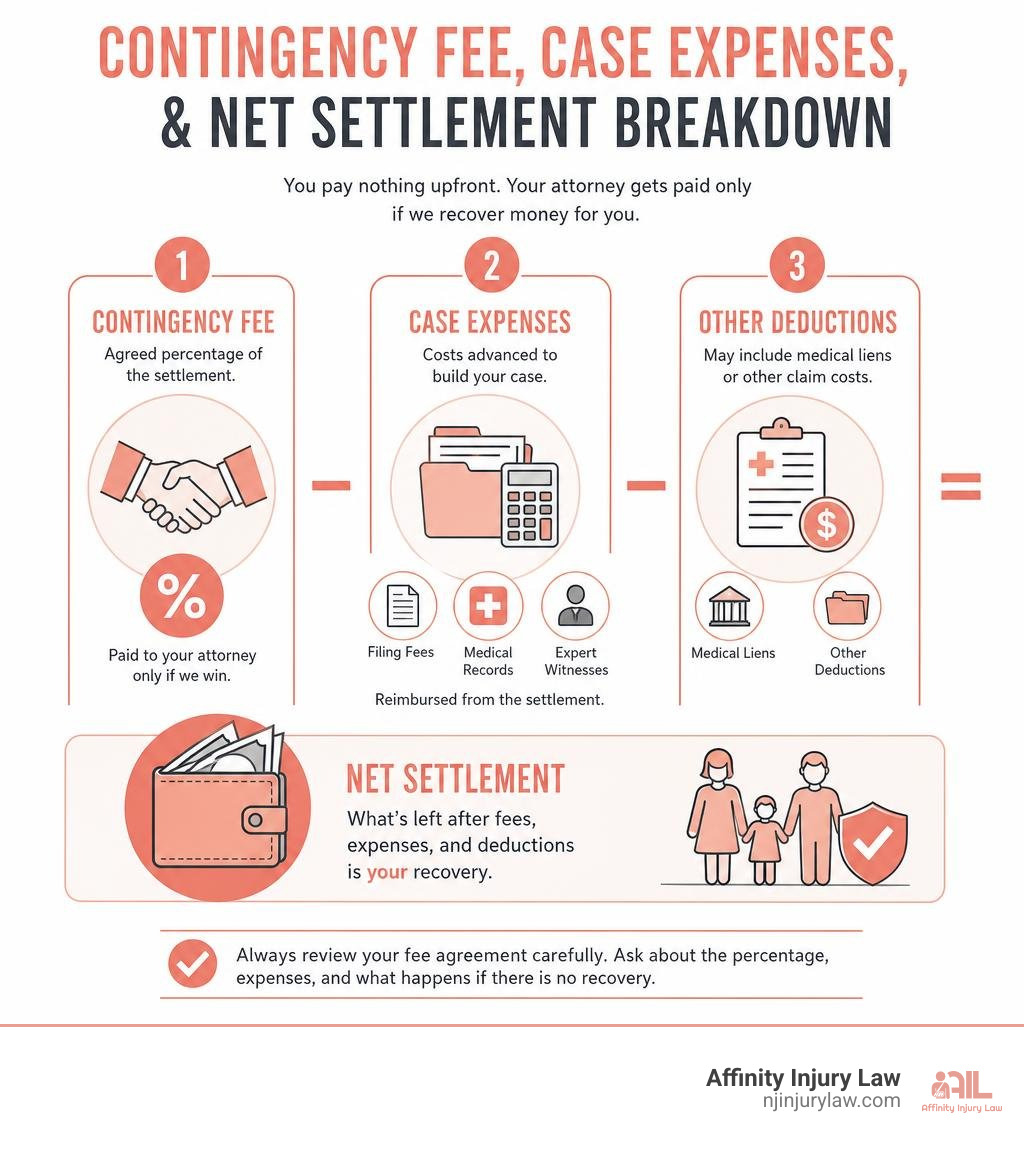
For most accident cases, Lyndhurst injury attorney cost is not paid upfront. Personal injury lawyers commonly use a contingency fee: they receive an agreed percentage of a settlement or court award only if they recover money for you. Before hiring anyone, ask for the percentage in writing, whether it increases if a lawsuit is filed, and who pays case expenses such as filing fees, medical records, and expert witnesses.
A quick way to compare fee agreements:
- Ask what percentage the lawyer receives before and after a lawsuit begins.
- Ask whether expenses come out before or after the attorney fee is calculated.
- Ask what, if anything, you could owe if there is no recovery.
- Read the retainer agreement before signing, especially its cost-repayment language.
The lowest percentage is not always the lowest total cost. A clear agreement should show how fees, case expenses, medical liens, and other deductions may affect your final net recovery.
I am Ioana Enescu, Esq., a founding member of Affinity Injury Law and a New Jersey attorney focused on helping injured people understand their options while seeking the care they need. When discussing Lyndhurst injury attorney cost, I believe clients deserve plain answers about fees, expenses, and what they may receive at the end of a case.
Lyndhurst injury attorney cost basics:
Understanding Lyndhurst Injury Attorney Cost and Fee Structures
When you or someone close to you is hurt in an accident, the last thing you need is a mountain of legal bills arriving in your mailbox each month. Fortunately, the personal injury field operates very differently from corporate law or divorce practice. Instead of demanding thousands of dollars in an upfront retainer, our legal system allows lawyers to work under a contingency fee model.
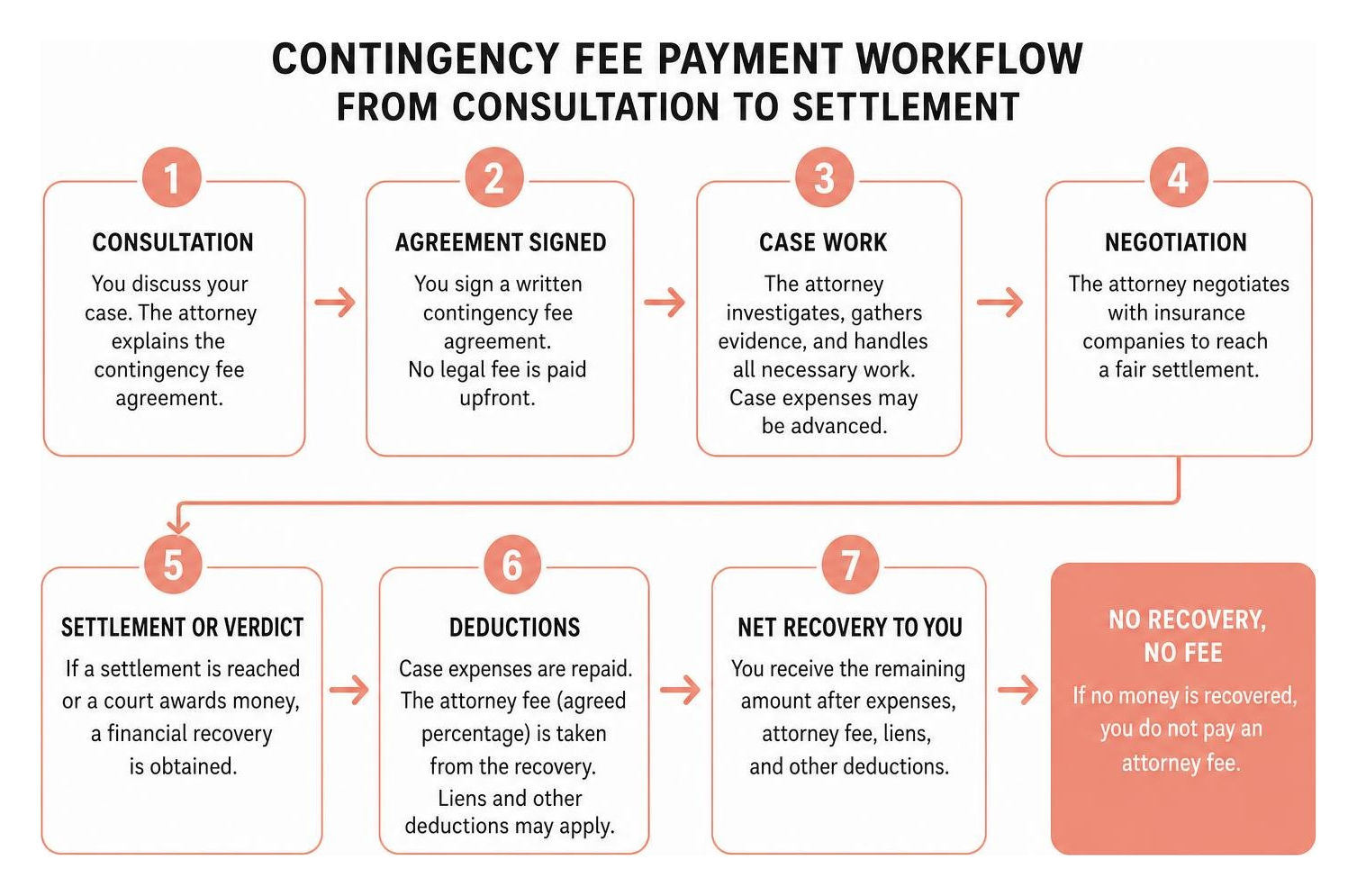
Under a pure contingency arrangement, legal fees are strictly contingent on a positive outcome. You pay zero legal fees while your case is ongoing. If we recover money through an insurance settlement or a courtroom verdict, our fee is paid as an agreed-upon percentage of that financial recovery. If we do not obtain financial compensation for you, you do not pay us an attorney fee.
Understanding how this structure functions is the best way to safeguard your financial recovery. For a deeper breakdown of how this model protects claimants, you can explore The Ultimate Guide to Hiring a Contingency Fee Accident Lawyer.
Standard Percentage Breakdown of Lyndhurst Injury Attorney Cost
Contingency fee rates are structured to align our goals directly with yours: maximizing your overall payout. However, the exact percentage can vary based on the stage at which your case concludes. In New Jersey, statutory guidelines and court rules (such as Rule 1:21-7) help govern maximum contingency fee percentages on personal injury recoveries to ensure that injured clients are treated fairly.
A typical fee schedule depends on whether the claim is resolved early through direct negotiations with an insurance adjuster or whether formal litigation, discovery, and trial are required:
| Litigation Stage | Typical Fee Percentage | Reason for Fee Structure |
|---|---|---|
| Pre-Litigation Settlement | ~33.3% (One-Third) | Claim is resolved via demand package, negotiations, and insurance settlement before filing a formal complaint in court. |
| Formal Lawsuit & Trial | ~33.3% to 40% | Lawsuit is filed, requiring extensive court filings, depositions, independent medical exams, motion practice, and trial representation. |
| Appellate Proceedings | Up to 40% (or negotiated rate) | If the opposing party appeals a verdict, additional appellate briefs and oral arguments before higher courts demand extensive legal work. |
Having clear fee tiers established from day one ensures that you never encounter surprises when the insurance carrier issues the settlement check.
How Case Expenses Influence Total Lyndhurst Injury Attorney Cost
Attorney fees and case expenses are two distinct categories on your final settlement distribution sheet. While the attorney fee compensates your legal team for their labor, representation, and advocacy, case expenses (often called disbursements) are the hard costs paid to third parties to build and prove your claim.
To establish liability and quantify your injuries, we advance several necessary costs:
- Court filing fees: Official fees paid to the county clerk to initiate your summons and complaint.
- Medical records retrieval: Fees charged by hospitals, diagnostic imaging centers, and treating physicians to release official charts and billing histories.
- Expert witness fees: Retaining accident reconstruction engineers, life care planners, and medical specialists who draft professional reports and provide sworn testimony.
- Deposition and transcription costs: Paying court reporters to record and transcribe sworn testimony from defendants, witnesses, and responding police officers.
- Investigative fees: Retaining private investigators or digital technicians to retrieve traffic surveillance footage before it is overwritten.
During your case, your law firm covers these costs upfront so that you do not have to pay out of pocket. Once your case settles, these advanced disbursements are reimbursed directly from the gross recovery.
Hidden Legal Costs and What Happens If You Do Not Win

No one likes fine print, especially when dealing with physical recovery. A primary concern for injured individuals is whether an unsuccessful claim will result in unexpected out-of-pocket bills.
Legitimate personal injury practices operate on a true “no win, no fee” framework. When you sign a retainer agreement, it should explicitly outline how advanced case expenses are handled if the claim does not yield a settlement or verdict.
Potential case disbursements that arise during personal injury claims include:
- Sheriff service fees for delivering court summonses
- Subpoena fees for third-party records and video archives
- Travel expenses for specialized expert witness depositions
- Court reporter attendance fees and rapid transcript delivery
- Medical illustrator fees for trial exhibits and injury models
Upfront Retainers vs. Pure Contingency Models
In traditional hourly billing models—common in criminal defense, family law, or commercial disputes—a client must deposit a large retainer (often $5,000 to $10,000) upfront. The attorney bills against that balance every time they draft a letter, answer a phone call, or file a motion. Once the retainer runs dry, the client must replenish it immediately or risk losing their representation.
A pure contingency model completely eliminates this barrier. It democratizes the civil justice system by allowing injured people to stand on equal footing with multi-billion-dollar insurance corporations, regardless of their current bank balance. You do not receive hourly invoices, and your cash flow is protected while you focus on medical rehabilitation.
Responsibility for Litigation Expenses After Case Dismissal
What happens if an insurance company refuses to settle, your case proceeds to trial, and the jury returns a defense verdict?
A reputable retainer agreement will state that if there is zero recovery, you owe zero dollars in attorney fees. Furthermore, consumer-friendly personal injury firms absorb the unrecovered litigation disbursements themselves rather than pursuing the client for reimbursement.
Before retaining any lawyer, verify that the retainer agreement contains a clear non-recourse clause regarding advanced case expenses in the event of an unsuccessful outcome. If a contract mandates that you must repay expert witness and court filing costs out of pocket even after losing, that is a clear red flag.
Comparing Injury Attorney Costs Across Lyndhurst and Regional Markets
Personal injury fee structures across Northern New Jersey—including Bergen County, Passaic County, and neighboring areas such as Hackensack, Paterson, Clifton, and Fair Lawn—are largely consistent due to statewide ethical caps and court-mandated fee limitations.
To learn more about how local claims are handled, review The Ultimate Guide to Lyndhurst Accident Claims and Legal Representation.

Because percentage caps are regulated across the state, cost differences between firms rarely come down to the base percentage rate. Instead, the true variation lies in:
- The resources a firm invests in building your claim (such as securing top-tier expert witnesses).
- The firm’s willingness to take a case all the way to trial rather than accepting a lowball settlement offer.
- How transparently the firm manages administrative disbursements and medical lien negotiations.
Comparative Fault Rules and Net Settlement Reductions
Your total financial recovery depends not only on the lawyer’s fee percentage, but also on statutory liability standards. Under comparative negligence rules (such as the 50% or 51% bar rules followed in various jurisdictions), your final payout is directly linked to your proportion of fault in the accident.
Under a modified comparative negligence system:
- You can recover compensation as long as your share of fault does not exceed the legal threshold (you cannot be more at fault than the other parties).
- Your total gross recovery is reduced proportionally by your assigned percentage of responsibility.
For example, if your total damages equal $100,000, but an investigation determines you were 20% at fault for the accident, your maximum gross recovery becomes $80,000. Attorney fees and case disbursements are then calculated based on that recovered $80,000, directly affecting your final net payout.
Statutory Filing Deadlines and Economic Damages
Every personal injury claim is bound by a strict statute of limitations. In most accident and wrongful death claims, you have a two-year statutory window from the date of the incident to file a formal complaint in court. Missing this deadline permanently forfeits your right to seek financial compensation.
An experienced legal team will quantify your full spectrum of damages before negotiating any settlement:
- Economic damages: Direct financial losses, including past and future medical bills, emergency room costs, physical therapy, prescription medication, lost wages, and loss of future earning capacity.
- Non-economic damages: Subjective, intangible losses, including physical pain, emotional distress, loss of enjoyment of life, and loss of consortium.
- Medical liens: Outstanding balances claimed by healthcare providers, private health insurance plans, Medicare, or Medicaid that must be resolved out of the settlement proceeds before funds are disbursed to you.
Essential Fee Questions to Ask During a Free Consultation
A free case review is not just an opportunity for an attorney to evaluate your claim; it is your chance to interview the firm. Clear, upfront communication about money prevents misunderstandings later.
When scheduling a case evaluation, you can consult Finding the Best Lyndhurst Injury Law Office for Your Free Consultation to prepare your questions.
Key fee-related questions to ask include:
- What specific percentage do you charge if the case settles before filing a lawsuit versus after a complaint is filed?
- Are advanced litigation expenses deducted before or after the attorney fee percentage is applied to the gross recovery?
- If my case is unsuccessful, will I be held liable for any court costs, expert fees, or deposition expenses?
- Do you assist with negotiating medical liens and outstanding health insurance claims to maximize my net payout?
- Will my case be handled directly by experienced attorneys or passed off entirely to administrative support staff?
Evaluating the Retainer Agreement Before Signing
A legal retainer agreement is a binding contract. Take time to review it carefully before signing. Pay close attention to:
- Gross vs. Net Calculation: Check whether the attorney fee is calculated on the gross settlement amount or the net recovery remaining after expenses are deducted.
- Lien Resolution Terms: Confirm whether the firm includes medical lien negotiation as part of its standard contingency service.
- Dispute Resolution: Review clauses outlining how disagreements over settlement authority or case strategy are handled.
Assessing Legal Representation Value Beyond Percentage Rates
Shopping purely for the lowest percentage rate can be a costly mistake. An attorney who charges a 30% fee but accepts a fast $50,000 insurance settlement leaves you with far less in your pocket than a trial-tested attorney charging a standard 33.3% fee who builds a strong case that yields a $150,000 settlement.
Value in legal representation comes from:
- Comprehensive case investigation and rapid evidence preservation (including gathering surveillance footage and witness testimony).
- Direct access to bilingual and multilingual legal professionals who ensure clear, comfortable communication.
- Low active caseloads that allow the team to give your claim the attention it deserves.
- A willingness to take cases to trial, which forces insurance carriers to evaluate your damages realistically.
Frequently Asked Questions About Lyndhurst Injury Lawyer Fees
Can I afford a personal injury lawyer in Lyndhurst if I have no money upfront?
Yes. Because personal injury attorneys operate on a contingency fee basis, you do not need any money to hire a lawyer. Consultations are completely free, and all costs associated with investigating and litigating your claim are advanced by the law firm. You never pay legal fees unless your case resolves with a settlement or verdict.
Are expert witness fees and court costs included in the attorney fee?
No. Attorney fees compensate your legal counsel for their professional time and representation, while expert fees, filing fees, and deposition transcription costs are litigation disbursements. These expenses are advanced by your legal team during the case and reimbursed from the gross settlement upon successful resolution.
What happens if my accident claim does not result in a financial recovery?
Under a standard pure contingency agreement, if your legal team does not recover compensation for you, you owe zero attorney fees. A transparent, client-centered law firm will also absorb any advanced litigation costs, meaning you walk away without out-of-pocket expenses for the failed claim.
Conclusion: Securing Transparent Legal Representation for Your Injury Claim
Navigating life after a serious injury is challenging enough without having to worry about hidden legal fees and complex billing statements. Understanding how contingency percentages, litigation disbursements, comparative fault, and statutory limits work puts you in control of your financial recovery.
At Affinity Injury Law, we pride ourselves on providing clear, transparent, and compassionate advocacy. We offer multilingual support across our offices in Lyndhurst and throughout Bergen and Passaic Counties, ensuring that language is never a barrier to justice. If you have questions about your case or want a straightforward discussion about your options, connect with our team of personal injury lawyers in New Jersey today for a free, no-obligation consultation.