


Understanding Claims: When to Hire a Wrongful Death Lawyer
When a preventable tragedy occurs, understanding your legal rights can feel overwhelming. By legal definition, a wrongful act, neglect, or default that leads to a person’s death gives rise to a civil action. In New Jersey, a wrongful death claim is designed to compensate the surviving family members for the financial and emotional losses caused by their loved one’s passing.
However, individual family members cannot simply file separate lawsuits on their own. Under New Jersey law, the claim must be formally brought by the personal representative (also known as the executor or administrator) of the decedent’s estate. This representative acts on behalf of all surviving statutory beneficiaries—such as a surviving spouse, children, or dependent parents.
If you are unsure who should serve as the estate representative or how to initiate this process, consulting with a knowledgeable legal team is an essential first step. Working alongside a dedicated wrongful death lawyer ensures that the estate is properly opened in the county surrogate’s court (such as in Bergen, Passaic, or Essex County) so the legal claim can move forward smoothly. You can learn more about how our firm handles these sensitive cases by reading about Standing Up for Your Loved One with an NJ Wrongful Death Lawyer.
How a Civil Wrongful Death Claim Differs from Criminal Charges
One of the most common points of confusion for grieving families is the distinction between a criminal prosecution and a civil lawsuit. It is helpful to view them as two entirely separate tracks in the legal system:
- Criminal Prosecution: Brought by government prosecutors to punish the at-fault party for violating state criminal statutes (such as vehicular homicide or manslaughter). The burden of proof is “beyond a reasonable doubt,” and penalties include prison time, probation, or state fines.
- Civil Wrongful Death Claim: Brought by the estate’s personal representative to recover monetary compensation for the surviving family. The burden of proof is lower—a “preponderance of the evidence” (meaning it is more likely than not that the defendant caused the death).
Because these systems operate independently, an at-fault driver or negligent party can be held civilly liable for financial damages even if criminal charges are dropped, reduced, or result in an acquittal.
Wrongful Death Claim vs Survival Action
In New Jersey, families often file two distinct types of claims simultaneously following a fatal accident: a wrongful death claim and a survival action.
- Wrongful Death Action (NJSA 2A:31-1): Focuses strictly on the financial and pecuniary losses suffered by the surviving family members after the death. This includes lost financial support, lost household services, and loss of companionship and guidance.
- Survival Action (NJSA 2A:15-3): Belongs to the decedent’s estate and compensates for the harm the deceased person experienced between the time of the injury and their final breath. This includes conscious pain and suffering endured prior to death, medical expenses incurred during that window, and lost wages between injury and death.
By bringing both actions together, an experienced wrongful death lawyer ensures that no aspect of your family’s loss or your loved one’s suffering is overlooked.
Common Causes and Evidence Required in Fatal Accident Cases
Fatal accidents can occur in a fraction of a second or develop over months of systemic neglect. In our practice across New Jersey, we routinely see wrongful death claims arising from several recurring scenarios:
- Motor Vehicle Crashes: High-speed collisions on major highways like the Garden State Parkway, NJ Turnpike, or Route 17, often caused by drunk drivers, distracted driving, or commercial truck driver fatigue.
- Medical Malpractice: Fatal surgical errors, failure to diagnose terminal conditions like cancer, mismanaged medication dosages, or delayed emergency care.
- Workplace Fatalities: Construction site falls, equipment malfunctions, electrocutions, or dangerous exposure to toxic substances on industrial job sites.
- Nursing Home Abuse and Neglect: Untreated pressure ulcers that turn septic, unmonitored falls resulting in fatal head trauma, or severe medication errors in long-term care facilities.
- Premises Liability and Defective Products: Dangerous property conditions, inadequate security leading to violent assaults, or faulty auto components like failing brakes or airbag deployments.
Building a compelling claim requires swift action to preserve physical and digital proof. Detailed guidance on gathering the necessary documentation can be found in our comprehensive resource on Building an Unshakable Case: The Essential Wrongful Death Evidence Needed.
| Cause of Fatal Accident | Key Evidence Required | Primary Expert Witnesses Involved |
|---|---|---|
| Motor Vehicle Crash | Police crash reports, black box (EDR) data, dashcam footage, cell phone records | Accident reconstructionists, automotive safety engineers |
| Medical Malpractice | Hospital charts, nursing flow sheets, lab results, surgical logs | Medical specialists, board-certified physicians, forensic pathologists |
| Workplace Accident | OSHA inspection reports, site safety logs, subcontractor contracts | Workplace safety experts, OSHA compliance specialists, structural engineers |
| Nursing Home Neglect | Care plans, chart notes, staffing schedules, bedbound repositioning logs | Geriatric nursing experts, wound care specialists |
Critical Evidence Needed by Your Wrongful Death Lawyer
Insurance companies act quickly after a fatal incident to minimize their financial liability. To protect your rights, your legal team must secure foundational evidence as early as possible, including:
- Official Reports: Police accident reports, state police crash investigations, or municipal incident logs.
- Medical and Autopsy Documentation: Paramedic reports, emergency room intake logs, hospital surgical charts, and the official state medical examiner’s death certificate and autopsy findings.
- Surveillance and Digital Media: Security camera footage from surrounding businesses, traffic camera recordings, and cell phone records showing driver distraction.
- Expert Testimony: Detailed reports and testimony from accident reconstruction experts, forensic medical examiners, certified vocational analysts, and economic experts who can calculate the lifetime financial contribution of your lost loved one.
Steps to Take Immediately After a Fatal Accident
In the immediate aftermath of a tragedy, taking a few clear steps can protect your legal rights while you focus on grieving and supporting your family:
- Avoid Detailed Statements to Insurance Adjusters: Insurance claims adjusters may contact you quickly, appearing sympathetic while trying to obtain recorded statements or offer quick, lowball settlements. Kindly decline to discuss the details until you have legal representation.
- Preserve All Physical and Paper Evidence: Keep physical items, damaged gear, medical bills, receipts for out-of-pocket expenses, and all written communications from property owners, employers, or medical providers.
- Contact a Personal Representative or Estate Attorney: Take steps to formally open the decedent’s estate in the local county surrogate court so an administrator or executor can be legally designated.
- Consult an Experienced Wrongful Death Lawyer Promptly: Partnering with a skilled attorney early allows for immediate evidence preservation letters (spoliation notices) to be sent, preventing key evidence like black box data or video footage from being wiped or destroyed.
Navigating Compensation, Damage Caps, and Comparative Fault

Calculating the financial impact of losing a loved one involves far more than simply tallying up immediate medical bills and funeral invoices. It requires evaluating the decades of support, guidance, and financial structure that person would have provided to their family. For a deeper look into the legal nuances of these claims, explore our article on Navigating a Wrongful Death Claim in NJ Without Losing Your Mind.
What Damages Can Surviving Family Members Recover?
Under New Jersey’s Wrongful Death Act, recoverable damages focus primarily on pecuniary losses (economic damages suffered by the surviving beneficiaries). Recoverable damages generally include:
- Funeral and Burial Expenses: Reasonable costs for funeral services, burial, cremation, and memorial services.
- Lost Financial Support: The lifetime earnings, income, benefits, pensions, and health insurance contributions the decedent would have provided to their dependents.
- Loss of Household Services: The monetary value of domestic work the deceased performed, such as childcare, home maintenance, cooking, elder care, and financial management.
- Loss of Companionship, Advice, and Guidance: While New Jersey law does not allow direct non-economic recovery for emotional grief or sorrow under the wrongful death statute itself, beneficiaries can recover the financial value of the lost care, moral guidance, and parental instruction the deceased would have provided to children and family members.
- Pre-Death Pain and Suffering (via Survival Action): Monetary compensation awarded to the estate for the physical pain, mental anguish, and conscious distress the victim endured prior to passing away.
Are Damages Capped in New Jersey?
Unlike some states that impose arbitrary statutory caps on personal injury or wrongful death compensation, New Jersey does not cap compensatory economic or non-economic damages in standard wrongful death cases. Juries are permitted to award full compensation based on the factual evidence presented. (Note: Punitive damages, which are rare and reserved for acts of extreme or deliberate malice, are capped under the NJ Punitive Damages Act at $350,000 or five times the liability award, whichever is greater).
How Comparative Negligence Affects Financial Recovery
Defense attorneys and insurance representatives frequently attempt to shift blame onto the deceased person to limit their payout. New Jersey operates under a modified comparative negligence rule (NJSA 2A:15-5.1).
Under this rule:
- A family can recover damages as long as the deceased person was 50% or less at fault for the fatal incident.
- If the decedent is found to be partially at fault, the total financial recovery is reduced by their allocated percentage of fault.
- If the decedent is determined to be more than 50% at fault, the estate and surviving family are legally barred from recovering any compensation.
Example: If a jury determines total economic damages are $2,000,000, but finds the decedent was 20% responsible for a vehicle collision due to speeding, the recovery is reduced by 20% ($400,000), resulting in a final award of $1,600,000. If the decedent were found 51% responsible, the family would receive $0.
Proving that your loved one was not primarily at fault is one of the crucial tasks undertaken by your wrongful death lawyer.
The Wrongful Death Lawsuit Timeline and Cost of Representation
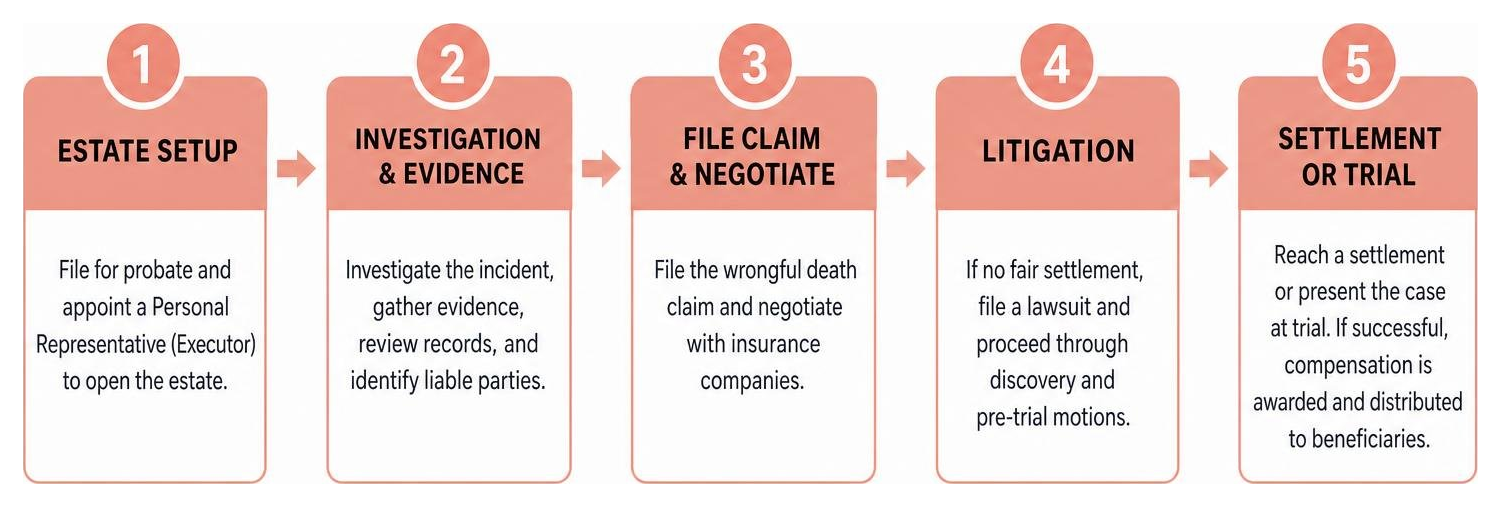
Understanding the progression of a lawsuit helps take away the mystery and anxiety from the legal process. For practical advice on choosing the right legal representation, read our guide on Finding Accidental Death Lawyers Without Losing Your Mind.
Step-by-Step Timeline of a Fatal Injury Lawsuit
While every legal claim carries unique timelines depending on case complexity and court dockets, most claims progress through five distinct phases:
- Opening the Estate and Legal Appointment: The family opens an estate in probate court to formally appoint an administrator or executor who possesses legal standing to bring the lawsuit.
- In-Depth Investigation and Evidence Gathering: Our legal team collects police records, subpoenas digital data, reviews medical records, inspects vehicle crash sites, and hires field experts.
- Pre-Suit Demand and Settlement Negotiations: Once damages are fully calculated by financial and medical experts, a formal demand letter is submitted to the insurance carriers. Negotiations take place to pursue a fair settlement without court delay.
- Formal Litigation (Filing the Complaint): If insurance companies refuse to offer fair value, a formal complaint is filed in Superior Court. Both sides engage in discovery (interrogatories, depositions, and document exchanges).
- Trial, Final Settlement, and Distribution: The case is either settled during mediation or tried before a jury. Once funds are secured, the probate court approves the final allocation and distribution of settlement proceeds to statutory beneficiaries.
How Much Does It Cost to Work with a Wrongful Death Lawyer?
Families experiencing sudden tragedy should never have to worry about out-of-pocket legal fees. At Affinity Injury Law, we work entirely on a contingency fee basis.
- Zero Upfront Costs: You pay nothing out of pocket to retain our services or begin the legal process.
- No Fee Unless We Win: We cover all upfront case expenses—including hiring top-tier experts, filing court fees, obtaining medical records, and legal research.
- Simple Fee Structure: Our attorney fees are calculated strictly as an agreed-upon percentage of the financial recovery we secure for your family. If we do not win compensation for your case, you owe us absolutely nothing.
Frequently Asked Questions About Wrongful Death Claims
What is the statute of limitations for filing a wrongful death claim?
In New Jersey, the standard statute of limitations for filing a wrongful death lawsuit is two years from the date of the person’s death (NJSA 2A:31-3). Missing this deadline almost always means forfeiting your legal right to pursue compensation forever.
Crucial Exception: If the fatal injury involved a government entity, municipality, public transit system (such as NJ Transit), or public employee, a Notice of Claim must be formally served within 90 days under the New Jersey Tort Claims Act before a lawsuit can be filed.
Can you file a wrongful death lawsuit if there is an ongoing criminal case?
Yes. Civil wrongful death claims and state criminal cases are completely separate legal matters. You do not have to wait for a criminal trial or police investigation to finish before filing a civil lawsuit. In fact, starting the civil process early helps ensure vital evidence is preserved before it gets lost or misplaced.
Are wrongful death settlement proceeds taxable or subject to damage caps?
Under federal law (Internal Revenue Code Section 104(a)(2)), compensatory damages received on account of personal physical injuries or physical sickness—including wrongful death settlements—are generally exempt from federal income tax. State laws generally follow similar principles for compensatory awards. However, any portion of an award designated specifically as punitive damages or accrued interest may be subject to taxation.
As noted earlier, New Jersey does not cap compensatory economic or non-economic damages in wrongful death actions, allowing full financial recovery for established losses.
Conclusion
No amount of financial compensation can ever replace a cherished family member. However, holding negligent parties accountable provides vital financial stability for surviving dependents, covers mounting expenses, and delivers a sense of legal justice.
Navigating probate requirements, insurance tactics, medical evaluations, and legal deadlines requires skilled, compassionate, and aggressive legal advocacy. At Affinity Injury Law, our team is dedicated to standing beside families through their hardest moments, taking on the heavy legal burden so you can focus on healing.
If you have lost a loved one due to someone else’s negligence anywhere in New Jersey—including Bergen, Passaic, Essex, or surrounding counties—reach out to our experienced team today. Contact Wrongful Death Lawyers New Jersey at Affinity Injury Law for a free, confidential, and compassionate consultation. We offer multilingual legal support and are ready to protect your rights every step of the way.