


When You Need Accidental Death Lawyers: What to Know First
Accidental death lawyers help families pursue financial compensation after a loved one is killed due to someone else’s negligence. If you just lost someone and need to know where to start, here is a quick overview:
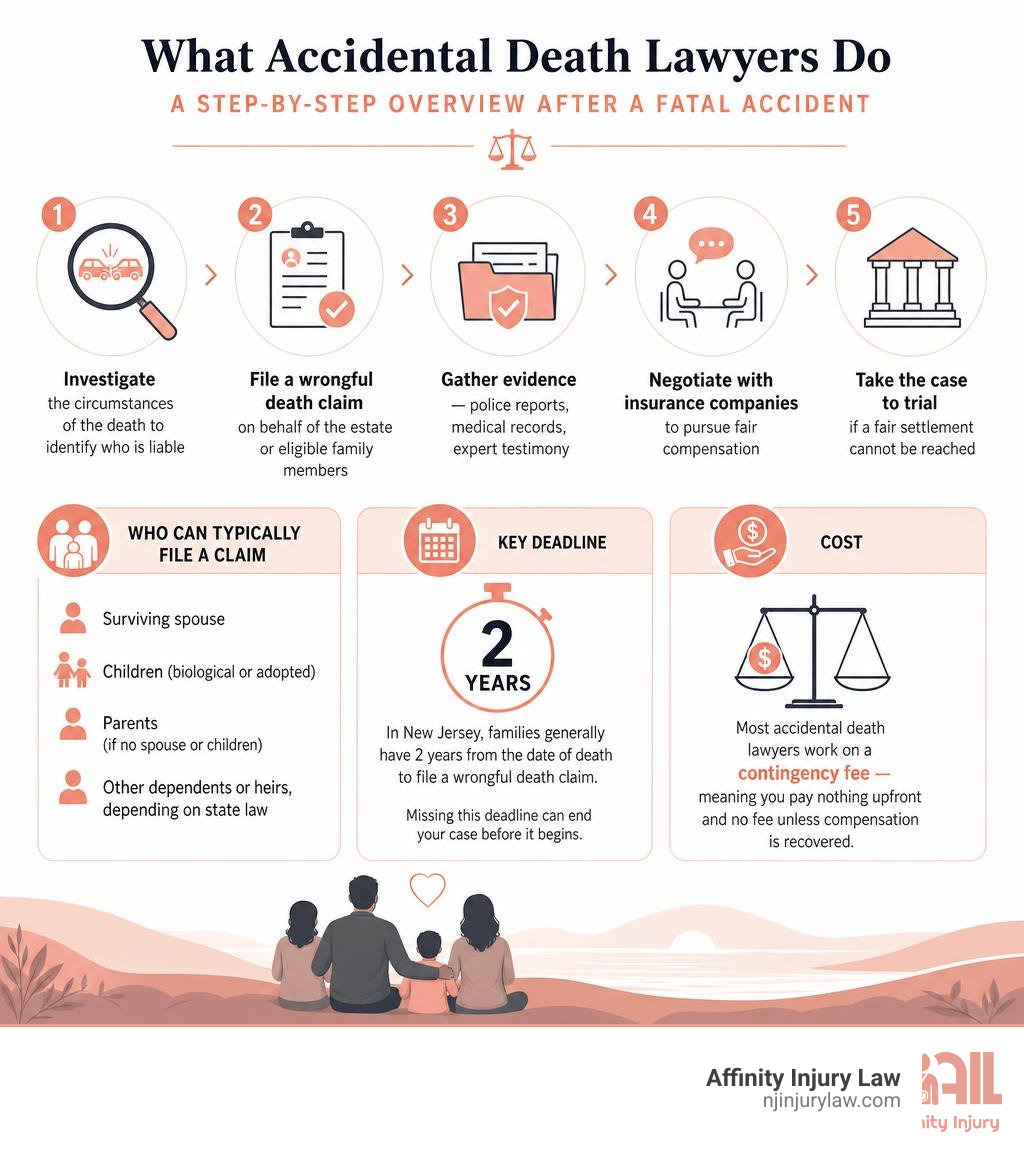
What accidental death lawyers do for your family:
- Investigate the circumstances of the death to identify who is liable
- File a wrongful death claim on behalf of the estate or eligible family members
- Gather evidence – police reports, medical records, expert testimony
- Negotiate with insurance companies to pursue fair compensation
- Take the case to trial if a fair settlement cannot be reached
Who can typically file a claim:
- Surviving spouse
- Children (biological or adopted)
- Parents (if no spouse or children)
- Other dependents or heirs, depending on state law
Key deadlines: In New Jersey, families generally have 2 years from the date of death to file a wrongful death claim. Missing this deadline can end your case before it begins.
Cost: Most accidental death lawyers work on a contingency fee – meaning you pay nothing upfront and no fee unless compensation is recovered.
Losing someone you love is devastating on its own. When that loss could have been prevented because a driver was reckless, a doctor made a serious mistake, or a property owner ignored a known hazard, the grief is compounded by anger, confusion, and urgent financial pressure.
Accidental deaths are the leading cause of death in the United States for people between the ages of 1 and 42, and the fifth leading cause across all age groups. According to the CDC’s National Center for Health Statistics, unintentional injuries remain one of the most significant causes of death nationwide. In 2021 alone, there were nearly 225,000 accidental deaths nationwide. Behind each of those numbers is a family left behind – often facing medical bills, funeral costs, and lost income all at once, while also trying to understand a legal system that can feel overwhelming and opaque.
The good news is that you do not have to figure this out alone. An experienced wrongful death attorney can shoulder the legal burden so your family can focus on healing.
I’m Ioana Enescu, Esq., a founding member of Affinity Injury Law and a New Jersey-based attorney with experience advocating for families navigating accidental death lawyers and wrongful death claims – including clients facing language barriers, insurance pressure, and complex liability questions. In this guide, I’ll walk you through everything you need to know to protect your family’s rights.
What is an Accidental Death Claim and How Can Accidental Death Lawyers Help?

When a tragic accident occurs, the legal system provides a pathway for surviving family members to seek accountability. In New Jersey, an accidental death claim is legally pursued as a wrongful death action. This type of civil lawsuit arises when a person’s death is caused by the wrongful act, neglect, or default of another party. If the deceased person would have been entitled to file a personal injury lawsuit had they survived, their estate and heirs retain the right to file a claim.
Working with dedicated Wrongful Death Lawyers New Jersey is critical because insurance companies do not simply hand over fair settlements out of sympathy. They employ teams of claims adjusters and corporate defense lawyers whose primary objective is to minimize financial exposure.
Experienced accidental death lawyers step in to level the playing field. We handle all communication with insurance companies, shield you from high-pressure settlement tactics, and build a compelling legal argument designed to maximize your recovery.
Understanding the Role of Accidental Death Lawyers
The legal landscape surrounding fatal accidents is highly technical and emotionally charged. Accidental death lawyers serve several vital roles during this difficult time:
- Establishing the Estate: Before any legal action can be filed in court, a personal representative (or administrator) must be officially appointed by the surrogate’s court in the county where the deceased resided (such as Bergen County or Passaic County). We guide you through this probate process to establish legal standing.
- Conducting an Independent Investigation: We do not rely solely on police reports. We work with accident reconstructionists, forensic experts, and private investigators to uncover what truly happened.
- Identifying All Liable Parties: In many accidents, multiple parties may share fault. For example, in a fatal commercial truck accident, liable parties might include the truck driver, the trucking company, the maintenance contractor, or even the manufacturer of a defective part.
- Calculating Full Economic Impact: We collaborate with forensic economists to project the lifetime financial losses suffered by the family, including lost wages, benefits, and retirement contributions.
Accidental Death vs. Survival Claims
In New Jersey, a fatal accident actually gives rise to two distinct types of legal claims under different state statutes: a Wrongful Death Action and a Survival Action. Understanding the difference is crucial for maximizing your family’s recovery.
- Wrongful Death Claim (N.J.S.A. 2A:31-1): This claim is designed to compensate the surviving family members for their pecuniary (financial) losses resulting from the death. It focuses entirely on the future financial support, services, and companionship that the family has lost.
- Survival Action (N.J.S.A. 2A:15-3): This claim belongs to the deceased person’s estate. It seeks compensation for the pain, suffering, and mental anguish the victim experienced between the moment of the accident and the moment of death. Even if the victim survived for only a few conscious seconds after a collision, the estate can pursue substantial damages for that pain and suffering. It also covers the medical bills incurred prior to death and funeral expenses.
Key Elements in Proving Negligence and Liability

To succeed in an accidental death claim, your legal team must establish negligence. Negligence is the legal theory that someone failed to behave with the level of care that a reasonable person would have exercised under the same circumstances.
Proving negligence requires establishing four key elements:
- Duty of Care: The defendant owed the deceased a legal obligation to act safely (e.g., a driver must obey traffic laws; a doctor must adhere to medical standards).
- Breach of Duty: The defendant violated that duty of care (e.g., speeding, misdiagnosing an illness, or failing to clean a wet floor).
- Causation: The defendant’s breach directly caused the accident that led to the victim’s death.
- Damages: The surviving family and estate suffered real, quantifiable financial and emotional losses as a result of the death.
Because these elements are strictly scrutinized, avoiding early missteps is vital. Grieving families are particularly vulnerable to making innocent errors when speaking to insurance adjusters. To protect your claim, read our guide on 5 Mistakes That Can Hurt Your Personal Injury Claim in New Jersey.
Types of Cases Handled by Accidental Death Lawyers
Fatal accidents can happen anywhere, but certain scenarios are more common. Experienced accidental death lawyers regularly handle claims involving:
- Motor Vehicle Accidents: High-speed collisions, distracted driving, and commercial truck crashes on major routes like the Garden State Parkway or Route 17 in Bergen County.
- Pedestrian and Bicycle Accidents: Vulnerable road users struck by negligent drivers in busy municipal areas like Lyndhurst or Passaic County.
- Medical Malpractice: Fatal surgical errors, misdiagnosis of life-threatening conditions, medication mistakes, and nursing home neglect.
- Premises Liability: Fatal slip-and-falls, swimming pool drownings, structural collapses, and negligent security leading to fatal assaults.
- Workplace Fatalities: Construction site falls, heavy machinery malfunctions, and industrial explosions. If a third party (someone other than the employer) was negligent, we can pursue a civil lawsuit alongside workers’ compensation.
Whether the incident involved a motor vehicle or an unsafe property, securing local representation in your specific region is crucial. For cases originating in northern New Jersey, families can look into specialized advice regarding Permanent Injuries Lawyers New Jersey.
Essential Evidence Needed to Support Your Claim
Building a trial-ready case requires collecting comprehensive evidence before it is lost or destroyed. When we take on a case, we immediately work to secure:
- Official Reports: Police accident reports, Occupational Safety and Health Administration (OSHA) incident reports, and medical examiner autopsy findings.
- Medical Documentation: Detailed records of any treatment the victim received immediately following the accident to prove conscious pain and suffering for the survival action.
- Digital Evidence: Surveillance camera footage from nearby businesses, dashcam videos, and cell phone records showing distracted driving.
- Expert Testimony: Accident reconstructionists to explain how a crash occurred, medical experts to testify on standards of care, and economic experts to calculate financial losses.
Understanding Compensation, Timelines, and Legal Fees
No amount of money can replace your loved one, but a successful legal claim provides financial stability and holds the negligent party accountable. In New Jersey, damages in accidental death cases are categorized into economic and non-economic losses.
| Damage Category | Type of Loss Covered | Who Receives the Compensation |
|---|---|---|
| Economic Damages | Funeral and burial costs, medical expenses incurred before death, loss of financial support, loss of household services (childcare, maintenance). | Surviving dependents / Heirs-at-law |
| Non-Economic Damages | Loss of companionship, guidance, advice, and parental instruction. Pain and suffering experienced by the victim prior to death. | Surviving family members / Deceased’s estate |
Who is Eligible to File and How Proceeds are Distributed
Under the New Jersey Wrongful Death Act, a wrongful death lawsuit must be brought by the executor or administrator of the deceased’s estate. However, any financial recovery is distributed to the surviving family members who were financially dependent on the deceased at the time of death.
The order of priority for receiving settlement proceeds generally follows New Jersey’s intestate laws:
- Surviving Spouse and Children: If the deceased left a spouse and children, they are the primary beneficiaries.
- Surviving Parents: If there is no spouse or child, the parents of the deceased are typically eligible to recover damages.
- Siblings and Other Relatives: If no spouse, children, or parents survive, siblings or other relatives who can prove actual financial dependency may be eligible.
The Timeline of an Accidental Death Lawsuit
A common question families ask is: How long will this process take? The timeline of an accidental death lawsuit varies significantly depending on the complexity of the case, the willingness of the insurance company to negotiate fairly, and court schedules.
- Investigation Phase (1–3 Months): Gathering medical records, police reports, and expert evaluations.
- Filing the Complaint (1–2 Months): Officially starting the lawsuit in court.
- Discovery Phase (6–18 Months): Both sides exchange evidence, take depositions of witnesses, and consult experts.
- Settlement Negotiations & Mediation (Ongoing): Many cases resolve during this phase without going to trial.
- Trial (3–5 Days, if necessary): If the insurance company refuses to offer a fair settlement, we present the case to a jury.
Frequently Asked Questions About Accidental Death Claims
Navigating the aftermath of a fatal accident brings up many legal questions. Here are clear answers to the questions families ask us most frequently.
Are accidental death or wrongful death settlements taxable?
In most cases, accidental death and wrongful death settlements are not taxable under federal IRS rules and New Jersey state tax laws.
- Compensatory Damages: Money awarded to compensate for financial losses, medical bills, funeral costs, and loss of companionship is considered non-taxable because it is intended to make the family “whole” after a personal injury or physical loss.
- Survival Action Damages: Compensation for the deceased’s physical pain and suffering prior to death is also generally tax-free.
- Punitive Damages: In rare cases of extreme or malicious negligence, a court may award punitive damages to punish the wrongdoer. Punitive damages are taxable and must be reported on your tax returns.
Can families pursue a civil claim if criminal charges are pending?
Yes. A criminal prosecution and a civil lawsuit are two completely separate legal proceedings that operate independently of one another.
- Criminal Case: Brought by the state (prosecutor) to punish the defendant for breaking the law (e.g., vehicular homicide or drunk driving). The burden of proof is “beyond a reasonable doubt” (near certainty).
- Civil Lawsuit: Brought by your family’s attorney to seek financial compensation for your losses. The burden of proof is a “preponderance of the evidence,” meaning we only need to prove that it is more likely than not (greater than 50% probability) that the defendant’s negligence caused the death.
You do not need to wait for a criminal trial to conclude before starting your civil claim. In fact, waiting too long can cause you to miss key deadlines.
What does it cost to hire an attorney for an accidental death case?
At Affinity Injury Law, we represent families on a contingency fee basis.
- No Upfront Costs: You do not pay us any retainer fees, hourly rates, or out-of-pocket expenses to start your case.
- No Fee Unless We Win: We cover all the upfront costs of the investigation, filing fees, and expert witnesses. We only collect a legal fee if we successfully secure a settlement or jury verdict for your family.
- Aligned Interests: Our fee is a percentage of the total recovery, meaning our goal is aligned with yours: to secure the maximum compensation possible.
Attempting to handle a complex fatal accident claim without representation is a risky path that often results in lowball settlements. To learn more about the risks of going it alone, read about the Common Mistakes Without Accident Injury Lawyers.
Conclusion
Losing a loved one to a preventable accident is an unimaginable tragedy. While no legal action can bring your family member back, pursuing a claim can provide the financial security your family needs to survive this transition and ensure that those responsible are held accountable.
At Affinity Injury Law, we are dedicated to helping families in Lyndhurst, Bergen County, Passaic County, and throughout New Jersey navigate these difficult legal waters with compassion, skill, and relentless advocacy.
What makes us different:
- Multilingual Support: We understand that legal jargon is hard enough to navigate in your native language, let alone a second one. We offer comprehensive multilingual support so you can communicate comfortably and clearly.
- No-Fee-Unless-They-Win Guarantee: You will never receive a bill from us unless we successfully recover compensation for your family.
- Local New Jersey Focus: We know the local courts, surfs, and judges in Bergen and Passaic Counties, giving your case a distinct home-court advantage.
If you are ready to explore your options and protect your family’s future, we are here to listen. Read our guide on Navigating a Wrongful Death Claim in NJ Without Losing Your Mind or contact our dedicated Wrongful Death Lawyers New Jersey today to schedule your free, confidential consultation. Let us carry the legal burden so you can focus on what matters most.