


Understanding State Hit and Run Laws and Criminal Penalties
If you are injured by a fleeing driver, you can secure financial compensation for your medical bills, lost wages, and pain and suffering through your own insurance policies—primarily Personal Injury Protection (PIP) and Uninsured Motorist (UM) coverage—or through state guaranty safety nets. Additionally, an experienced hit and run attorney can launch an independent investigation using traffic camera footage, accident reconstruction, and witness statements to track down the driver and pursue a direct lawsuit for full damages.
Every driver owes a fundamental legal duty to stop after an accident, exchange identifying details, and render reasonable assistance. When a motorist panics, steps on the gas, and disappears into traffic, that civil collision escalates into a serious crime.
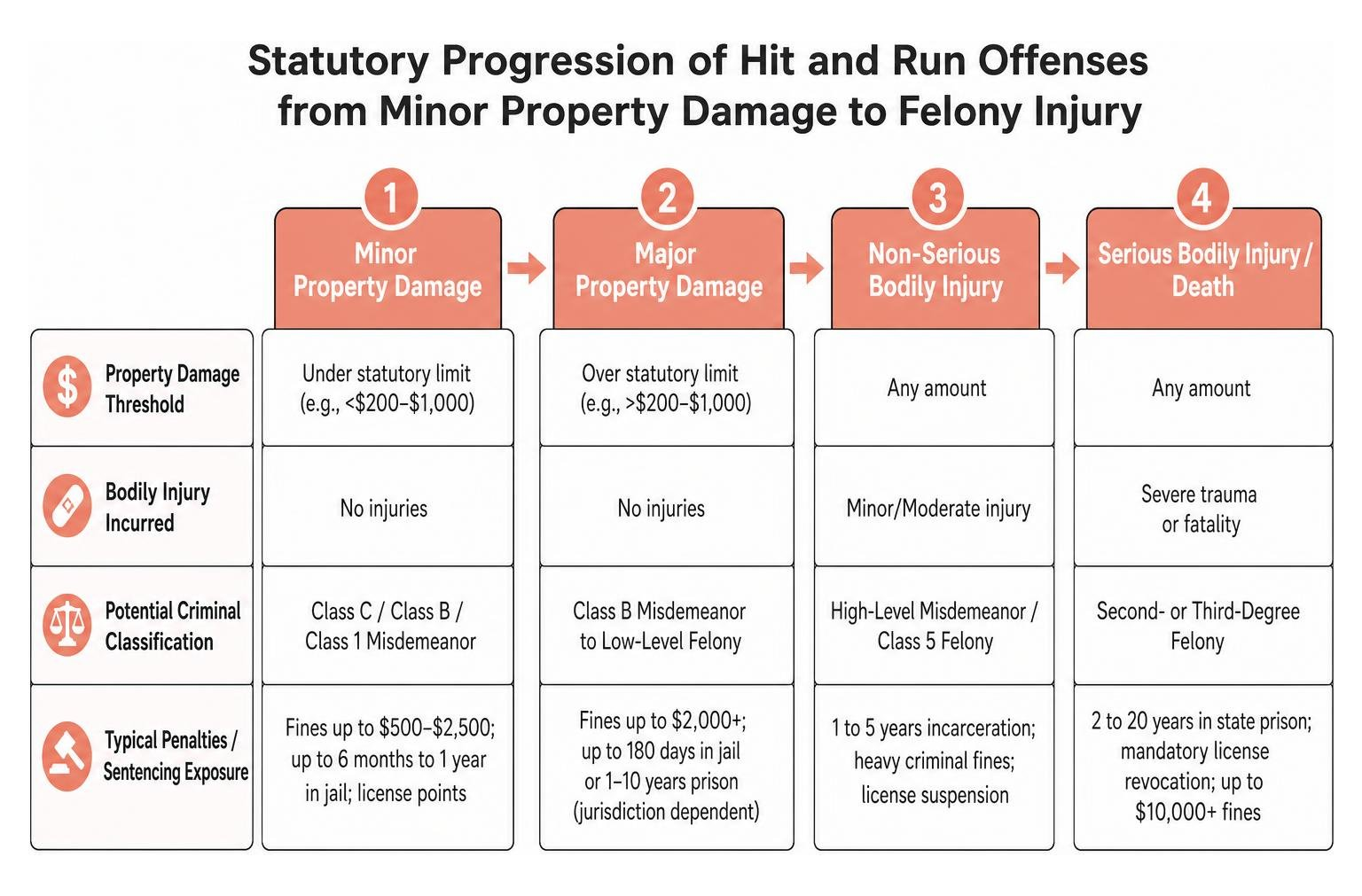
Hit-and-run statutes establish strict criminal consequences that scale upward based on the severity of the damage, the extent of physical injuries, and whether the crash resulted in a fatality. While minor fender-benders involving attended or unattended vehicles often result in misdemeanor charges, leaving the scene of an injury crash crosses into felony territory in most jurisdictions.
| Offense Severity | Property Damage Threshold | Bodily Injury Incurred | Potential Criminal Classification | Typical Penalties / Sentencing Exposure |
|---|---|---|---|---|
| Minor Property Damage | Under statutory limit (e.g., <$200–$1,000) | No injuries | Class C / Class B / Class 1 Misdemeanor | Fines up to $500–$2,500; up to 6 months to 1 year in jail; license points |
| Major Property Damage | Over statutory limit (e.g., >$200–$1,000) | No injuries | Class B Misdemeanor to Low-Level Felony | Fines up to $2,000+; up to 180 days in jail or 1–10 years prison (jurisdiction dependent) |
| Non-Serious Bodily Injury | Any amount | Minor/Moderate injury | High-Level Misdemeanor / Class 5 Felony | 1 to 5 years incarceration; heavy criminal fines; license suspension |
| Serious Bodily Injury / Death | Any amount | Severe trauma or fatality | Second- or Third-Degree Felony | 2 to 20 years in state prison; mandatory license revocation; up to $10,000+ fines |
Legal Duties and Penalties Across Key States
State legislatures and safety organizations like the National Highway Traffic Safety Administration continuously monitor traffic incident data, prompting updated motor vehicle codes to discourage drivers from fleeing crash scenes. Across various jurisdictions, the statutory requirements to stop and render aid are clear:
- Texas: Under the Texas Transportation Code, leaving the scene of an accident involving property damage under $200 is a Class C misdemeanor punishable by a fine up to $500. If the damage equals or exceeds $200, it becomes a Class B misdemeanor with up to 180 days in jail and fines up to $2,000. Under legislative reforms that equalized hit-and-run penalties with intoxication manslaughter, fleeing an accident involving serious bodily injury is a third-degree felony (2 to 10 years in prison), while leaving the scene of a fatal crash escalates to a second-degree felony carrying 2 to 20 years in state prison and fines up to $10,000.
- California: California Vehicle Code distinguishes sharply between property damage and bodily harm. Hit and run involving only property damage (VC 20002) is classified as a misdemeanor carrying up to six months in county jail. However, leaving the scene of an accident resulting in injury or death (VC 20001) can be charged as a felony punishable by up to four years in state prison, with an additional five-year sentence enhancement if the fleeing motorist was intoxicated and the crash proved fatal.
- Virginia: Virginia Code § 46.2-894 mandates that leaving the scene of a crash causing injury, death, or property damage exceeding $1,000 is a Class 5 felony carrying 1 to 10 years in prison and fines up to $2,500. If damage remains under $1,000 with no injuries, it is treated as a Class 1 misdemeanor carrying up to one year in jail. Furthermore, under Virginia Code § 46.2-895, passengers aged 16 or older who were in a fleeing vehicle face criminal liability if they fail to report the collision to police within 24 hours.
Common Legal Defenses in Leaving the Scene Accusations
In the criminal justice system, individuals accused of leaving an accident scene often attempt to present specific legal defenses:
- Lack of Knowledge: A motorist in a large commercial truck or heavy SUV might claim they did not realize an impact occurred, particularly in low-speed collisions with smaller vehicles or roadside fixtures.
- Mistaken Identity or Stolen Vehicle: Proving the owner was not behind the wheel at the time of the crash, such as when a vehicle was borrowed, rented, or stolen.
- No Property Damage or Injury: Demonstrating that the incident caused no actual damage or injury to a third party’s person or property.
- Pre-Filing Restitution and Diversion: In certain jurisdictions, defense counsel attempts to negotiate civil compromises or judicial diversions where full property restitution is paid before formal charges are filed, sometimes avoiding a criminal conviction.
For victims, understanding these defenses is vital because insurance companies often adopt similar skeptical arguments to delay or deny payouts.
Why You Need an Experienced Hit and Run Attorney to Secure Compensation
When an at-fault driver speeds away, your injury claim does not simply disappear, but it does become significantly more complex. Unlike a standard two-vehicle crash where both motorists pull over and exchange insurance cards, a hit-and-run forces you to battle on two fronts: tracking down the responsible party and navigating difficult first-party insurance policies.
Our team of Personal Injury Lawyers New Jersey knows that insurance carriers frequently treat hit-and-run victims with immediate skepticism. Adjusters may question whether a collision actually occurred, suggest you caused the damage yourself, or argue that your injuries stem from a pre-existing condition. Legal advocacy levels the playing field, ensuring your rights are protected throughout the claims process.
How a Hit and Run Attorney Tracks Down Fleeing Drivers
Just because a driver made a quick escape does not mean they are gone forever. Modern legal investigations employ an array of digital and physical resources to locate fleeing motorists:
- Subpoenaing Surveillance Footage: We canvass local businesses, traffic cameras, residential doorbell cameras, and municipal dashcams to capture footage of the fleeing vehicle before, during, or after the impact.
- Accident Reconstruction Specialists: Forensic engineers analyze paint transfers, skid marks, debris fields, and vehicle crush patterns to determine the exact make, model, speed, and trajectory of the striking car.
- Partial Plate Lookups: In coordination with law enforcement and private investigators, partial license plate numbers combined with color, year, and make can narrow a suspect pool from thousands down to a handful of registered owners.
- Witness Canvassing: Independent bystanders, delivery drivers, and local workers often provide impartial, highly credible accounts that corroborate your story and identify crucial vehicle details.
How a Hit and Run Attorney Negotiates with Uninsured Motorist Insurers
If the fleeing motorist remains unidentified, your recovery hinges on your own Uninsured Motorist (UM) and Personal Injury Protection (PIP) coverage. Unfortunately, your own insurer does not automatically write a fair check. In fact, your insurance company steps directly into the shoes of the absent at-fault driver, adopting an adversarial stance to minimize payout amounts.
Adjusters will push for recorded statements early in the process, hoping you inadvertently downplay your pain, guess about speed, or omit symptoms. Avoiding 5 Mistakes That Can Hurt Your Personal Injury Claim in New Jersey—such as delaying medical care or giving unrepresented recorded statements—is essential to preserving the true financial value of your claim.
How Accident Victims Can Recover Compensation After a Hit and Run
Being the victim of a hit-and-run should never leave you bearing the crushing weight of medical bills and vehicle repairs alone. Multiple avenues of insurance recovery exist to cover your losses, whether the driver is located or remains unknown.

Our dedicated Car Accidents Lawyers New Jersey help victims systematically identify every available policy layer to secure maximum financial compensation.
Maximizing Uninsured Motorist and Personal Injury Protection Benefits
In a hit-and-run collision, your insurance benefits work together to cover distinct financial and medical needs:
- Personal Injury Protection (PIP): Under no-fault frameworks, PIP covers reasonable and necessary medical treatments, diagnostic tests, ambulance fees, and a portion of lost wages regardless of who caused the crash.
- Uninsured Motorist (UM) Bodily Injury: When a driver flees the scene and cannot be identified, the law treats that phantom motorist as an uninsured driver. UM coverage allows you to recover non-economic damages, including pain, physical suffering, emotional distress, and permanent impairment, subject to your policy limits.
- Collision Coverage: This pays for the repair or total-loss replacement of your motor vehicle, minus your selected deductible.
Direct Civil Lawsuits and Punitive Damages When Drivers Are Located
If law enforcement or our investigative team tracks down the hit-and-run driver, your legal options expand dramatically. We can file a direct third-party personal injury lawsuit against the driver and their insurance carrier.
Beyond standard compensatory damages for medical expenses and lost wages, fleeing the scene of an accident constitutes gross negligence and intentional misconduct. In egregious cases, courts may award punitive damages designed to punish the wrongdoer and deter others from abandoning injured victims on public roadways. Additionally, criminal court judges may order the offender to pay direct criminal restitution as part of their sentencing.
Critical Steps to Take Immediately After a Hit and Run Crash
The minutes and hours following a hit-and-run accident are crucial for both your physical health and your future legal claim. Taking deliberate, calm actions will preserve the evidence needed to hold insurers and fleeing drivers accountable.

Follow these immediate steps after a collision:
- Call 911 Right Away: Request emergency medical personnel and police dispatch immediately. An official police accident report is an absolute prerequisite for filing a valid Uninsured Motorist claim.
- Document Every Detail of the Fleeing Vehicle: While your memory is fresh, jot down notes or record a voice memo detailing the vehicle’s make, model, color, body style, partial license plate, bumper stickers, dents, and the driver’s general appearance.
- Photograph the Entire Crash Scene: Capture wide-angle and close-up images of vehicle damage, paint transfers from the other car, broken glass, skid marks, street signage, weather conditions, and visible bodily injuries.
- Gather Eyewitness Information: Collect names, phone numbers, and addresses from any pedestrians, nearby business employees, or fellow motorists who witnessed the crash or saw the vehicle flee.
- Seek Comprehensive Medical Attention: Adrenaline masks pain. Visit an emergency room, urgent care, or your primary physician right away to diagnose hidden injuries like concussions, whiplash, or internal trauma.
- Notify Your Auto Insurer Promptly: Report that an accident occurred, but avoid giving speculative or recorded statements regarding injuries or fault until you have consulted legal counsel.
Frequently Asked Questions About Hit and Run Claims
Who pays for my damages if the hit and run driver is never identified?
If the at-fault driver is never caught, your primary financial recovery comes from your own auto insurance policy via Uninsured Motorist (UM) coverage, Personal Injury Protection (PIP) for medical expenses, and collision coverage for vehicle repairs. In specific scenarios involving uninsured pedestrians or bicyclists who lack household auto policies, state-specific guaranty associations (such as NJ PLIGA) may step in to provide safety-net injury coverage.
Can passengers face criminal charges in a hit and run crash?
In most circumstances, passengers are not legally responsible for the driving decisions of the vehicle’s operator. However, under specific state statutes (such as Virginia Code § 46.2-895), passengers aged 16 or older who were in a vehicle that fled an injury or attended property crash have an affirmative duty to report the incident to law enforcement within 24 hours. Furthermore, passengers across any jurisdiction who actively encourage the driver to flee, conceal evidence, or provide false statements to police can face criminal charges for aiding, abetting, or obstruction of justice.
How soon must a hit and run be reported to police and insurers?
You should call 911 immediately from the scene of the accident. Most auto insurance policies contain strict notification clauses requiring policyholders to report hit-and-run incidents within 24 hours (or as soon as reasonably possible). Failing to report the crash to police and your insurer within these tight contractual deadlines can give the insurance company legal grounds to deny your Uninsured Motorist claim entirely.
Conclusion
A hit-and-run collision can leave you feeling disoriented, injured, and anxious about medical bills and car repairs. But you do not have to shoulder the financial burden caused by an irresponsible driver. By acting quickly to document the scene, securing immediate medical care, and mobilizing experienced legal representation, you can protect your rights and recover the full compensation you are owed.
At Affinity Injury Law, we represent accident victims on a strict contingency basis—meaning there is no fee unless we win your case. Our multilingual legal team provides compassionate, clear guidance in multiple languages to ensure you always understand your options. If you were injured in a hit-and-run crash in Lyndhurst, Hackensack, Paterson, Clifton, Paramus, or anywhere across Passaic or Bergen County, speak with a dedicated Bergen County injury lawyer today to schedule your free consultation.