

What New Jersey Workers Compensation Lawyers Actually Do — and Why It Matters
If you’re looking for new jersey workers compensation lawyers, here’s a quick overview of what you need to know right now:
Top reasons to hire a NJ workers’ comp attorney:
- Workers’ comp benefits are not automatic — insurers routinely delay or deny claims
- Injured workers with legal representation recover significantly more than those who go it alone
- Most workers’ comp attorneys work on contingency — no upfront cost to you
- You may be entitled to both workers’ comp benefits and a separate personal injury lawsuit
- Your employer cannot legally fire you for filing a claim
Every year, more than $2 billion in workers’ compensation benefits are paid out to injured New Jersey employees. Yet the average injured worker without legal help receives shockingly little — sometimes just a few hundred dollars — while medical bills stack up and paychecks stop coming.
New Jersey’s workers’ comp system is supposed to protect you. It’s a no-fault system, meaning you don’t have to prove your employer did anything wrong. But “no-fault” doesn’t mean “no fight.” Insurance companies have attorneys working against your claim from day one.
Whether you suffered a sudden injury on a job site or developed a condition over months of repetitive work, the process of getting full benefits can be confusing and frustrating — especially when you’re already dealing with pain and financial pressure.
I’m Ioana Enescu, Esq., a founding member of Affinity Injury Law and a long-time New Jersey resident who has dedicated her practice to fighting for injured workers across the state — including helping clients navigate new jersey workers compensation lawyers and the full claims process. As the daughter of two physicians, I bring a unique understanding of medical advocacy to every case I handle.
This guide walks you through everything — from filing your first claim to maximizing your recovery.
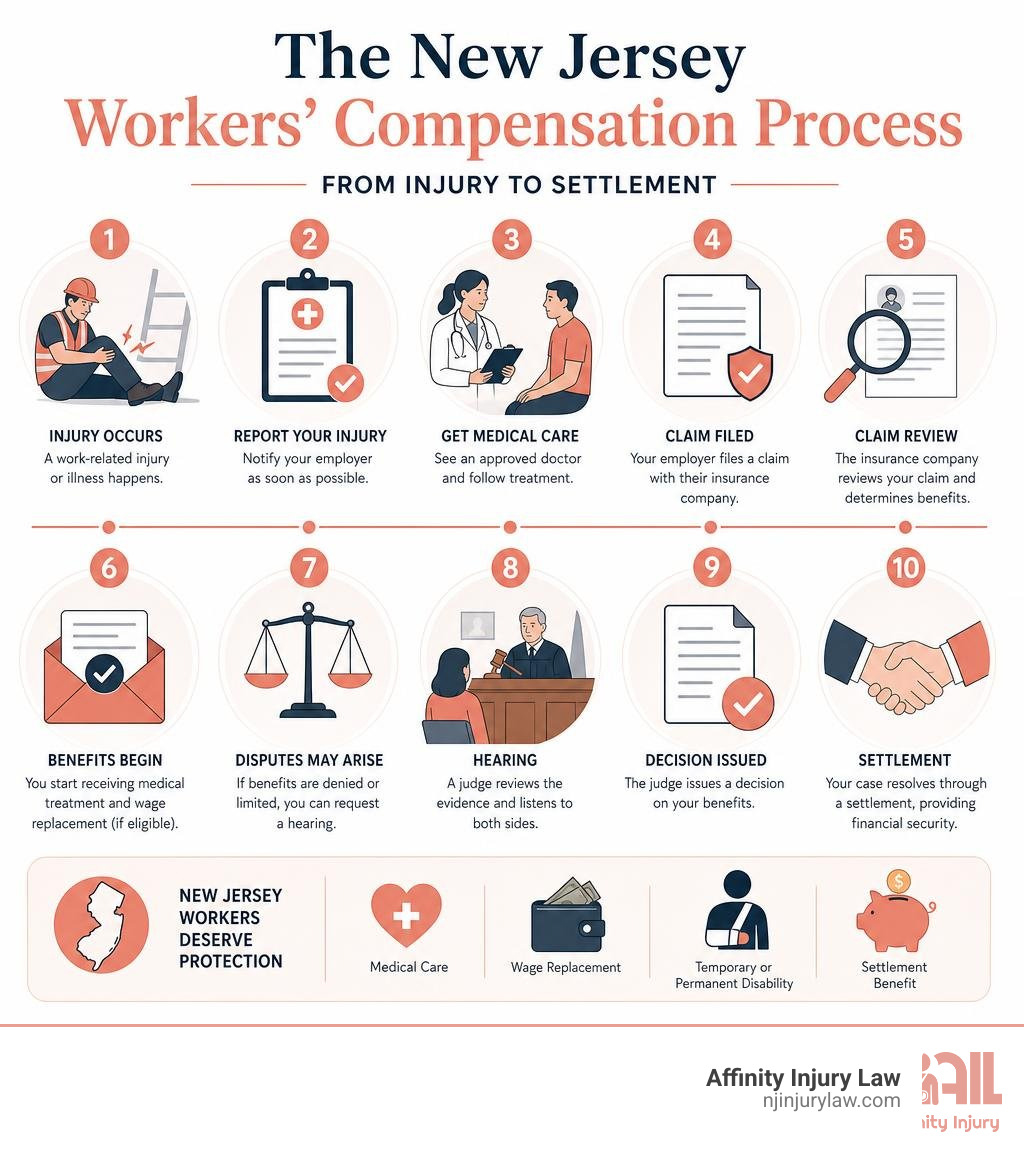
Understanding Workers’ Compensation in New Jersey and Your Rights
Under New Jersey law, workers’ compensation is a state-mandated insurance program designed to provide a financial safety net for employees who suffer job-related injuries or illnesses. This system is designed to provide essential benefits, including comprehensive medical coverage and wage replacement, without requiring you to prove your employer was negligent.
In exchange for this guaranteed no-fault coverage, employees generally surrender their right to bring a civil negligence lawsuit directly against their employer. However, this trade-off only works in your favor if you actually receive the full scope of benefits you are legally owed.
To qualify for temporary wage replacement benefits, New Jersey law enforces a 7-day waiting period. You must be unable to work for more than seven consecutive days (including weekends and holidays) before temporary disability payments kick in. If your disability extends beyond this 7-day threshold, your benefits will retroactively cover those first seven days as well.
To help you understand the different tiers of disability benefits available under New Jersey law, we have outlined them in the comparison table below:
| Benefit Type | Description | Duration | Payment Rate |
|---|---|---|---|
| Temporary Total Disability (TTD) | For workers completely unable to work while recovering under active medical care. | Until you return to work, reach Maximum Medical Improvement (MMI), or hit the 400-week maximum. | 70% of your average weekly wage (subject to statutory state maximums and minimums). |
| Permanent Partial Disability (PPD) | For workers who suffer a permanent impairment but can still perform some level of work. | Based on a schedule of body parts or “non-scheduled” systemic injuries, up to 600 weeks. | Scaled weekly payments determined by the percentage of functional loss. |
| Permanent Total Disability (PTD) | For workers whose injuries permanently prevent them from returning to any gainful employment. | Initially paid for 450 weeks; can be extended for life if the total disability continues. | 70% of your average weekly wage. |
Who Qualifies for Coverage Under NJ Law?
A common misconception is that workers’ compensation is only reserved for full-time, long-term corporate employees. In New Jersey, the law is incredibly broad. Full-time employees, part-time workers, and seasonal employees are all covered from their very first day on the job.
Furthermore, New Jersey public policy is highly protective of vulnerable workforces: undocumented workers are fully eligible to file workers’ compensation claims and receive medical and wage benefits. Your immigration status cannot be used as a weapon by an insurance company or employer to deny you the care you need.
Unfortunately, some employers attempt to escape their financial obligations by misclassifying employees as independent contractors. Simply because your boss pays you with a 1099 form or calls you a “freelancer” does not make it legally true. New Jersey courts look at the reality of the working relationship—such as the level of control the employer has over your schedule, tools, and daily duties—rather than the label on your tax documents.
If you suspect you have been misclassified, consulting with experienced Workers Compensation Lawyers New Jersey is the fastest way to protect your rights.
Wage Replacement and Disability Benefits Explained
Wage replacement benefits, specifically TTD, are calculated at 70% of your gross average weekly wage leading up to the accident. However, this amount is capped by state-mandated maximums that adjust annually.
When your active medical treatment concludes, your authorized doctor will declare that you have reached Maximum Medical Improvement (MMI). This is the point at which your condition has stabilized and is not expected to improve any further with additional treatment.
Once you reach MMI, your eligibility for temporary disability benefits ends. If you are left with permanent physical limitations, your case transitions to determining a permanent disability award. Under New Jersey’s 26-week rule (N.J.S.A. 34:15-16), a permanent disability rating cannot be finalized until at least 26 weeks have passed from the date of your last active medical treatment or your return to work, whichever is later. This waiting period ensures that the true, long-term impact of your injury is fully understood before a final settlement or award is calculated.
How to File a Claim and Navigate the Medical Treatment Process
Filing a claim and securing treatment requires strict adherence to procedural timelines. If you miss a deadline, you risk losing your right to medical care and financial benefits entirely.

The first and most critical step is reporting your injury to your employer. Under New Jersey law, you must notify your employer of a workplace accident within 90 days of its occurrence. While verbal notice to a supervisor is legally acceptable, we highly recommend submitting this notification in writing (via email or text) so you have a physical paper trail.
After notifying your employer, the ultimate legal deadline to file a formal claim petition with the New Jersey Division of Workers’ Compensation is two years from the date of the accident, or two years from the date you last received a workers’ comp benefit payment. You can also review general filing information through the New Jersey Department of Labor and Workforce Development’s Division of Workers’ Compensation.
Step-by-Step Filing Process and Crucial Deadlines
Navigating the filing process step-by-step helps prevent costly administrative mistakes:
- Report the Injury Immediately: Notify your supervisor or HR department right away. Do not wait for the 90-day limit to run out.
- Seek Authorized Medical Care: Request that your employer or their insurance carrier direct you to an authorized medical provider.
- Confirm the Insurance Report: Ensure your employer files a “First Report of Injury” with their insurance carrier. If they refuse to do so, an attorney can help you file a formal claim petition directly with the state.
- File a Formal Claim Petition: If there are disputes regarding your treatment, wages, or permanency, your attorney will file a formal Claim Petition with the New Jersey Division of Workers’ Compensation.
- Access the Uninsured Employers Fund (UEF): If your employer illegally failed to carry workers’ compensation insurance, we can help you pursue benefits through the state’s Uninsured Employers Fund, which steps in to cover medical expenses and temporary disability payments.
Failing to follow these steps precisely can severely damage your case. To learn more about common pitfalls, read our guide on Common Mistakes Without Accident Injury Lawyers.
The Doctor Dilemma: Can You Choose Your Own Physician?
In New Jersey, the employer or their insurance carrier has the legal right to select the authorized treating physician for your work-related injury. This is often the most frustrating aspect of the workers’ comp system for injured workers, as insurance-appointed doctors may sometimes downplay injuries to clear patients for work prematurely.
There are, however, two key exceptions to this rule:
- Emergency Care: If you require immediate, emergency medical attention, you have the right to go to the nearest emergency room or urgent care center without waiting for authorization. Once the emergency has passed, you must transition your care back to the insurer’s authorized doctor.
- Refusal or Delay of Care: If the insurance company unreasonably delays or outright refuses to provide necessary medical treatment, a workers’ comp attorney can file an emergent motion with a judge to force them to authorize and pay for care from an independent specialist.
Workers’ Comp vs. Personal Injury: Maximizing Your Recovery
Many injured workers do not realize that a workers’ compensation claim is entirely different from a personal injury lawsuit.
While workers’ comp is a no-fault administrative process that covers medical bills and a portion of lost wages, it does not provide any compensation for “pain and suffering,” emotional distress, or loss of enjoyment of life.
However, if your workplace injury was caused by the negligence of someone other than your employer or a direct coworker, you may have the right to file both a workers’ comp claim and a separate third-party personal injury lawsuit. This dual approach allows you to maximize your overall financial recovery. You can learn more about how these civil cases operate by speaking with our Personal Injury Lawyers New Jersey.
When to Pursue a Third-Party Personal Injury Claim
Third-party personal injury claims frequently arise in specific workplace scenarios, including:
- Defective Equipment: If you are injured on the job by a malfunctioning machine, defective power tool, or poorly designed safety gear, you can file a product liability lawsuit against the manufacturer.
- Negligent Subcontractors: On complex construction sites, workers from multiple companies operate side-by-side. If an employee of a separate subcontractor drops a tool from a scaffold or operates heavy machinery unsafely, causing you injury, they can be held liable. For detailed insights on these multi-party cases, consult our specialized Construction Accident Lawyers New Jersey.
- Motor Vehicle Accidents: If you are driving a commercial vehicle, making a delivery, or traveling between job sites and are struck by a negligent driver, you can pursue a personal injury claim against that third-party driver.
Damages Recoverable in Civil Lawsuits vs. Workers’ Comp
In a third-party civil lawsuit, you can recover damages that are completely unavailable through workers’ compensation. These include compensation for physical pain, mental anguish, loss of future earning capacity, and the full value of your lost wages (unlike the 70% cap enforced by workers’ comp).
That while you have two years to file a workers’ comp claim petition, the statute of limitations for a third-party personal injury lawsuit in New Jersey is also two years from the date of the accident. Managing both claims simultaneously requires careful coordination to avoid costly mistakes. To protect your rights, read about the 5 Mistakes That Can Hurt Your Personal Injury Claim in New Jersey.
Overcoming Denials, Delays, and Employer Retaliation
It is a sad reality that insurance companies frequently deny valid claims, delay critical medical procedures, or send injured workers to Independent Medical Examinations (IMEs) with doctors who may write biased reports designed to cut off benefits.
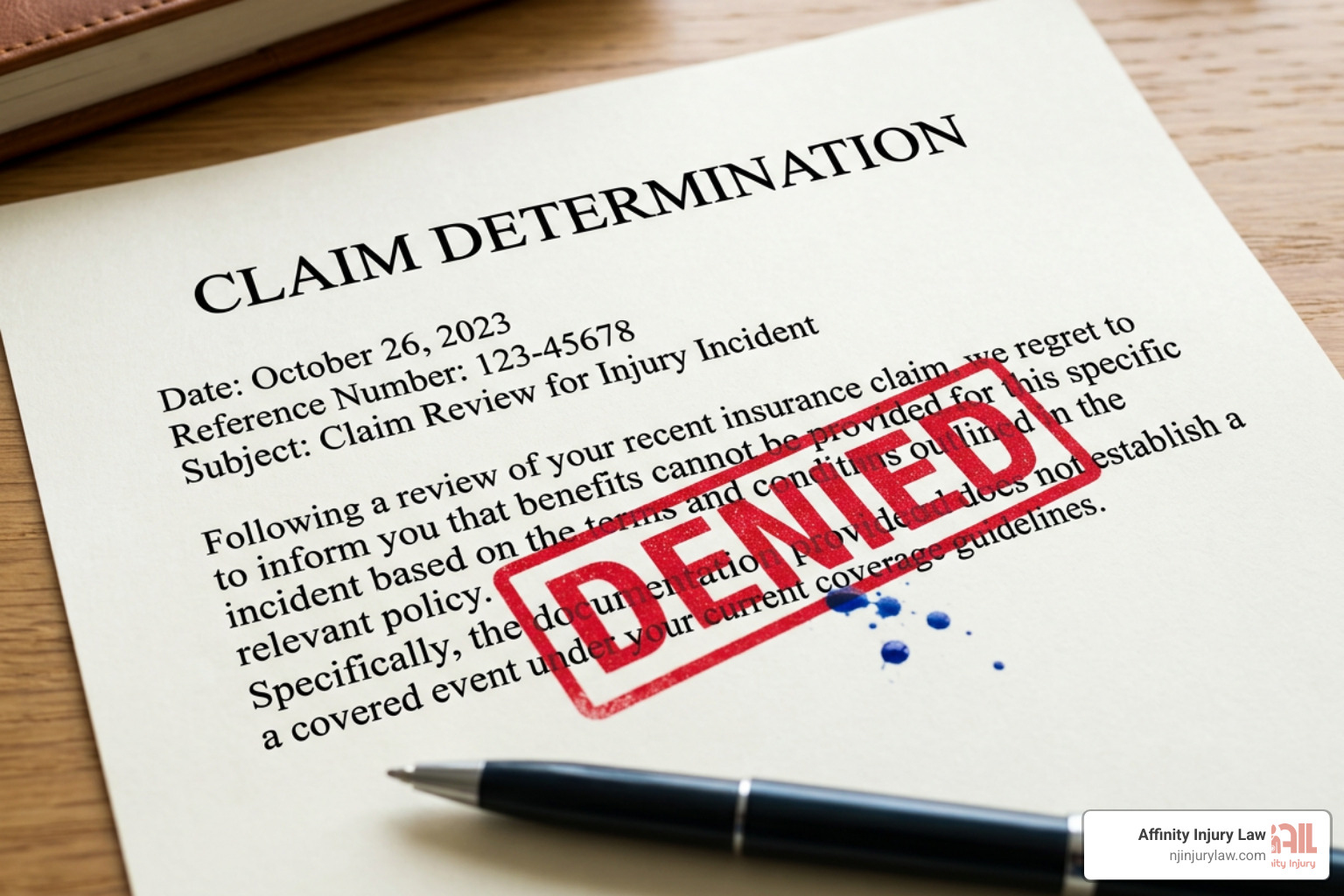
What to Do If Your Claim Is Denied or Delayed
If your claim is denied, or if the insurance carrier is dragging their feet on authorizing a surgery or diagnostic test, do not lose hope. A denial is simply the insurance company’s opening position—it is not the final word.
We can immediately file an administrative motion (such as a Motion for Medical and Temporary Benefits) to secure an expedited hearing before a judge in the New Jersey Division of Workers’ Compensation.
Protection Against Retaliation and Wrongful Termination
Many injured workers hesitate to file a claim because they fear their boss will fire them or make their lives miserable. In New Jersey, this fear is addressed by strict legal protections.
Under N.J.S.A. 34:15-39.1, it is unlawful for an employer to discharge, demote, or discriminate against an employee in any manner because they have claimed or attempted to claim workers’ compensation benefits.
If your employer retaliates against you, they can face severe civil penalties, and you may be entitled to job reinstatement, back pay, and additional damages. Your job security and your health are protected by law.
Why You Need Experienced New Jersey Workers Compensation Lawyers
Navigating the workers’ comp system on your own is like playing a game where the other side wrote the rulebook and owns the referee. Insurance adjusters are trained to minimize payouts, and they will use every administrative trick in the book to pay you as little as possible.
How New Jersey Workers Compensation Lawyers Maximize Your Claim
An experienced attorney acts as your shield and advocate. We take over all communication with the insurance adjuster, gather vital medical evidence, challenge biased IME reports, and represent you in administrative hearings before Workers’ Compensation Judges.
Most importantly, we ensure you receive a fair permanency award (PPD) at the end of your case, reflecting the true, long-term impact of your injuries. To understand how legal fees work in these scenarios, read The Ultimate Guide to Hiring a Contingency Fee Accident Lawyer.
How to Choose the Best New Jersey Workers Compensation Lawyers for Your Case
When searching for the right attorney, look for a firm with deep roots in New Jersey, extensive experience representing workers in Bergen and Passaic counties, and a proven track record of handling both workers’ comp and third-party personal injury claims.
In New Jersey, workers’ compensation attorneys operate on a contingency fee basis. This means you pay absolutely nothing upfront. Attorney fees are capped at 20% of your total recovery and must be formally approved by a Workers’ Compensation Judge. In most cases, the judge will order the insurance carrier to pay the majority of that 20% fee, leaving you with minimal out-of-pocket legal expenses.
Frequently Asked Questions about New Jersey Workers’ Comp
Can I receive workers’ compensation if my injury happened over time?
Yes. New Jersey law fully covers occupational exposure and repetitive stress injuries. Conditions like carpal tunnel syndrome, progressive spinal wear and tear, or lung diseases caused by toxic chemical exposure develop gradually over months or years. You are just as entitled to benefits for these gradual injuries as you are for a sudden slip-and-fall accident.
What happens if my employer does not carry workers’ compensation insurance?
If your employer does not carry the mandatory workers’ comp insurance, you can file a claim through the New Jersey Uninsured Employers Fund (UEF) to cover your medical bills and temporary disability wages. Additionally, because your employer broke the law by failing to carry insurance, you have the right to file a direct civil lawsuit against them in court.
How much does it cost to hire a workers’ comp attorney in New Jersey?
There are no upfront, out-of-pocket costs to hire our firm. We work on a strict contingency fee structure. Our fee is capped at 20% of your final award, must be approved by the judge, and is typically split between you and the insurance carrier, meaning the insurer often pays the largest portion of our fee.
Conclusion
If you or a loved one has been injured on the job in Lyndhurst, Bergen County, Passaic County, or anywhere in New Jersey, do not let an insurance company shortchange your recovery.
At Affinity Injury Law (NJ Injury Law), we believe that legal representation should be accessible to everyone. That is why we provide dedicated, high-quality legal advocacy with a no-fee-unless-we-win guarantee.
Our key differentiator is our robust multilingual support, ensuring that you can communicate comfortably and clearly in your preferred language throughout your recovery journey.
Don’t wait for your benefits to get delayed or denied. Contact us today for a free, confidential consultation, and let us fight to secure the maximum compensation you deserve.
Schedule Your Free Consultation with Workers Compensation Lawyers New Jersey