


When Every Detail Matters: The Wrongful Death Evidence Needed to Build Your Case
Understanding wrongful death evidence needed is the first step toward holding a negligent party accountable after losing someone you love. Here is a quick overview of what you need:
Essential Wrongful Death Evidence Checklist
- Death certificate and autopsy report – establishes cause of death
- Police or accident reports – documents the incident officially
- Medical records – shows treatment, injuries, and timeline
- Witness statements – supports your version of events
- Photos and video footage – captures the scene and conditions
- Digital evidence – cell phone records, black box data, surveillance
- Financial records – tax returns, pay stubs, proof of dependency
- Expert testimony – medical, economic, and accident reconstruction experts
Losing someone because of another person’s carelessness is devastating. And then, on top of grief, families are suddenly expected to navigate legal processes they have never faced before.
Here is the hard truth: a wrongful death case is only as strong as the evidence behind it. Without the right documentation, even the most clear-cut case can fall apart.
The good news? You do not need to figure this out alone — and you do not need to know everything right now.
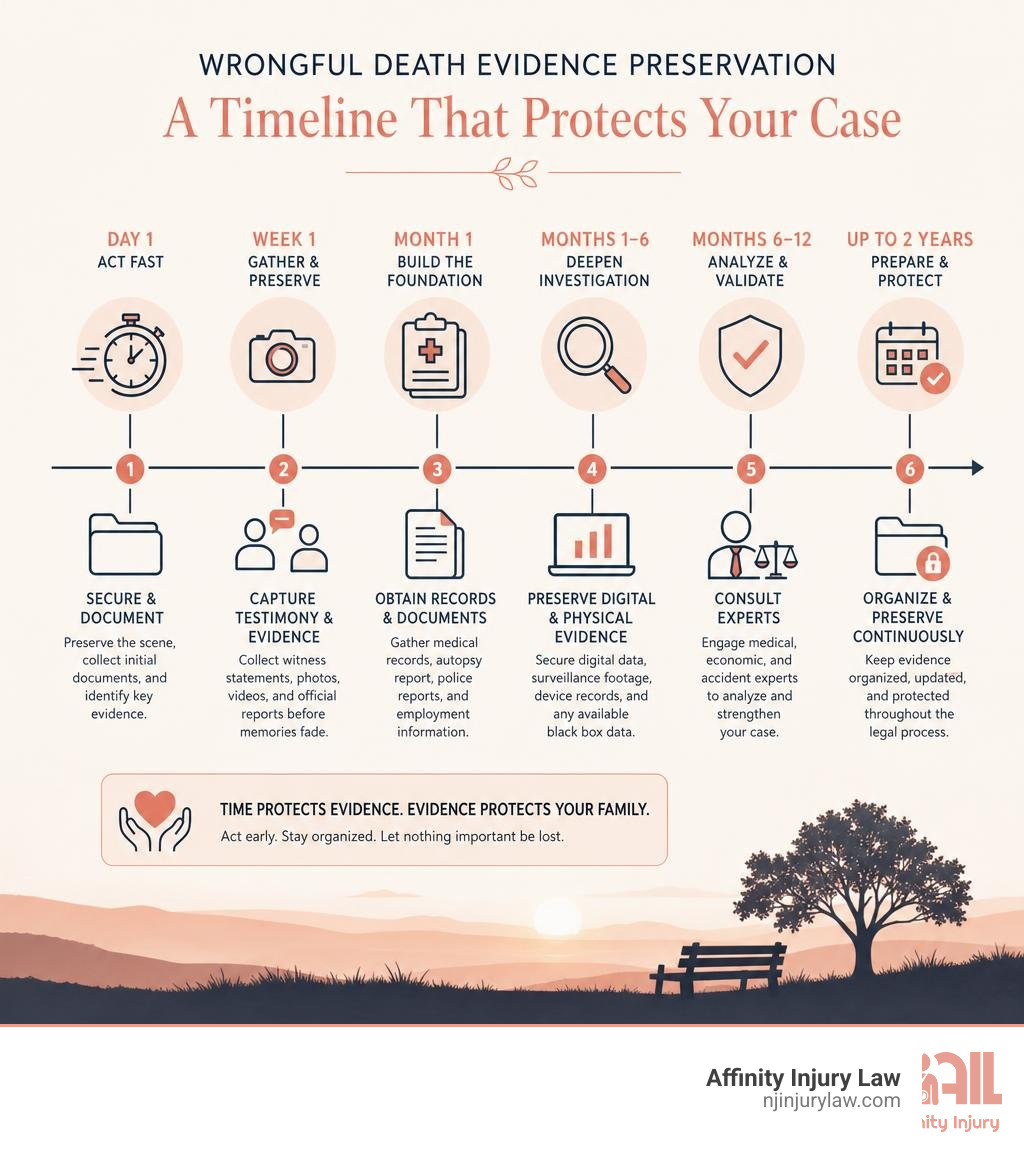
This guide walks you through exactly what evidence matters, how to preserve it, and why acting quickly makes all the difference.
My name is Ioana Enescu, Esq., founding member of Affinity Injury Law, and I have spent my career in New Jersey advocating for families who need someone in their corner when it matters most — including guiding them through the wrongful death evidence needed to build a compelling civil claim. If you are navigating this process right now, I want this guide to give you clarity and confidence in your next steps.
The Legal Framework: Four Elements of a Wrongful Death Claim
To understand why certain pieces of information are so vital, we first need to look at the legal framework of a wrongful death lawsuit. In New Jersey, a civil claim is entirely separate from any criminal proceedings. While a criminal case focuses on punishing a wrongdoer, a civil case focuses on providing financial recovery and a sense of justice for the surviving family members.
In a civil court, the burden of proof is much lower than the criminal standard of “beyond a reasonable doubt.” Instead, we operate under the “preponderance of the evidence” standard. This means we must prove that our version of events is more likely true than not—essentially, a 50.1% probability is enough to win. To meet this standard, we must systematically prove four core legal elements. You can learn more about this standard in this guide on How to Prove a Wrongful Death Civil Lawsuit.
These four elements are:
- Duty of Care: The defendant owed your loved one a legal duty to act with reasonable care (e.g., a driver must obey traffic laws, or a doctor must follow established medical standards).
- Breach of Duty: The defendant failed to uphold that standard of care through a careless action or a failure to act.
- Causation: The defendant’s breach of duty was the direct and proximate cause of your loved one’s passing.
- Damages: The surviving family members or the estate suffered quantifiable financial and emotional losses as a result of the death.
Proving the Defendant’s Breach of Duty
Proving a breach of duty is where we demonstrate the exact nature of the defendant’s negligence or reckless conduct. Negligence isn’t always a deliberate act of malice; more often, it is a careless mistake that has catastrophic consequences. For instance, in a fatal truck accident on Route 3 in Lyndhurst or a multi-car collision in Bergen County, a breach of duty might involve speeding, distracted driving, or violating federal trucking hours-of-service safety violations.
To prove this breach, we gather physical and documentary evidence that demonstrates exactly how the defendant departed from their legal obligations. Working with dedicated Personal Injury Lawyers New Jersey ensures that these safety violations are identified and documented before they can be swept under the rug by corporate defense teams or insurance adjusters.
Establishing Direct Causation and Damages
The absolute trickiest part of many wrongful death claims is proving the link of proximate cause. The defense will almost always try to argue that something else caused your loved one’s passing. They might claim a pre-existing medical condition was the real culprit, or that a delay in medical treatment after the accident was the true cause of death.
To counter these arguments, we rely heavily on official determinations from the medical examiner and clinical data. We must establish that “but for” the defendant’s negligence, your loved one would still be here today. If there are gaps in this causal chain, it can lead to devastating consequences for your claim. Understanding these hurdles is essential, as outline in our resource on 5 Mistakes That Can Hurt Your Personal Injury Claim in New Jersey, which highlights how failing to establish clear causation early on can weaken your legal standing.
Critical Wrongful Death Evidence Needed to Establish Liability
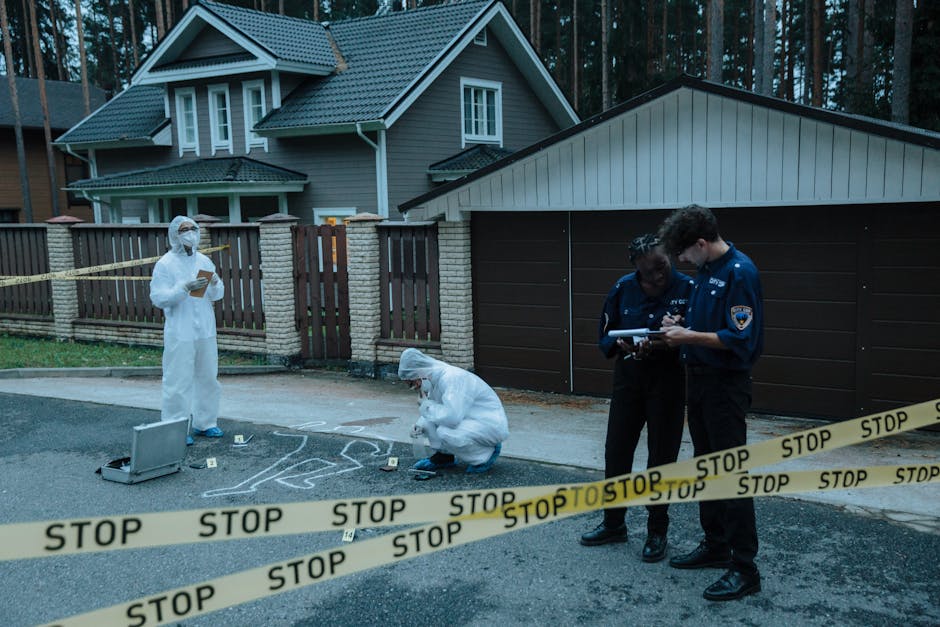
Building an unshakable case means collecting a diverse array of physical evidence, police reports, and digital records. Think of your case as a mosaic—each individual piece of evidence might seem small on its own, but when fit together, they create a clear, undeniable picture of liability. For a detailed legal definition of how these claims operate, you can refer to the Wrongful Death Overview – Cornell Law School Legal Information Institute.
Accident Reports and Witness Statements as Wrongful Death Evidence Needed
When an accident occurs in Passaic County or Bergen County, local law enforcement or the New Jersey State Police will conduct a police investigation. The resulting crash or incident report is a foundational piece of wrongful death evidence needed for your case. These reports contain:
- The officer’s initial determination of fault.
- Citations issued for traffic or safety violations.
- Diagrams of the scene and weather conditions.
- Contact information for key parties.
However, police reports are only the beginning. Eyewitness testimony is incredibly powerful. Bystanders who saw the event unfold provide an unbiased perspective that carries immense weight with insurance companies and juries alike. We also interview first responders—paramedics and firefighters—whose immediate observations of the scene and the victim’s condition can establish the severity of the impact and the initial timeline of injuries.
Digital Evidence and Surveillance Footage
In our modern, connected world, some of the most reliable wrongful death evidence needed is digital. This includes:
- Dashcam Footage: From the victim’s car, the defendant’s car, or nearby rideshare vehicles.
- Commercial Vehicle Black Boxes: Heavy trucks carry Electronic Control Modules (ECMs) that record speed, braking patterns, and steering angles directly prior to a crash.
- Cell Phone Records: These can prove a driver was actively texting or browsing at the exact second of impact.
There is a major catch, though: time is your enemy. Most commercial and private surveillance systems automatically delete or overwrite footage within 30 days—and in some cases, as quickly as 72 hours. To prevent this, we immediately draft and send a formal spoliation letter. This is a legally binding notice that compels the defendant and any third parties to preserve all physical and digital evidence related to the incident. If they destroy it after receiving this letter, they face severe court sanctions.
To ensure you have local representation that understands how to secure this evidence in Bergen County, consulting a qualified legal professional can be a critical step in protecting your family’s rights.
Medical Records, Autopsies, and Expert Testimony

When a tragedy occurs, medical records and post-mortem examinations provide the scientific baseline for your claim. Without clinical data, a case becomes a battle of opinions. With it, we can present hard, undeniable facts. Relying on professional guidance to gather these records prevents Common Mistakes Without Accident Injury Lawyers, such as missing critical medical files or failing to request complete nursing logs.
In many cases, a state-mandated autopsy is performed. However, if the state declines to perform one, we often advise families to secure a private autopsy. While this can feel like an incredibly difficult decision during a time of intense grief, a private autopsy report can be the single most powerful piece of evidence in a wrongful death case. It provides an independent, detailed analysis of the exact physical trauma or clinical failure that caused the death, leaving no room for the defense to blame pre-existing conditions.
For families seeking local representation in Passaic County, reaching out to a dedicated legal team can help streamline the process of obtaining these highly technical medical records.
The Role of Expert Witnesses in Translating Complex Data
Juries are made up of everyday people—teachers, accountants, retail workers, and landscapers. They are not medical doctors, mechanical engineers, or forensic accountants. That is why expert witnesses are so vital. They act as translators, turning dense clinical data and physics equations into clear, understandable concepts for the jury.
We routinely collaborate with a network of respected experts, including:
- Medical Experts: To explain how a delayed diagnosis or surgical error directly resulted in a patient’s death.
- Accident Reconstruction Specialists: Who use crash debris, skid marks, and black box data to create 3D animations showing exactly how a collision occurred.
- Economic Experts: To project the lifetime financial contributions the deceased would have provided to their family.
Calculating and Supporting Economic and Non-Economic Damages
In New Jersey, wrongful death damages are designed to compensate the survivors for the losses they suffer due to their loved one’s absence. This is legally distinct from a “survival action,” which compensates the deceased’s estate for the conscious pain and suffering the victim experienced between the time of the injury and their actual passing.
| Damage Type | Description | Key Evidence Needed |
|---|---|---|
| Economic (Pecuniary) Losses | Tangible, financial losses suffered by the surviving family members. | Pay stubs, tax returns, funeral invoices, medical bills. |
| Non-Economic Losses | Intangible, emotional losses resulting from the death. | Testimony from family, family photos, proof of relationship. |
| Survival Action Damages | Compensation for the deceased’s conscious pain and suffering before death. | EMT reports, medical charts, eyewitness testimony of conscious distress. |
To properly calculate and demand these damages, Our Attorneys work alongside forensic economists to ensure no financial detail is overlooked, from lost retirement benefits to the monetary value of household services. If you are seeking representation in southern or central parts of the state, consulting an experienced legal professional can provide additional regional context.
Proving Financial and Relationship Ties as Wrongful Death Evidence Needed
To recover damages, we must prove both your relationship to the deceased and your financial dependency. The wrongful death evidence needed to establish these ties includes:
- Marriage Certificates or Birth Certificates: To legally establish your status as a surviving spouse or child.
- Tax Returns: Showing that you were claimed as a dependent, or demonstrating joint household income.
- Proof of Shared Expenses: Mortgage statements, utility bills, and joint bank accounts.
- Evidence of Loss of Companionship: Personal journals, photographs, videos, and testimony from neighbors or community members showing the active, loving role the deceased played in your daily life.
For families located in southern Bergen County, speaking with a dedicated legal team can help you gather these sensitive personal documents with the care and privacy you deserve.
Frequently Asked Questions About Wrongful Death Evidence
Navigating a legal claim while grieving is incredibly heavy. Here are direct, clear answers to the most common questions families ask us about the legal process and evidence requirements.
What is the burden of proof in a wrongful death lawsuit compared to a criminal case?
The differences between civil and criminal cases are massive:
- Criminal Case: Brought by the state to punish a crime. The standard of proof is beyond a reasonable doubt (nearly 100% certainty). A defendant can be acquitted if there is even a small sliver of doubt.
- Civil Wrongful Death Case: Brought by the family or estate to recover financial compensation. The standard is a preponderance of the evidence (more likely than not, or 50.1%).
This lower civil standard is why a family can successfully win a wrongful death lawsuit even if the defendant was never criminally charged, or was acquitted in a criminal trial (a famous historical example being the O.J. Simpson civil verdict).
What happens if the defendant destroys or fails to preserve evidence?
If a defendant intentionally deletes surveillance footage, alters logs, or disposes of physical evidence, it is known as spoliation of evidence.
When we can prove that a defendant destroyed evidence after receiving a spoliation letter (or when they reasonably should have known a lawsuit was pending), the court can issue an adverse inference instruction to the jury. This means the judge tells the jury they are legally allowed to assume that the destroyed evidence would have completely proven the defendant’s guilt. The court can also levy heavy financial sanctions against the defense.
How long do families have to gather evidence and file a claim in New Jersey?
Under New Jersey law, the statute of limitations for a wrongful death claim is generally two years from the date of the person’s death.
As we write this in June 2026, if a tragic loss occurred today, the family would have until June 2028 to file a formal lawsuit. However, waiting is highly risky. While the legal deadline is two years, the practical deadline to preserve critical evidence (like dashcam footage, witness memories, and physical road debris) is often just a matter of days. If you wait too long, the evidence needed to win your case may simply vanish.
Conclusion
When you are mourning the loss of a loved one, the legal system can feel cold, confusing, and completely overwhelming. But securing justice and protecting your family’s financial future does not have to be a burden you carry alone. Taking immediate action to preserve evidence is the single best way to build an unshakable case.
At Affinity Injury Law, we are here to carry the legal weight so you can focus on healing. We offer compassionate, highly strategic representation with two major advantages:
- Multilingual Support: We speak your language. We believe that communication barriers should never stand in the way of justice, and we are proud to offer comprehensive legal support in multiple languages to serve New Jersey’s diverse communities.
- No-Fee-Unless-They-Win: You will never pay us a single penny out of pocket. We operate entirely on a contingency fee basis, meaning our legal fees are only paid if we successfully secure a settlement or jury verdict for your family.
If you have questions about the wrongful death evidence needed for your unique situation, please do not hesitate to reach out. Contact our Wrongful Death Lawyers New Jersey today to schedule a completely free, confidential, and compassionate consultation. Let us stand in your corner and help you take the first step toward justice.